Spring time in southern Germany comes just a week or two later than it does at our current base at 40 degrees N latitude in the U.S. So normally, the week of AERO Friedrichshafen trends cool, and often rainy.
Not so for 2026, and frankly we were relieved. We’d conned our friends Mike and Marsha into coming with us to the show, with promises of flowers and budding vines and flowing wines along the Bodensee…as well as a hefty dose of general aviation innovation and fun served up alongside a juicy wurst or two.
Bavaria delivered in spades, and the growth all around us in the town and countryside was echoed resonantly in the growth of the show itself. What was the biggest (and of the 6 I’ve attended, the best) AERO ever displayed the full gamut of aerial conveyances from gliders to business jets, and I really think every flying thing in between.
We had a dual mission, to assist clients with their media outreach, and to report on the latest and greatest for AvBrief.com. The twin goals kept us busily running around and capturing the whole thing in photos and prose.
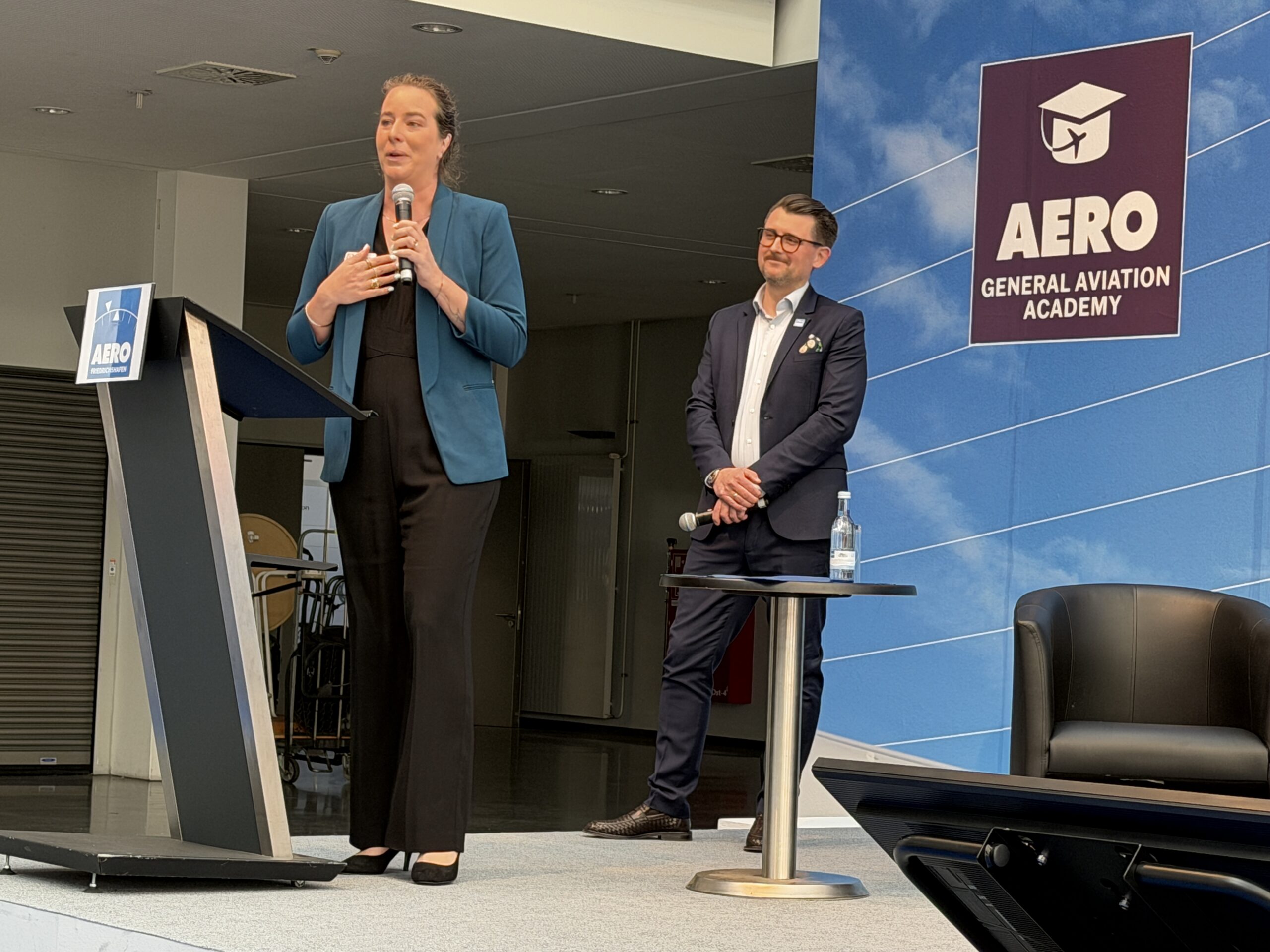
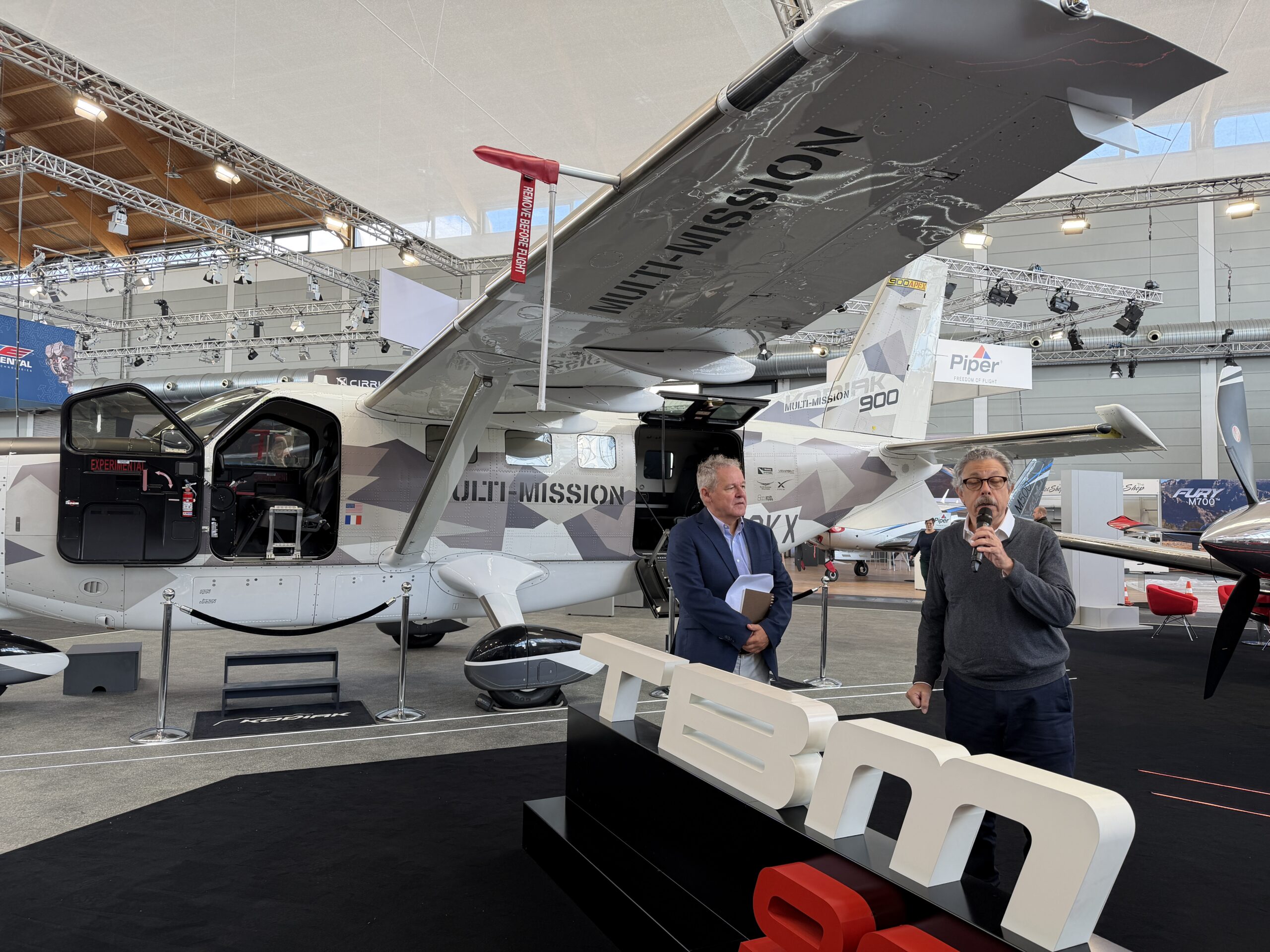
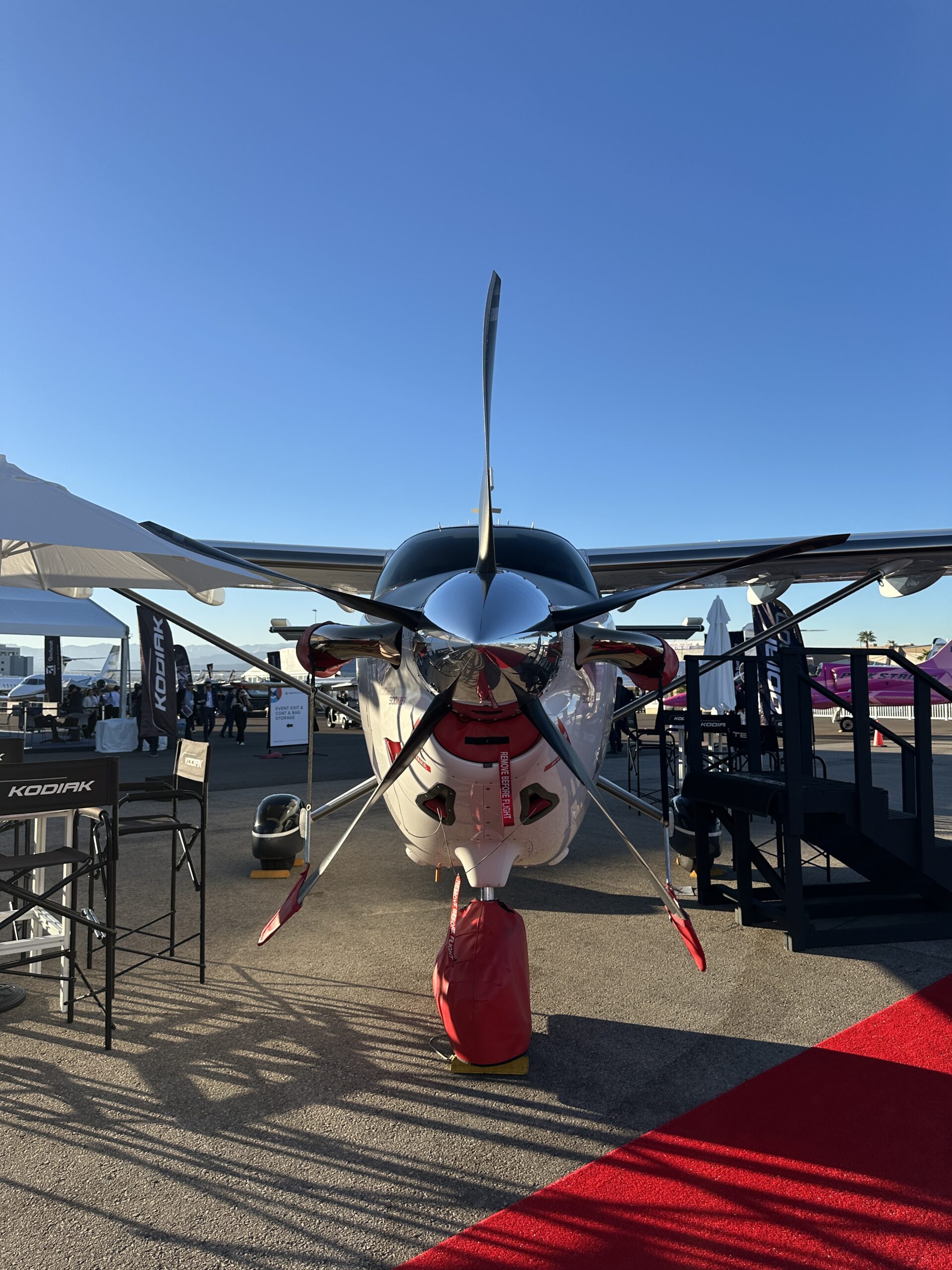
Cate Brancart (GAMA) and Tobias Bretzel (AERO) kick off AERO’s Media day with a state of the GA industry in Europe. [Credit: Julie Boatman]Volker Thomalla (AERO) and Jeff Lenorowitz (Daher) introduce the Daher Kodiak 900 multimission aircraft to AERO 2026. [Credit: Julie Boatman]
The festivities began on Tuesday with a solid lineup for Media Day, during which we enjoyed presentations from GAMA’s EU office as well as a tour of just a handful of highlights in new aircraft at the show.
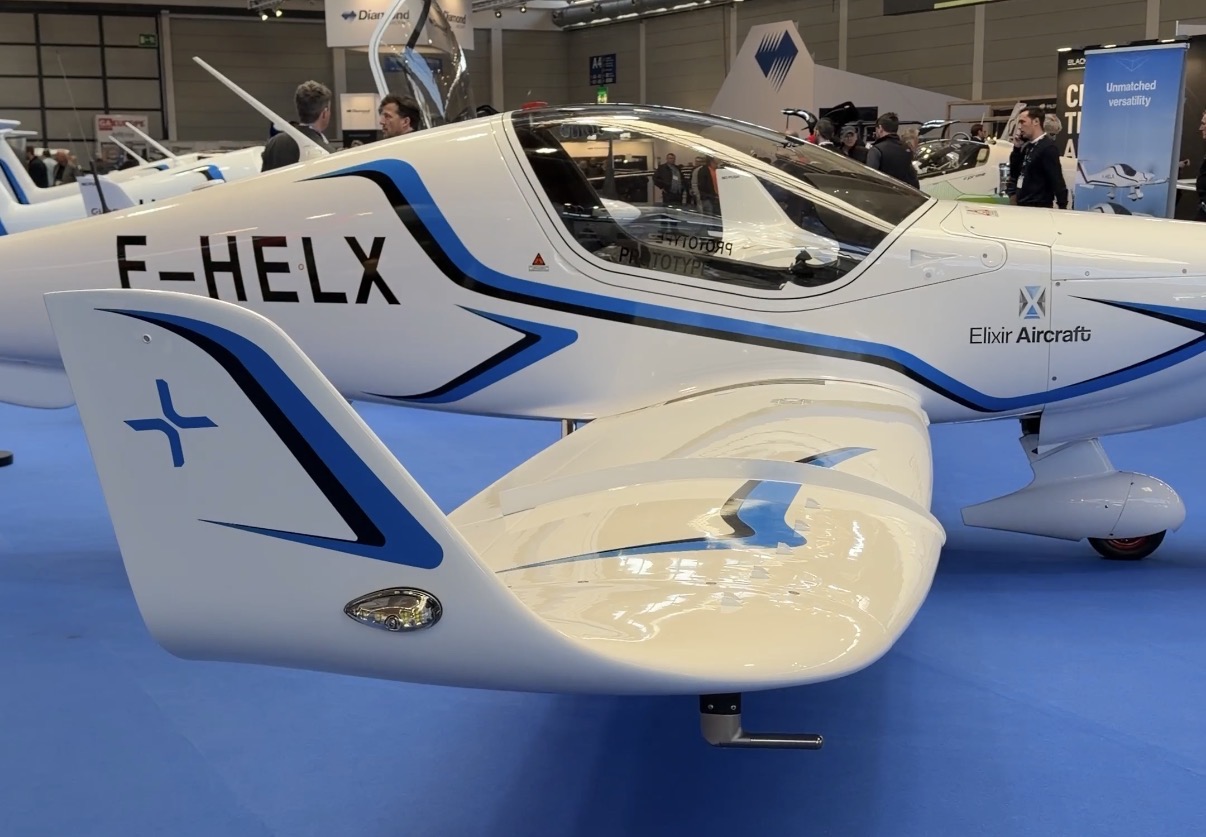
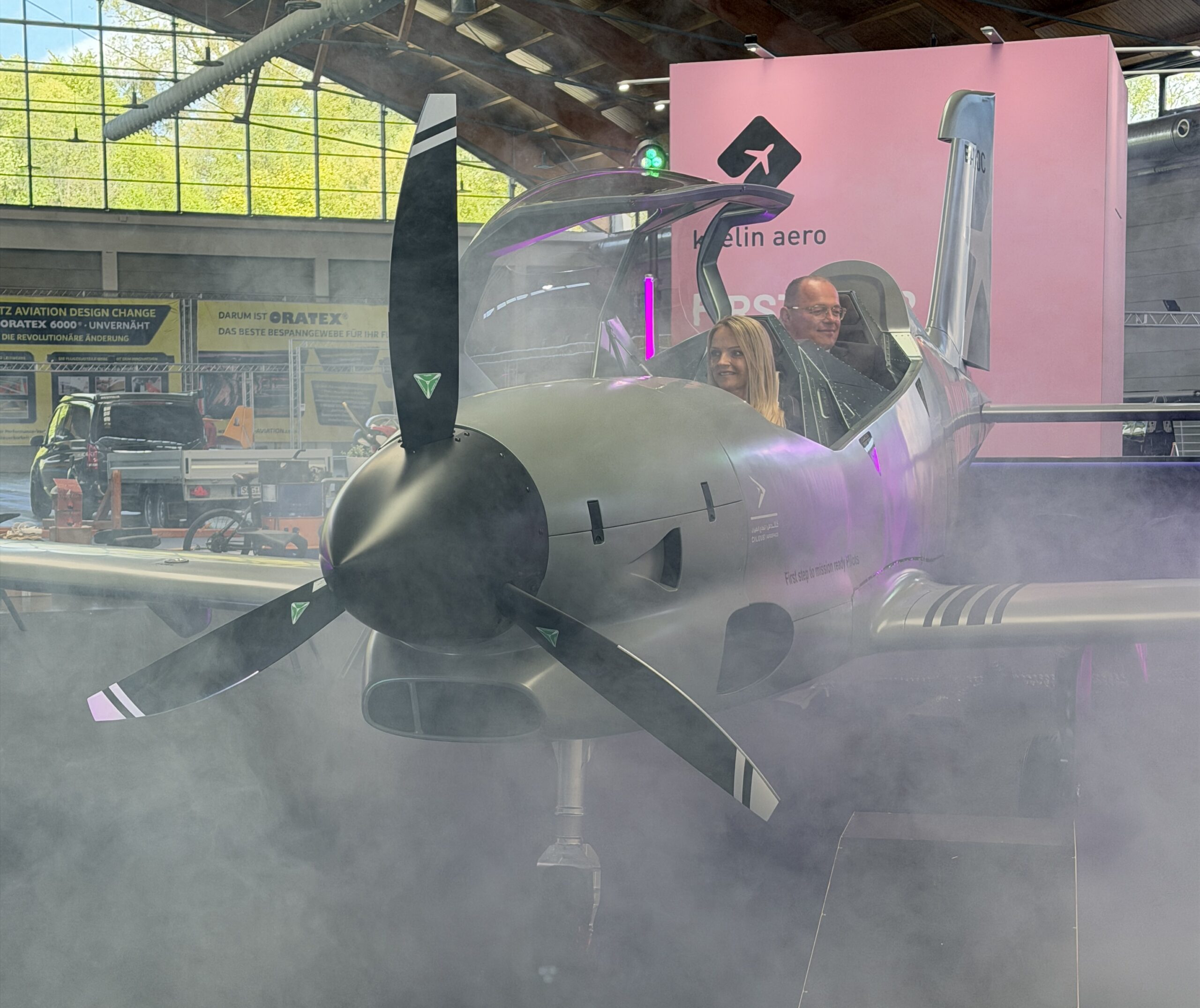
Elixir Aircraft introduced its Elixir + model at AERO 2026 with new wingtips. [Credit: Julie Boatman]Kaelin Aero debuts the two-seat trainer aimed at both the military and civilian markets at AERO 2026. [Credit: Julie Boatman]
For AvBrief, I featured the Elixir + aircraft that had just debuted, fresh from its FAA Part 23 certification last summer. We also saw a dynamic display of the new Kaelin Aero B100C two-seat trainer during the media tour.
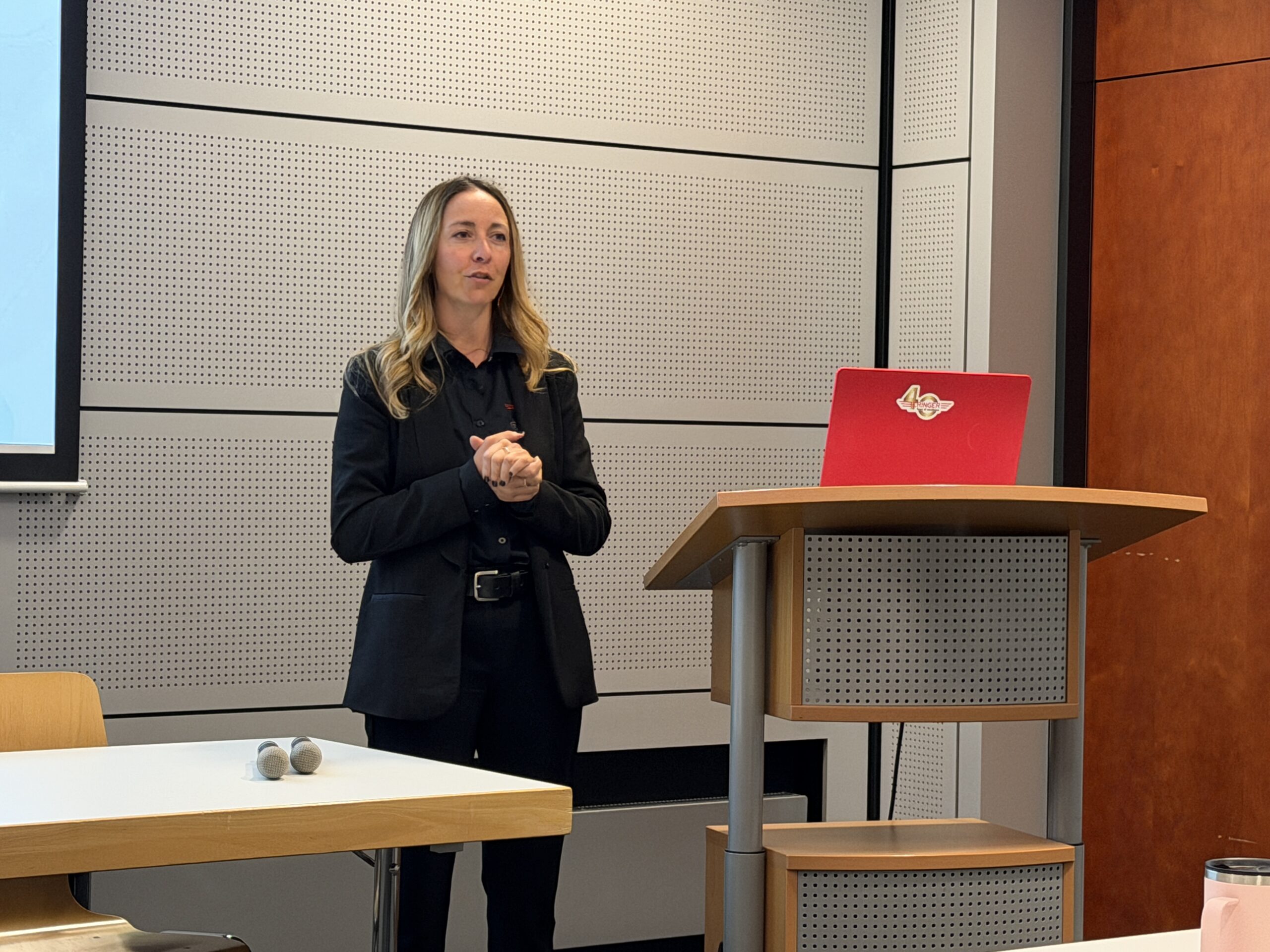
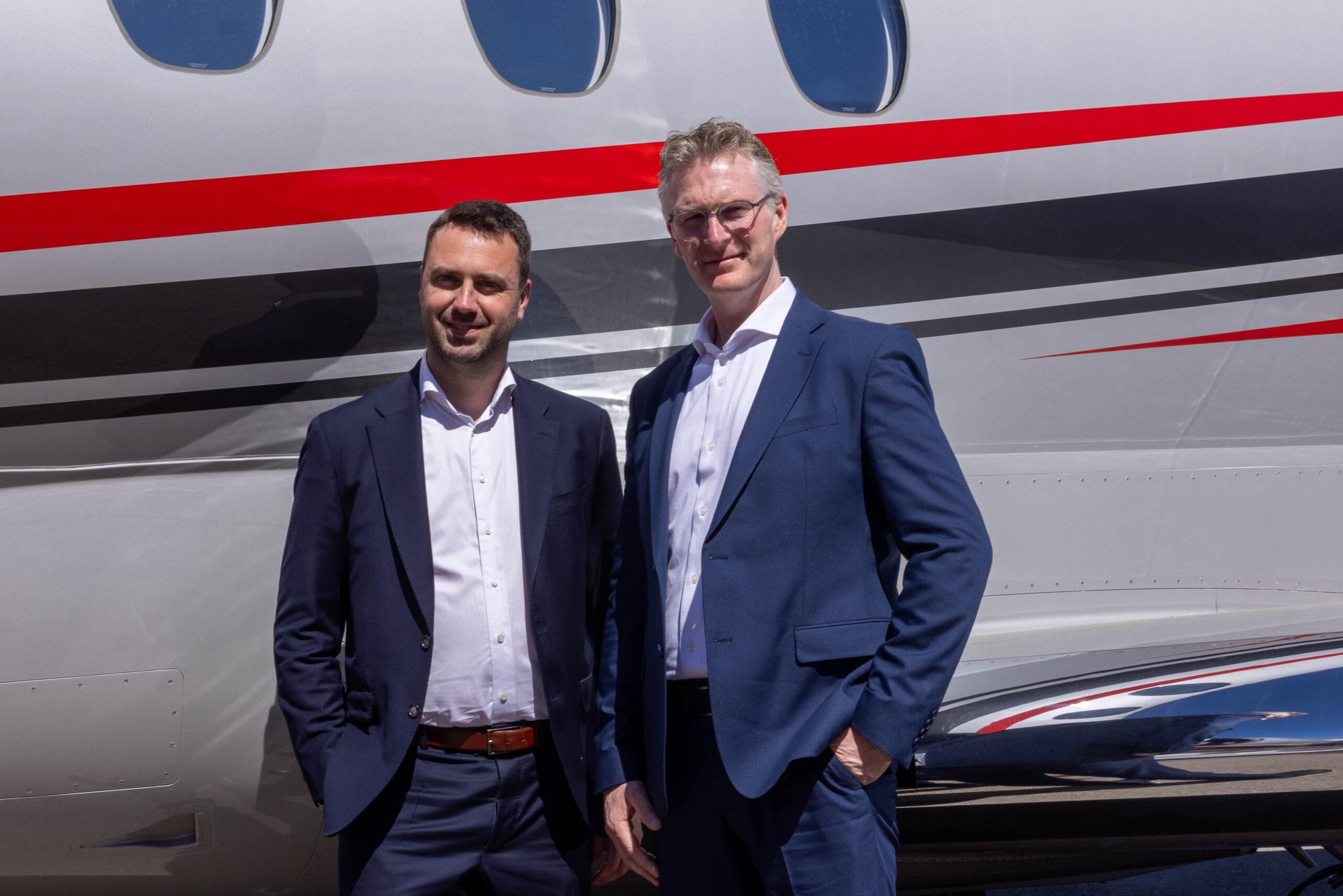
Claire Beringer introduced the latest products from Beringer Aero’s wheels and brakes line at AERO 2026. [Credit: Julie Boatman]Ward Bonduel (Luxaviation) and Duncan Van de Velde (Textron Aviation) stand in front of a Cessna Citation Latitude similar to the one just contracted by Luxaviation at AERO 2026. [Credit: Julie Boatman]
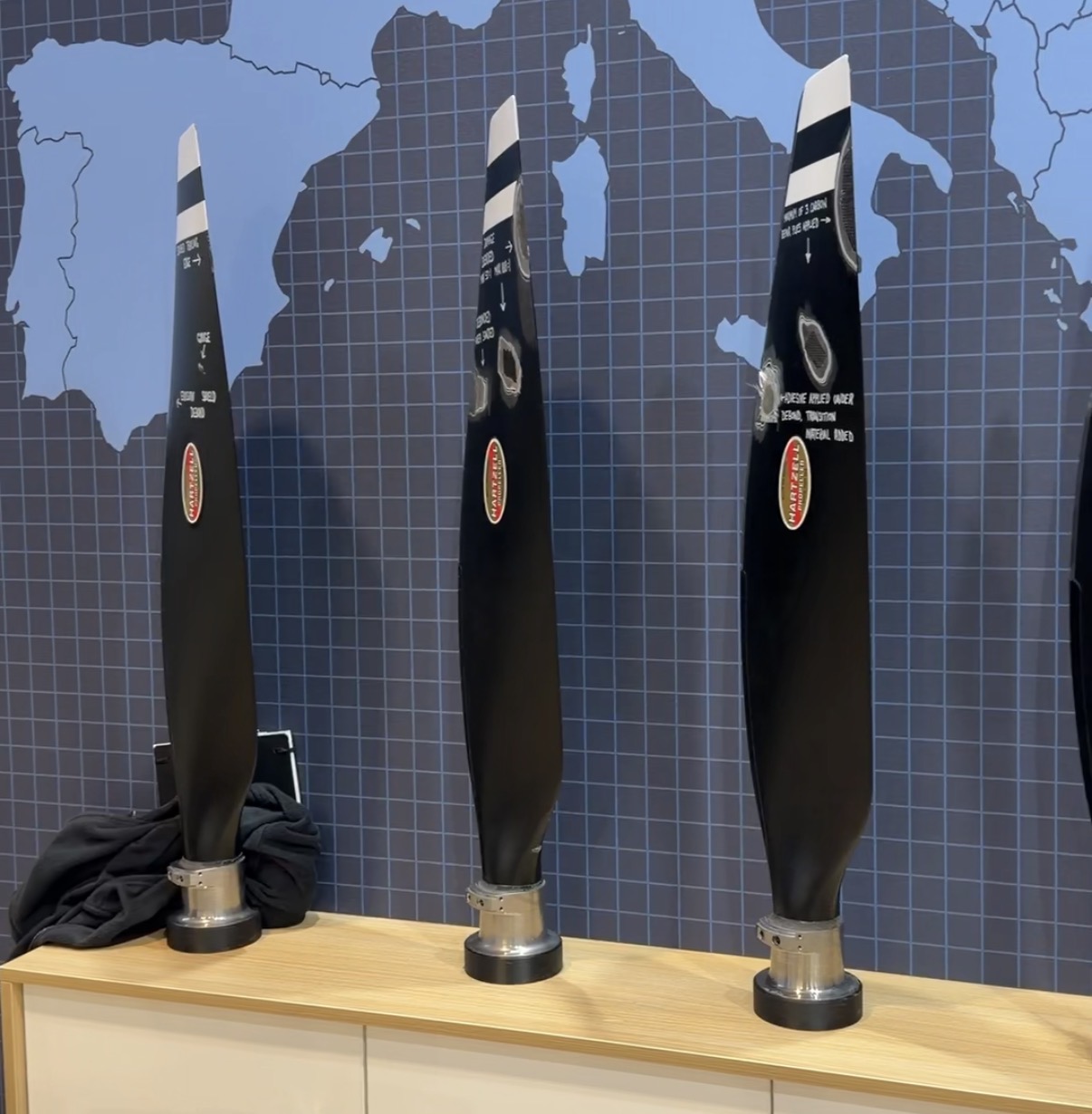
Press conferences and seminars gave us a chance to catch up on innovations from Beringer Aero, with its high performance wheels and brakes, and Hartzell Propeller’s carbon fiber composite prop technology. We also celebrated a lot of jet orders, emphasizing the evolving nature of the show into the business aviation realm. Topping these were several from Textron Aviation, including Luminair and Luxaviation.
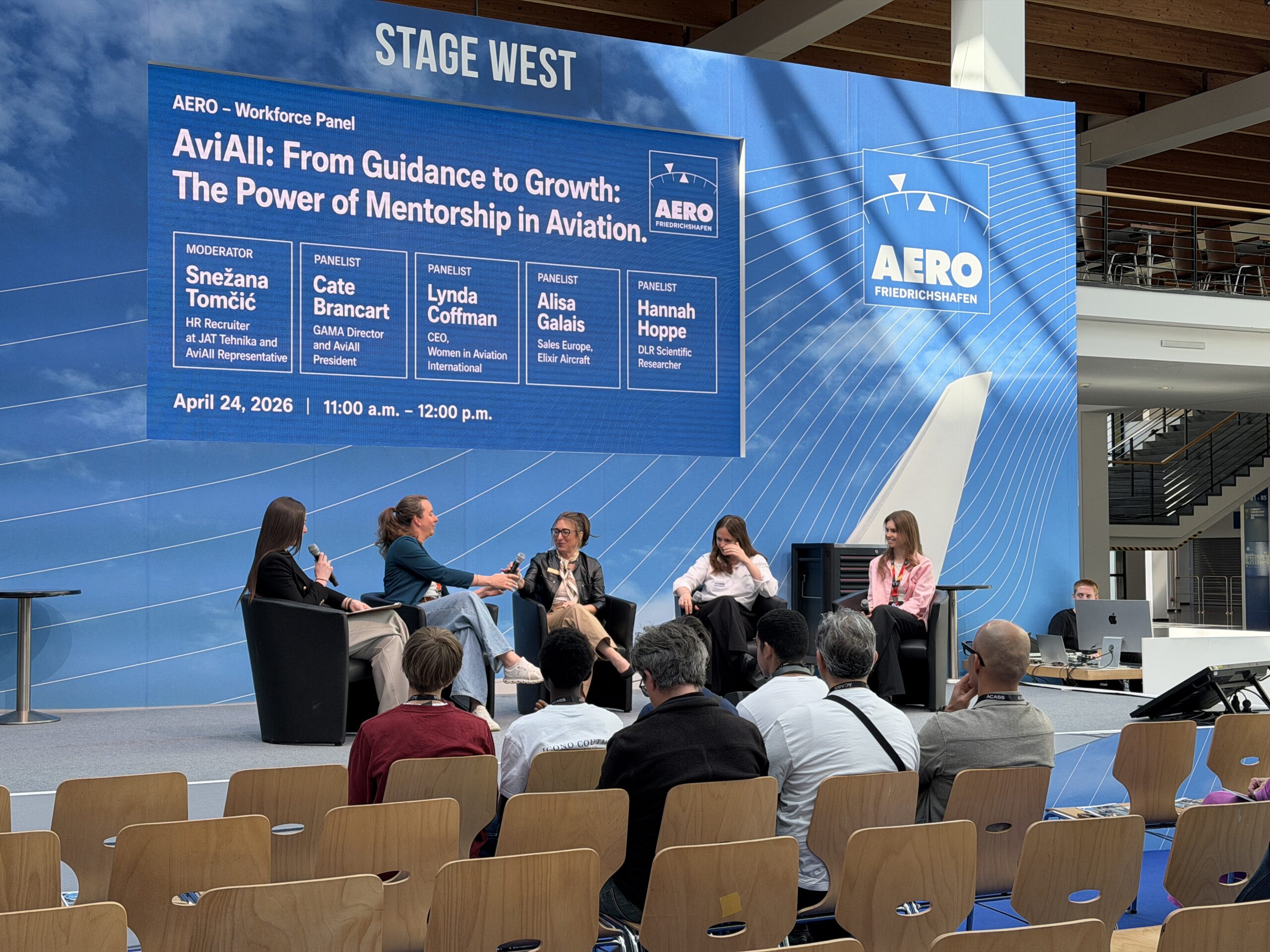
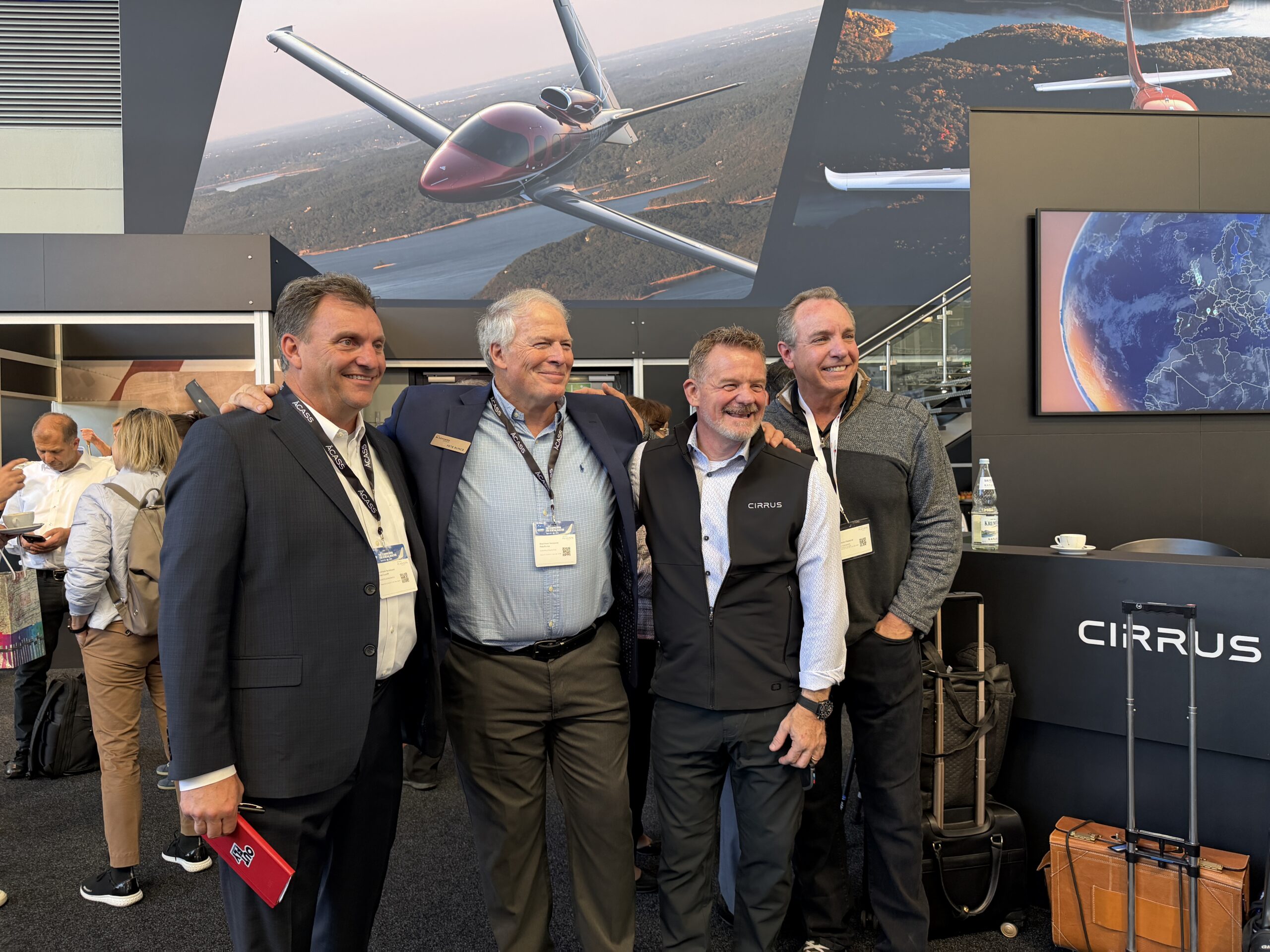
A panel of leaders discuss the power of mentorship in aviation and how it opens doors to all, and expands our resources. [Credit: Julie Boatman]Chad Cundiff (The Blackhawk Group), Pete Bunce (former GAMA), Todd Simmons (Cirrus), and Darren Pleasance (former AOPA) relax and share a laugh at the Cirrus display at AERO 2026. [Credit: Julie Boatman]
AERO also made global connections possible, bringing aviation leaders and enthusiasts from around the world into one place. The focus was on the state of GA in the EU, for clear reasons: the seeds of innovation grow here, but they are not nurtured as they should be, which is why aviation manufacturers from Europe tend to build facilities in North America. I had a candid conversation with Kyle Martin, who leads GAMA’s EU office, and we went over those continuing challenges at length, along with what the association is striving to do about changing that playing field.
While not much has moved since our last visit to AERO, with the right momentum behind those initiatives, we could see progress. If it were up to the thousands plying the halls of the Messe, it would be a no brainer. We want the new, the exciting, the sustainable to give us wings.
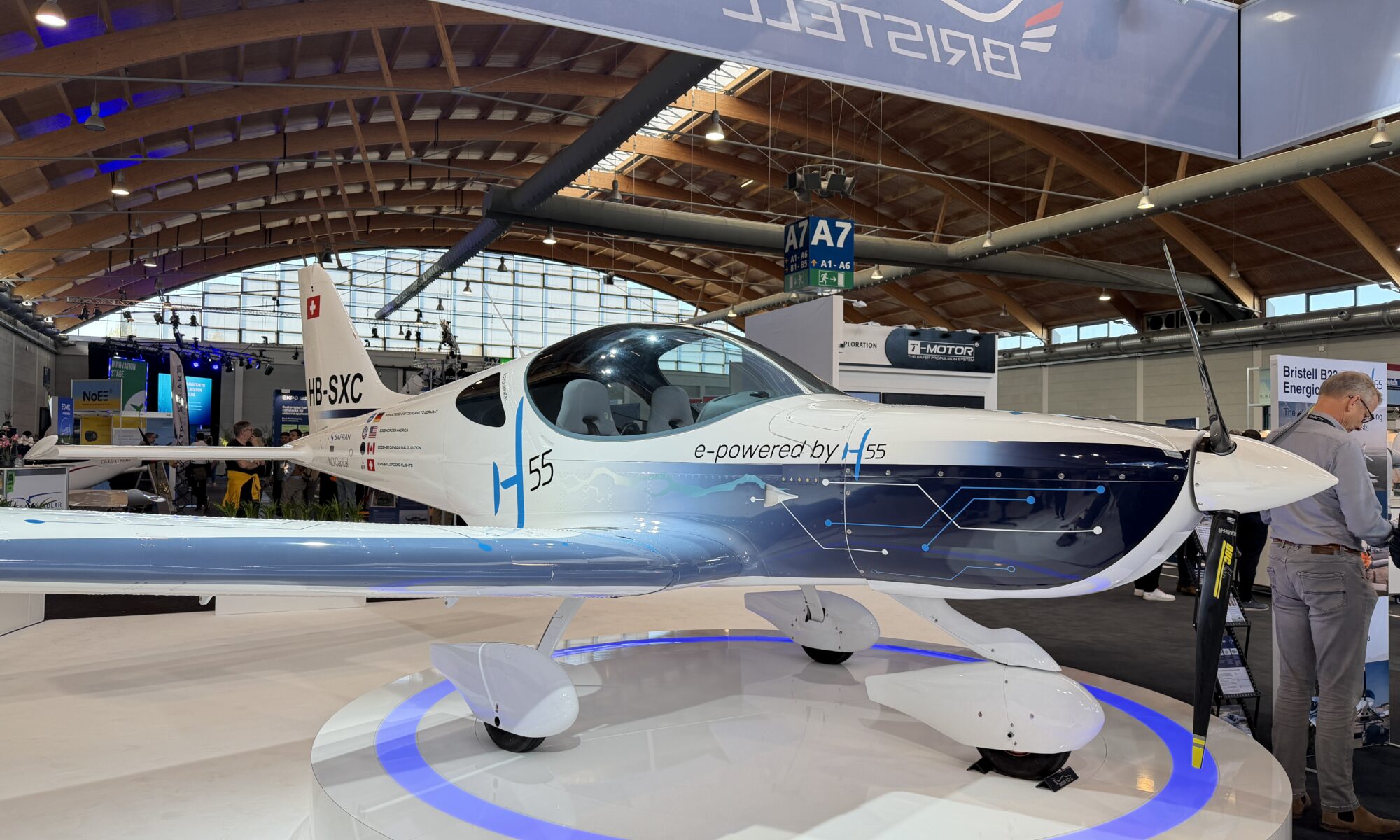
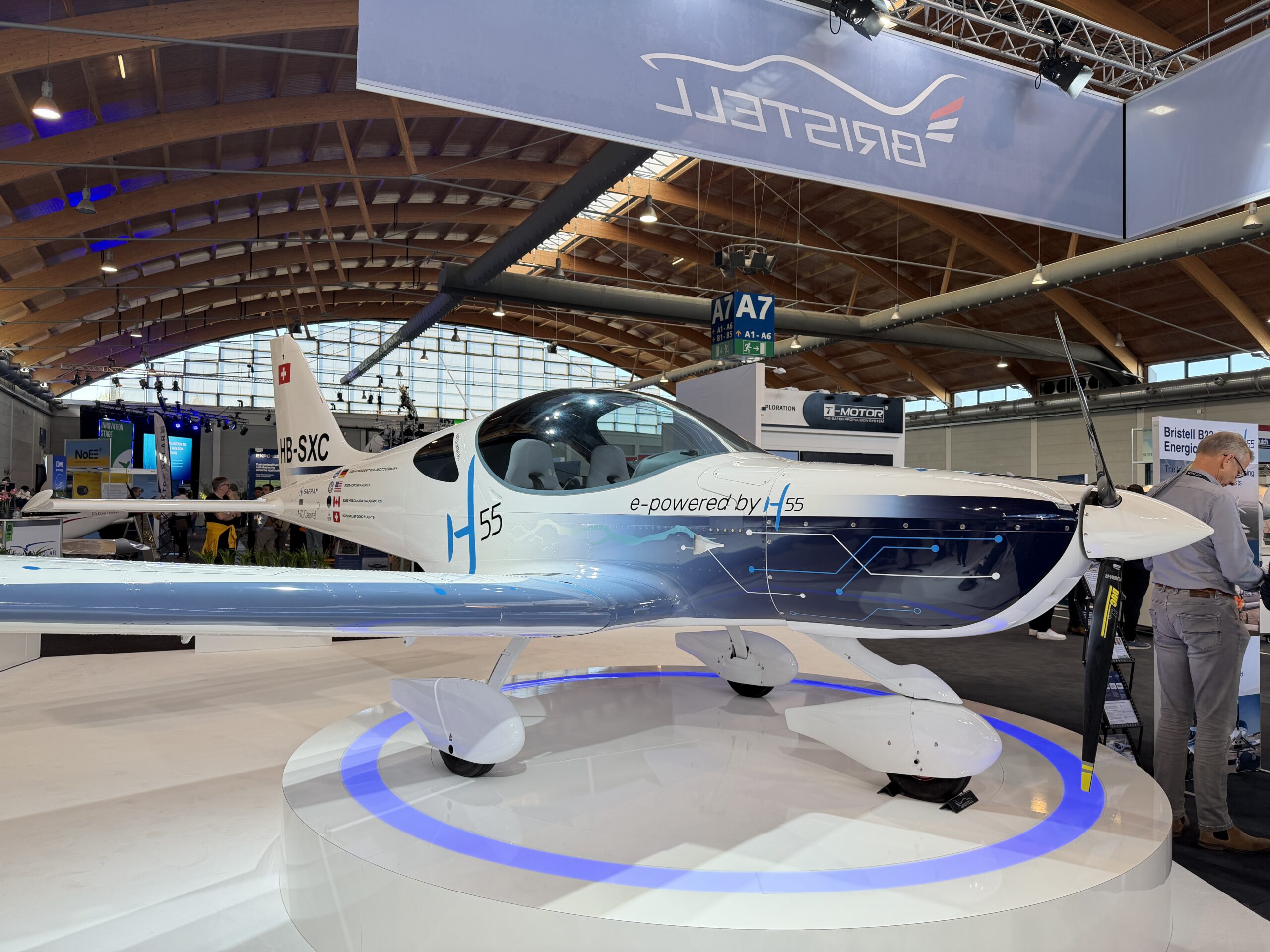
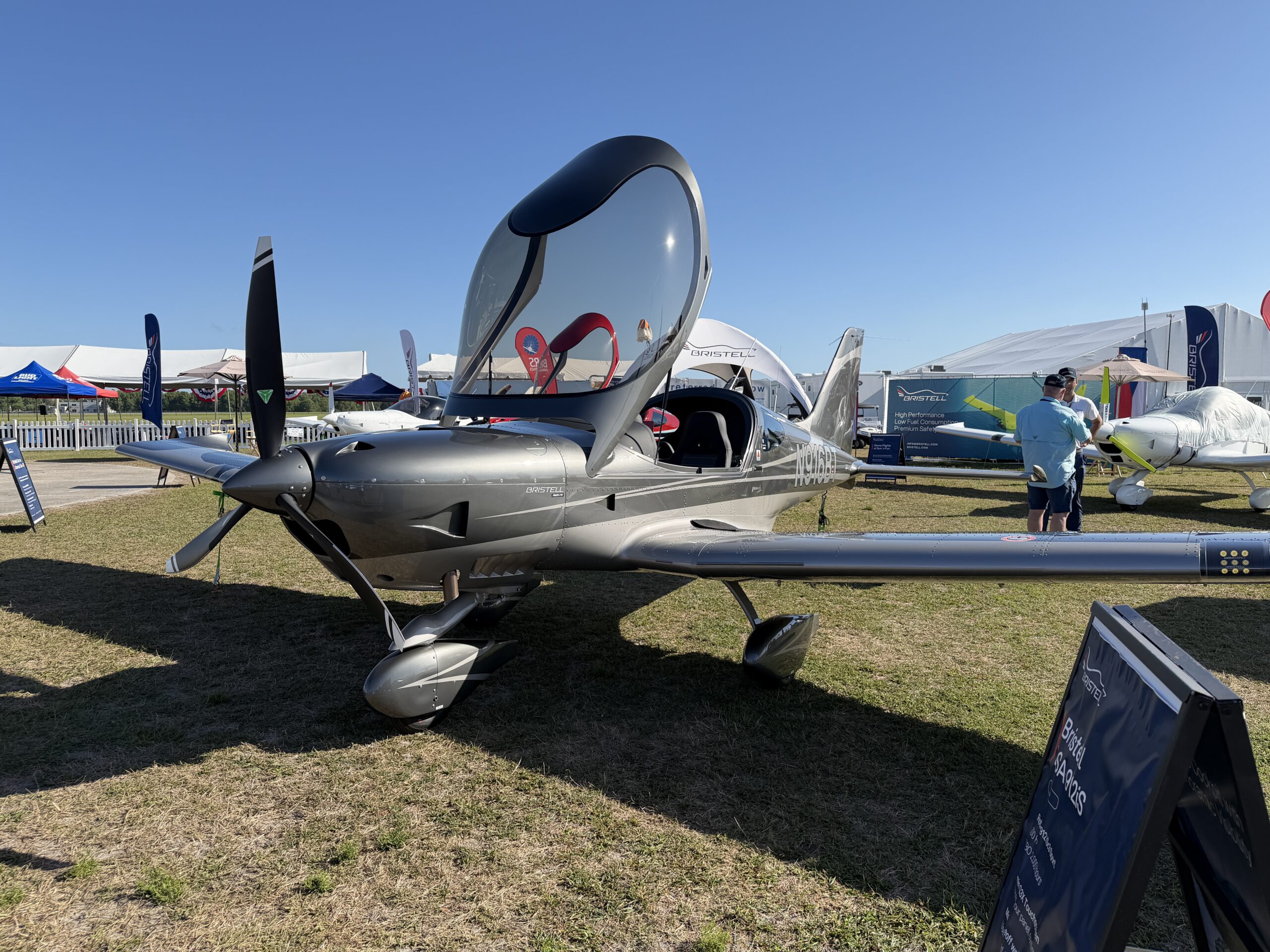
The Bristell electric B23 powered by the H55 powertrain and packs launched at AERO 2026. [Credit: Julie Boatman]
Well, it wasn’t on my dance card, to begin with, but circumstances dictated that I head down to Florida for the first time in a couple of years to attend the Sun ‘n Fun Aerospace Expo this year.
My primary mission was to help out with my fellow volunteers with the Society of Aviation and Flight Educators at the triple-wide booth we had planned in Hangar A for the show.
SAFE volunteers proudly show off the new display booth at Sun n Fun 2026. [Credit: Donna Wilt]
But since I was already on site, I met up with fellow AvBrief contributor Larry Anglisano to put together a few bits for the home team at avbrief.com. We started off with this video showing off the Bristell B23 with the Rotax 916iS powerplant, interviewing my pal David Copeland of Bristell on the company’s plans for the model, now that MOSAIC is reality.
Next, I covered the several press conferences on Tuesday, with news from Daher including their Me & My Kodiak app and the proud display of the new TBM 980 and Kodiak 900 out front. Larry and I enjoyed a coffee (I only spilled a little on my feet) on their spacious deck).
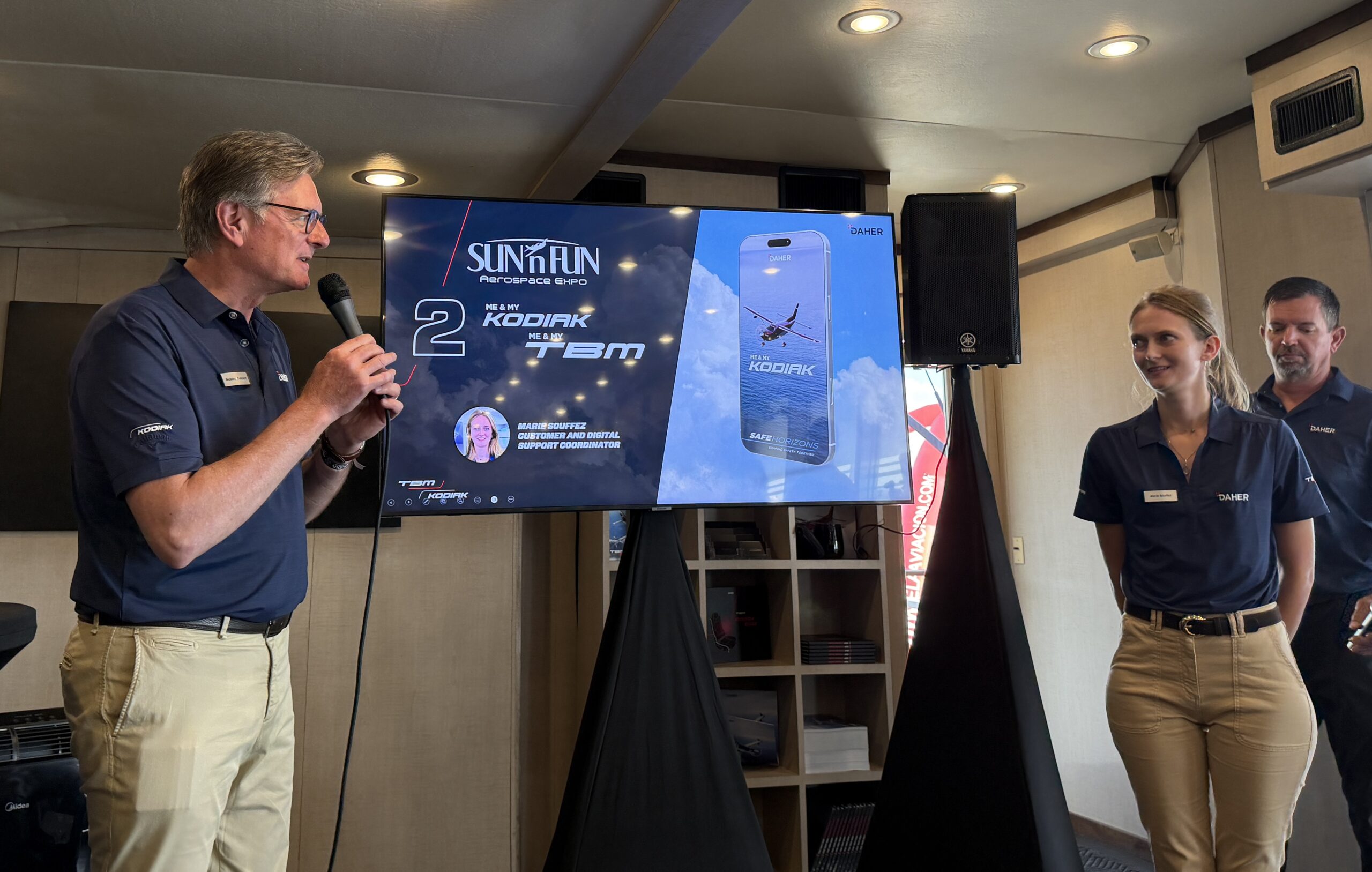
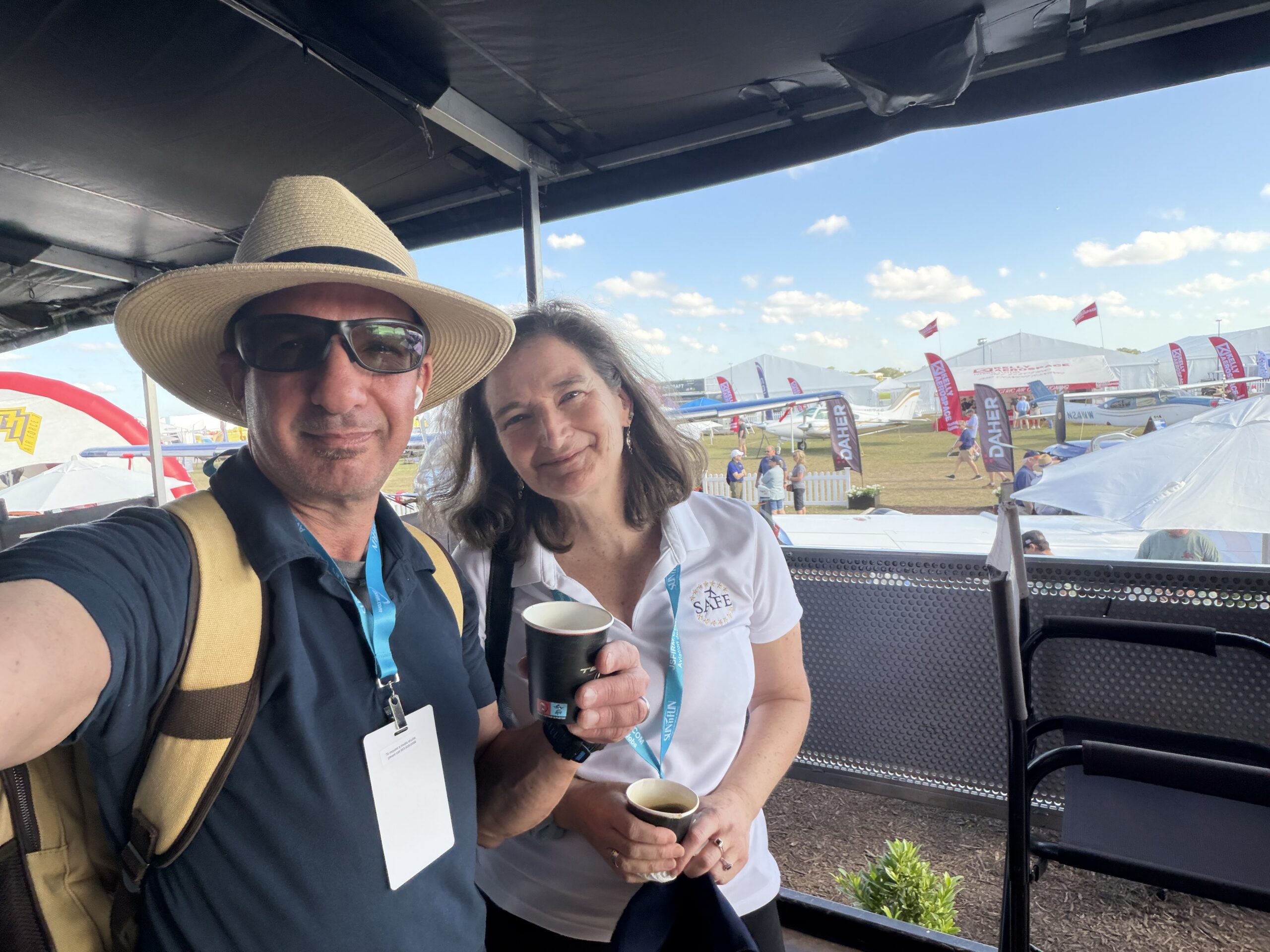
Nicolas Chabbert introduces the Me & My Kodiak app at Sun n Fun 2026. [Credit: Julie Boatman]AvBrief’s Larry Anglisano and Julie Boatman share a great espresso on the porch at Daher at SNF 26. [Credit: Larry Anglisano]
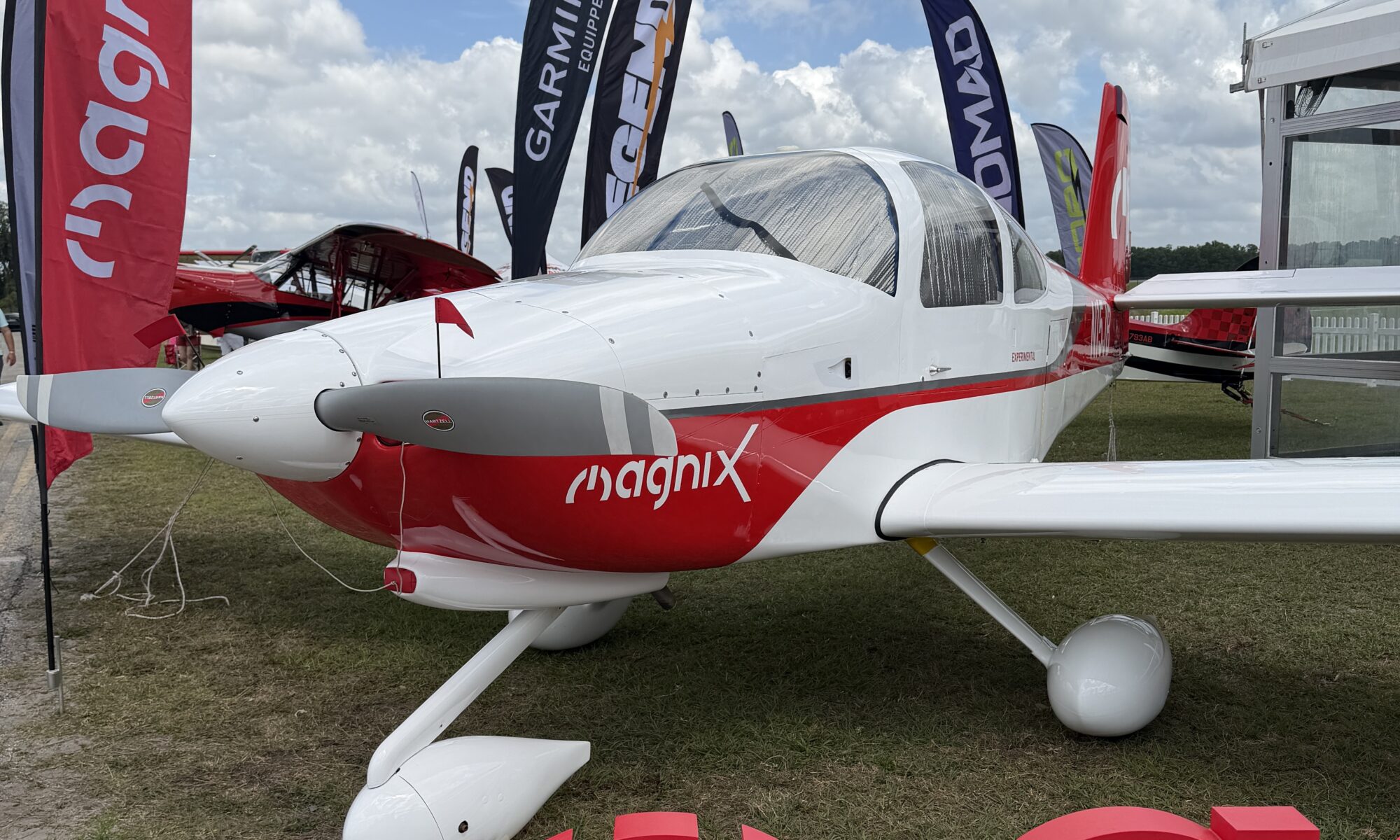
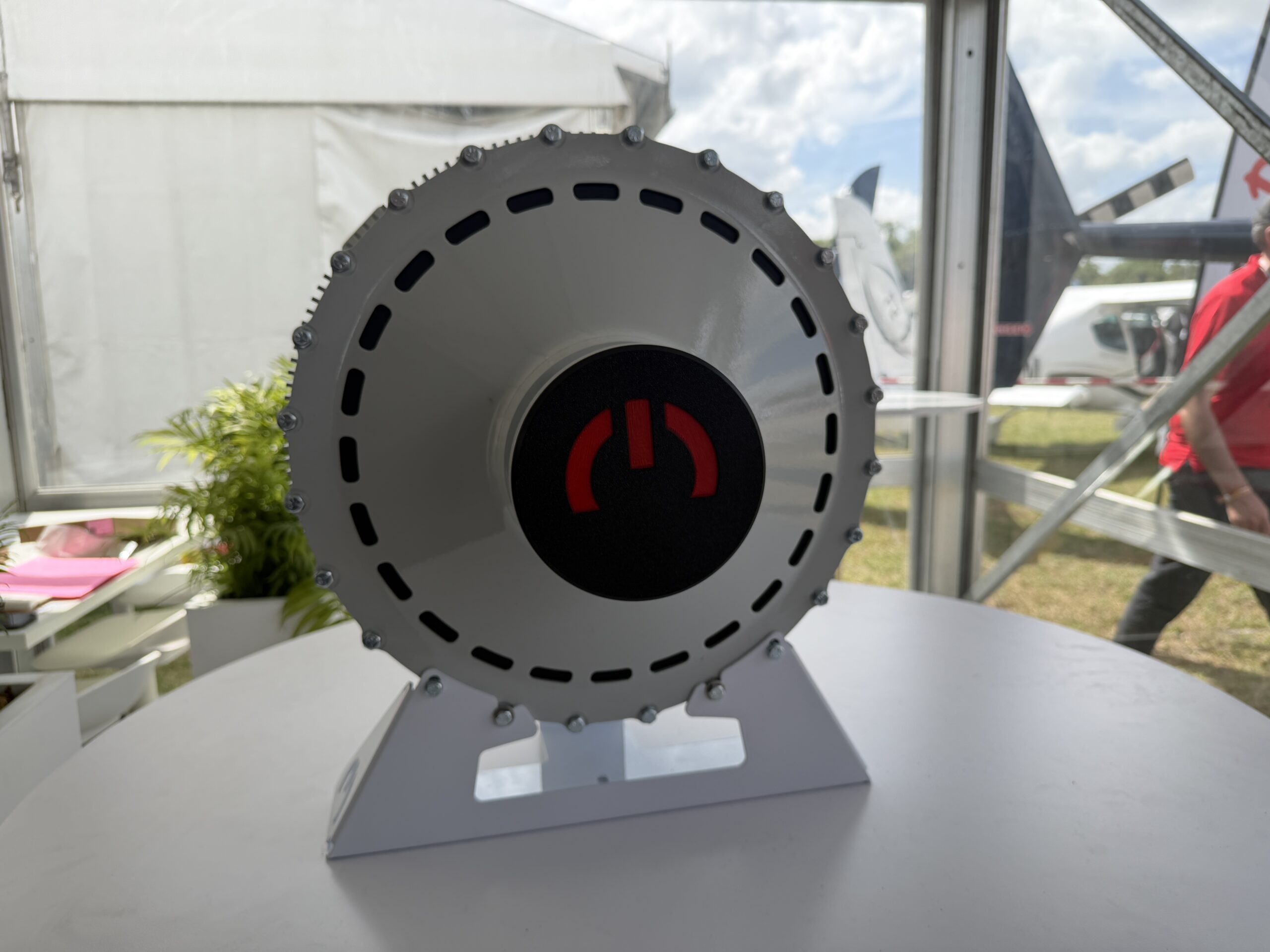
Then, I scooted over to MagniX to check out their big reveal of a rather little powerplant, one that will be going into no less than the pretty Van’s RV-10 parked outside the tent.
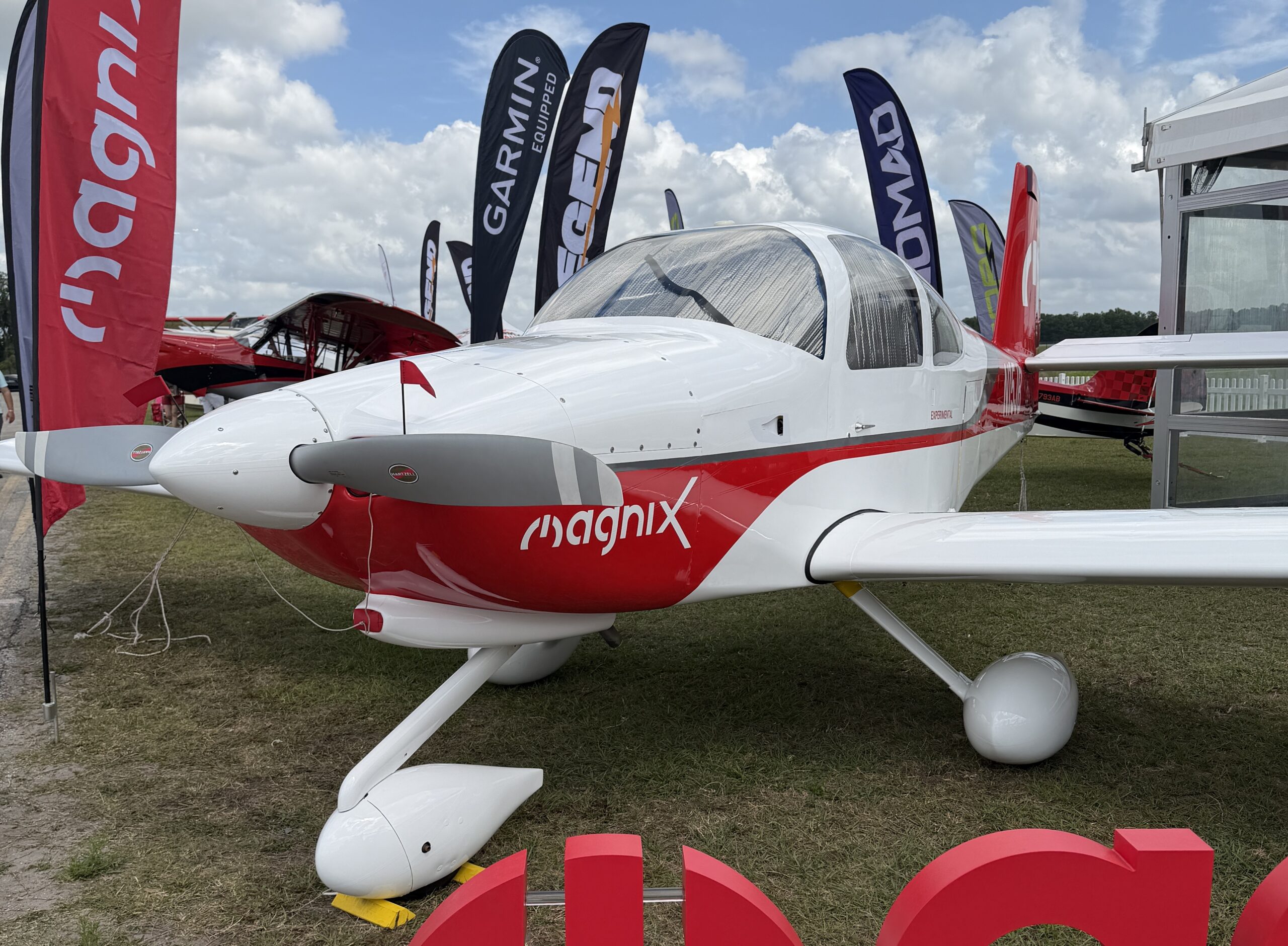
The magniX motor will go next into this Van’s RV-10 for testing. [Credit: Julie Boatman]The magniX motor is destined for several test applications. [Credit: Julie Boatman]
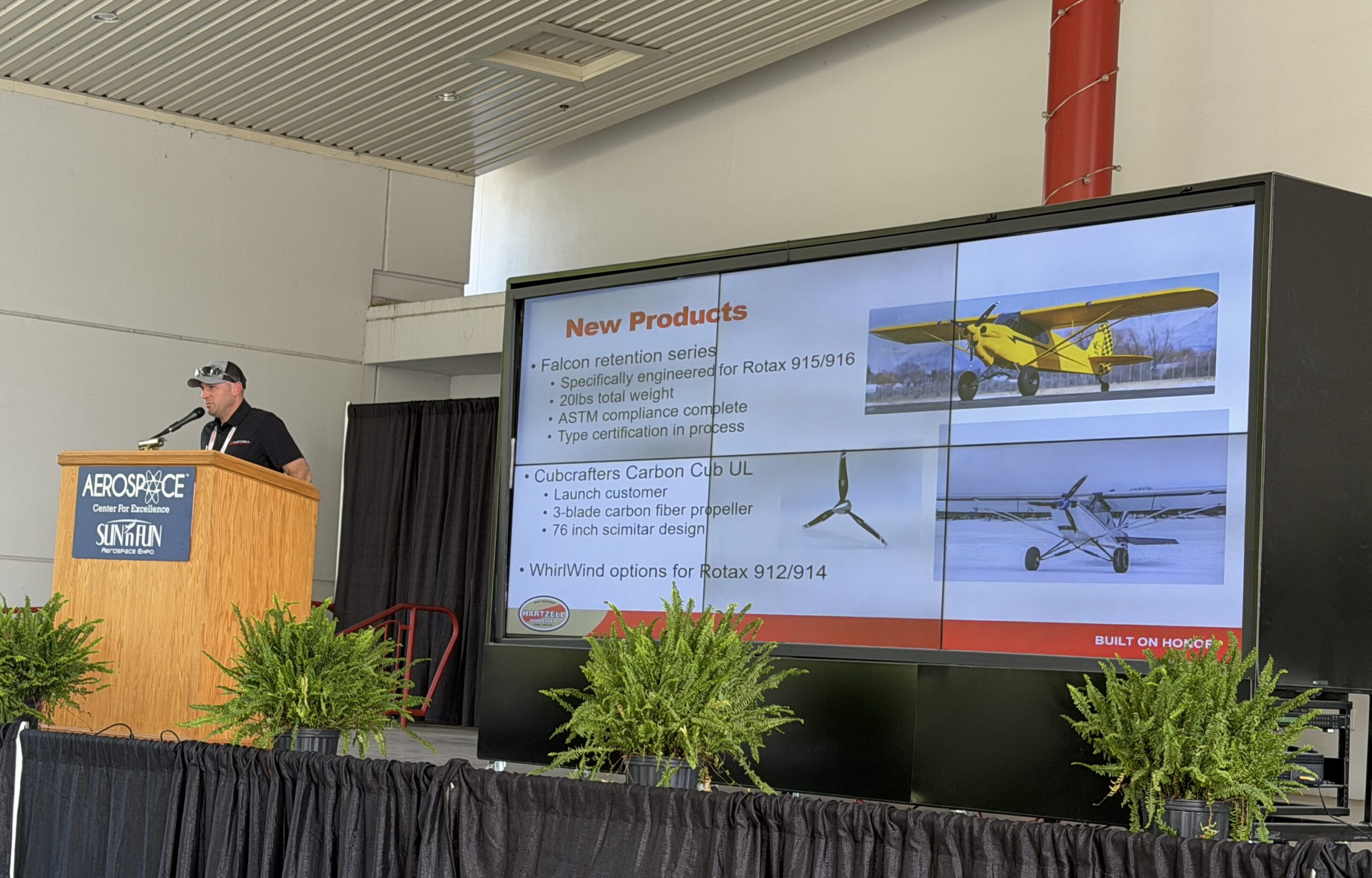
I also had a chance to support client Hartzell Propeller during the company’s seminar as part of the Sun ‘n Fun Innovation Preview on Monday afternoon under the breezy pavilion (which won’t be so breezy next year, once it is enclosed). Great stuff coming from the Top Prop line, and new prop applications in the works…
JJ Frigge of Hartzell Propeller introduces the company’s new products at the Sun n Fun 2026 Innovation Preview. [Credit: Julie Boatman]
Overall props to the excellent media headquarters staff, who kept me watered and fed and charged up during my whirlwind visit… and to the entire Sun ‘n Fun team for a great show… things are looking up at least in this part of central Florida.
With the snow capping the Pyrenées to the south, my last visit to Tarbes took place on a chilly day in November 2021. I was meeting up with Margrit Waltz, who readied a new TBM 940 for its ferry flight across the ocean.
At the time, I didn’t realize that the next TBM had already moved onto the production line, the serial number (SN) that would become the first TBM 960. That model debuted in April 2022, and I had a chance to fly it from Sun ‘n Fun Aerospace Expo down to Daher’s then HQ in south Florida, at KPMP, Pompano Beach.
Now, nearly four years later, Daher debuts its latest, the TBM 980, and what looks like a similar aircraft has changed significantly under its gorgeous skin.
Similiarly, Daher may look like the same company if you just glance at the buildings collected on the ramp at LFBT, but so much has changed. The company has three locations now in Florida—at KSUA where the TBM will soon be built on a new line, and at KFLL where the new U.S. headquarters is located. And the Kodiak’s home base in Sandpoint, Idaho, now churns out Kodial 900s as well as the 100 Series III.
And…just in time to kickoff 2026, the TBM 980 takes the stage.
The sixth 900-series turboprop launched by Daher since it took possession of the aircraft model line in 2014, the TBM 980 integrates the Garmin G3000 PRIME that the avionics OEM debuted in late 2024 on the competing Pilatus PC-12 Pro. But this is more than a makeup game. The G3000 PRIME replaces the previous G3000 with three 14-inch touchscreens and app-based functionality to evolve the flight deck experience to match what most pilots carry in their pockets.
The first integrated flight deck into the TBM series took off when Garmin and then-SOCATA signed the contract to put the G1000 into the TBM 850 at NBAA 2005. It was the beginning of the end of “federated” avionics—the separate boxes that worked in concert that we used to know so well.
Twenty years and 1,000 TBMs later, the flight deck now integrates into the pilot’s life. “When you pick up an iPad, you don’t read a manual, you pick it up and use it intuitively,” said Nicolas Chabbert, Daher Aircraft CEO, at a livestream event on Thursday, January 15, in the evening from Daher’s main hangar in Tarbes. The PRIME drives closer to that mark than any flight deck thus far.
The presets are contextual, allowing for the phase of flight to drive them. And that’s just the beginning. There’s a joystick to aid in selection, rather than a button for scrolling, and the ability to check in on the airplane remotely via Garmin PlaneSync.
Guillaume Remigi, test pilot, said at the event that the biggest surprise he discovered during flight test was how much he appreciated the touchscreens. Rather than being a novelty, they became natural and intuitive, he found.
Another operational improvement sure to be well-received by pilots is the ability to operate without adding Prist to the fuel. The Prist-free option had to be validated in hot and humid weather conditions, so the test pilots related during the livestream how they flew to Agadir, Morocco, leaving the aircraft outside overnight, experiencing temperatures ranging from +40C to -50C in the desert, and up to 90 percent humidity on the coast.
An enhanced interior features a new passenger display through which the folks in the back can see flight data… Chabbert likened it to Concorde, though perhaps not into the Mach numbers!
The new TBM will be Starlink Mini-capable, and to preview this, Daher’s Michel Adam de Villiers and longtime TBM pilot and superfan Dr. Ian Fries called in during the event from in-flight over Florida. Fries is the first publicly announced customer to purchase the TBM 980, which will be SN 1634, ready in March—Number 6 for Dr. Fries. That said, SN 1627 and SN 1628 are already poised to depart for their first customers.
Frankly, I can’t wait to get my hands on the new yoke—and on the touchscreens—either.
Trying to re-vision a massive event like NBAA’s BACE—the association’s largest annual gathering—takes time as well as overcoming a lot of inertia, both institutional and across the industry.
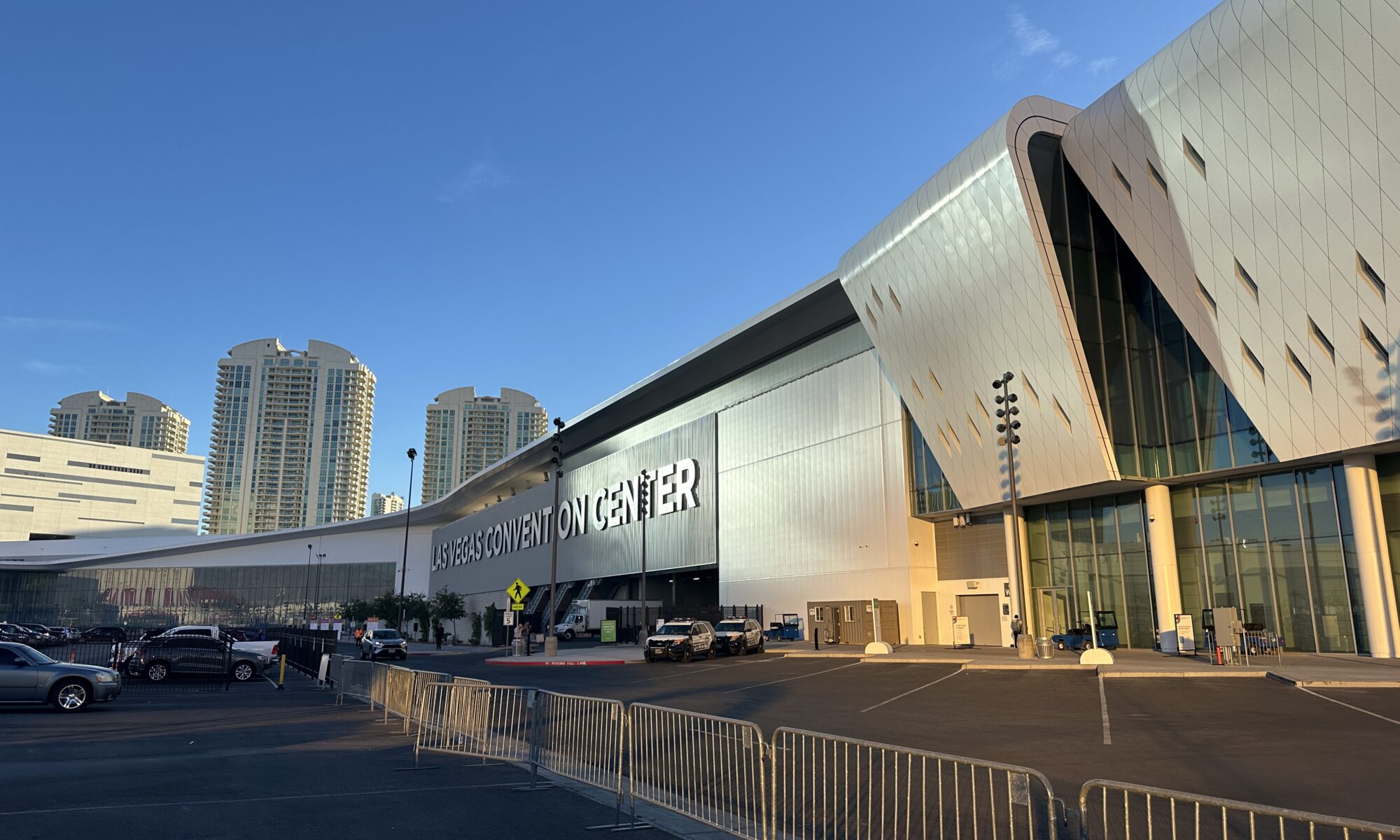
With a long-term agreement signed with the Las Vegas Convention Center, NBAA is constricted in its ability to revamp the conference, but it made valiant efforts to do so this year, and try to bring value to the members of the association and the companies and customers they serve.
The Gulfstream team brought the G400, G800, and the cabin mockup of the G300 to the show at NBAA-BACE. [Credit: Julie Boatman]
I found the most value in the meetings, the networking, and the chance conversations that only bringing together a lot of disparate folks in person can do. And that’s really why bizav exists, really, that gathering people together, face to face.
At one point on the exhibit hall floor, I was in a gathering of random friends I knew from no less than 3 prior corporate engagements. No one can plan that kind of synergy.
The sleek black Epic E1000 GX poises on the ramp at NBAA-BACE. [Credit: Julie Boatman]The Citation Ascend on the display at Textron Aviation, greeting the morning sun. [Credit: Julie Boatman]Bombardier brought several of its Global and Challenger fleet to the static display at NBAA-BACE 2025. [Credit: Julie Boatman]
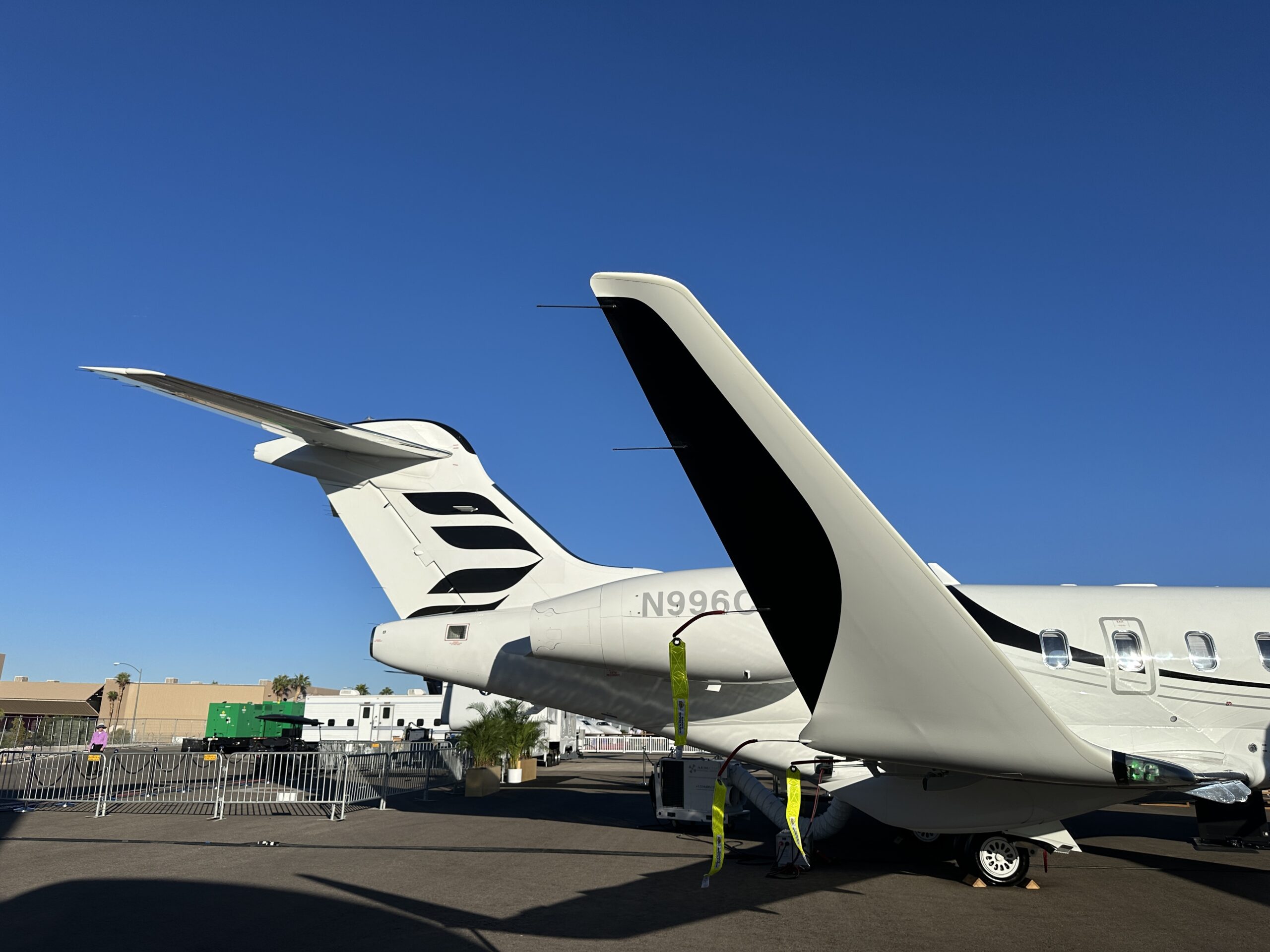
By necessity, the exhibit hall floor was smaller, less full, as well as the static display, with fewer aircraft overall (and a wind/duststorm on Tuesday that drove people away from KHND). But there were some big players there (Gulfstream, Bombardier) as well as new entrants (Epic in a sleek, super-black E1000 GX). In fact, black was a bit of a theme, with Daher’s Kodiak 100 showing up in stealth colors as well.
The flight deck of the Citation Ascend shows the layout of the significant upgrade to the XLS line. [Credit: Julie Boatman]The center power console on the Citation Ascend features two touchscreen controllers as well as the power levers. [Credit: Julie Boatman]
The new Citation Ascend from Textron Aviation made the scene too, and its upgrade from the XLS (though it shares the same type rating, as I was assured) looks pretty spiffy. I can’t wait to fly it. Someday. Maybe I’ll get a chance to do some other Citation flying when the next Special Olympics Airlift comes around—in June 2026, into Minneapolis-St. Paul. It will be my fifth SOA if I can make it happen.
Can you even see the Daher Kodiak multimission aircraft? It is so black. [Credit: Julie Boatman]The stealthy black Cirrus Vision Jet graces the ramp at the NBAA-BACE static display. [Credit: Julie Boatman]
In talking with colleagues from around the bizav space following the show, there was good energy—the dynamic duo of Dierks Bentley and Steuart Walton at the keynote was a high point. I wonder how many downloads/streams of “Drunk on a Plane” or “Riser” happened from that GPS location on the Strip immediately following the keynote… I admit I claim both of them.
All in all, this was still a show not to miss. I found a lot of value in networking and will come away with new business and strengthened relationships across the board.
But the slimmed-down versions of most exhibitors seemed to serve them well too. Your thoughts?
A pair of Falcons perches on the ramp at the NBAA-BACE static display. [Credit: Julie Boatman]
The unofficial kickoff for theannual BACE in Vegas included reflections from all corners of the business aviation industry in a quest to make sense of a challenging, changeable time.
For those of us coming in from the East Coast, or Europe, the sun doesn’t rise quickly enough in Las Vegas. As usual, I woke up, sans alarm, at 4:57 am, ready to roll. Fueled by Tacos El Gordo from the night before, the action began at 7:30 am and did not conclude until I walked “home” from the Honeywell media event at the Las Vegas Country Club (very old school Vegas in a mid-century modern clubhouse) at 8:30 pm. Whew.
Éric Martel, president of Bombardier, announced the goal of a Mach 0.95 certification MMO for the Global 8000. [Credit: Julie Boatman]
Big—and Fast—Jets
We covered Gulfstream’s G300 launch in late September in Savannah. The greater story lies in the rationalization of their product line that has occurred under the leadership of Mark Burns and team. I’m hoping to talk later at BACE with chief of engineering flight test, pilot Scott Evans, out at the static display where the G400 test article, G800 production model, and G300 cabin mockup grace the ramp.
Bombardier in a celebration fested by Cirque du Soleil gymnastiques announced its Global 8000 will aim for certification at a new top MMO of Mach 0.95. The nuances behind the number have been significant, and clearly already addressed in flight test to date, but the traverse to M1.2 during those tests opens up a slew of questions.
Rollie Vincent, CEO of JetNet IQ, remarked upon the effect that the spectre of tariffs have had on the business jet market. {Credit: Julie Boatman]WingX’s Christoph Kohler noted the headwinds and tailwinds found in the market ahead for business aircraft. [Credit: Julie Boatman]
The Market
At the Newsmaker’s Luncheon—during which The Air Current’s Elan Head deservedly secured NBAA’s Gold Wing Award for business aviation reporting—the mood in the room smacked of cautious optimism (that has been a theme for a while), with the collective sentiment captured in two keynote speeches referencing the current political situation in the U.S. as well as the leadership panel convened following lunch.
Those two keynotes formed an interesting parallel. Nick Daniels, president of the National Air Traffic Controllers Association, gave an impassioned plea for Congress to work towards the same kind of bipartisan solution to resolve the shutdown as the one that had led to the FAA reauthorization bill of last year, and which was discussed by Rep. Sam Graves in his remarks just prior to Daniels’. We can all hope, but hope is not a strategy.
Elan Head, of The Air Current, accepts the NBAA Gold Wing Award at the Newsmakers’ Luncheon. [Credit: Julie Boatman]The leadership panel at the Newsmakers’ Luncheon on Monday at NBAA BACE 2025 featured CEOs from aircraft OEMs and fractional operators. [Credit: Julie Boatman]
The uncertainty generated by global economic and geo-political forces underpins each of the market reports presented to the media on Monday, both by Rollie Vincent (JetNet IQ) and Christoph Kohler (WingX/JetNet) and by the Honeywell team, led by strategic planning manager Kevin Schwab. While the demand for business jets continues to rise—with 8,500 (Honeywell) or 9,700 (JetNet) new jets predicted to deliver over the next decade, forces from tariffs, to regulatory/shutdown headwinds, to black swan events on the geo-political scene are keeping everyone on pins and needles about the tenacity of that demand.
Leveling things out a bit, Michael Amalfitano, president and CEO of Embraer Executive Jets (and wearer of the purple socks, always spot on in style) noted the significant impact that large fleet sales have on their business. “What you have in terms of stability of strategic partners like FlexJet…is a great testimony to being able to find efficiencies in your production line, look for solutions that are going to bring more volume to that sector, and recognize that they’re a sales group in the sky.” However, Ron Draper, CEO of Textron Aviation, offered a balancing note–and one grounded in the company’s experience during the recession of 2008: “Fleet customers can change as the economy goes up and down. And so we like a mix of retail and fleet orders, and that’s what our backlog represents today.”
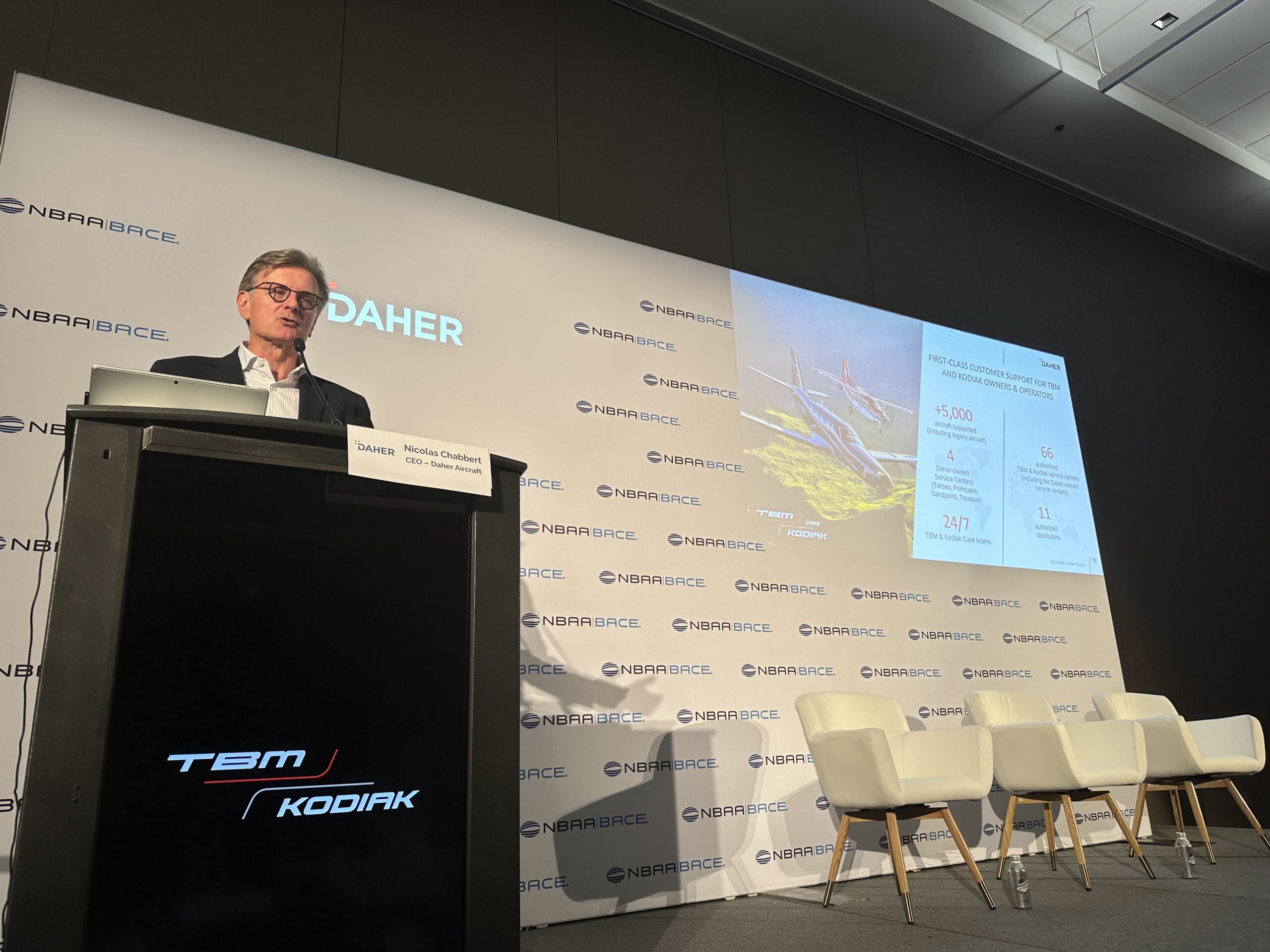
Kevin Schwab, Honeywell, presents the company’s market forecast at an event at the Las Vegas Country Club on Monday evening.Nicolas Chabbert of Daher highlighted the multimission capabilities of the Kodiak turboprops with a video showing a surveillance action in Las Vegas. [Credit: Julie Boatman]
Brazil, Multimission in Focus
In several press conferences, the growth recently seen in Latin America has led to a greater focus on that market by OEMs seeking to capitalize on economic opportunity there, particularly in Brazil, where light jets and turboprops find great application in connecting remote areas of the country to its population centers. As an example, Daher opened its Brazilian office this summer and has now appointed its leadership team on site: Paulo Cesar Olenscki assumes the role of Executive Director for the operation in São Paulo, along with Rodrigo Cendon as the Customer Relations Director.
Also noted by Daher Aircraft CEO Nicolas Chabbert, the Tagine R&D project continues to roll along under funding by the French government. “This program is underway and is delivering papers and a cabinet full of ideas on the innovation side,” said Chabbert. “We took the Kodiak as a good bench to provide the mix between what could be advertised and what solutions can you do when it comes to the trade offs with the battery, and electricity. So this is the purpose of Tagine; it doesn’t necessarily end up with a product.”
In fact, the mountain of papers and data resulting from the joint exercise will be published publicly, according to Chabbert, so the company will determine following that report out if it will put into application the learnings gleaned from it. The problem presented by slow progress on improving energy density in the batteries currently available remains—capacity is roughly 50 percent of what it should be, he noted. And with collaboration on the FAA side that has come to a standstill during the current government shutdown, Chabbert would only remark that Daher’s progress on certification programs in process have paused.
Partnerships
Hartzell Propeller and The Blackhawk Group also announced their partnership ahead of BACE this fall. The plan is to leverage the service and support capabilities of both entities and expand their footprint in North America and Europe. Hartzell will supply its Top Props to Blackhawk for use on its upgrades and aircraft overhaul programs, and provide maintenance and overhaul facilities via its eight service centers.
We look forward to more time in the exhibit hall and at the static display on the official Day One of NBAA on Tuesday…more aircraft pics to come, along with fun times celebrating aviation with friends and colleagues.
There’s a common thread here. Each one helps add context and fluency to our daily flight ops, whether we fly for ourselves, professionally, or in pursuit of opportunity.
Making sense of all the data we carry in our pocket or purse (or just being able to find it when we need it, at the moment we need it)….this has been the holy grail, elusive to grasp even as we power up the devices we have access to.
Any aircraft owner or pilot flying a high performance airplane in the IFR system knows the intersection of documentation both operational and procedural. Tying all of it together has felt like pushing a boulder up a mountain—from planning the flight and ensuring the aircraft is ready (and legal) to executing a flight plan through the clouds, to recording it faithfully at the end (and getting credit for those approaches logged) and making appointments for the next inspections.
With the sequential release of Garmin’s Smart Charts and ForeFlight’s Dynamic Procedures, depending on which app you use in your planning and as a backup on the flight deck, you can now use the power of the database (Garmin proprietary for Smart Charts or Jeppesen for ForeFlight) to carve out the plan you expect, and then be able to change it on the fly—and only present the data (from NOTAMs to fixes and altitudes) relevant to the approach you plan to fly. Or the one ATC switches you over to (or you choose based on changing conditions).
You can then follow along as your blue ownship toodles through the course on your smart phone or tablet. Briefly. While flying the airplane IRL.
ForeFlight’s Dynamic Procedures reduces the info on the display (here shown on the iPad) and uses a unique sidebar to distill the information and put it into context. [Credit: Julie Boatman]Flying with Garmin Pilot testing Smart Charts on the map view. [Credit: Julie Boatman]The geo-referenced profile view on Garmin Pilot with Smart Charts enabled puts you on the approach, with an immediate visual representation. [Credit: Julie Boatman]
On the aircraft side, two recent updates to the airplane management app world continue to drive critical information into your device, and connect you remotely to your airplane, should you be lucky enough to own one of the new ones. The enabling technology underneath both the Cirrus IQ app and the Daher Me & My TBM (now in a Kodiak version) is Garmin’s GDL 60 datalink unit installed in the airplane.
It needs a connection in order to “go live” so, as it was mentioned in Daher’s press conference today, you need to make sure you park your TBM 960 or Kodiak 900 in a pot with LTE 4G service. Hopefully your hangar has this capability, to start with.
If so, you can wake up the airplane remotely, and find out the fuel, TKS, oxygen, and database status on your phone…before you call the FBO to truck you over some avgas or Jet-A. Pretty amazing stuff.
Cirrus’ Todd Simmons talks about the connected nature of the Cirrus Experience at its press conference at Oshkosh 2025. [Credit: Julie Boatman]Capturing the latest connected Cirrus SR22 G7+ at EAA AirVenture 2025. [Credit: Julie Boatman]Daher Aircraft CEO Nicolas Chabbert and customer service developer Mathieu Pardo talk about the connectivity needed through the Garmin GDL 60 to enable the Me & My Kodiak app. [Credit: Julie Boatman]
Plus, you can stay connected with your friends in the type association, comparing notes on landing prowess and efficiency. If you want. Or you can just assess your own performance and take note accordingly the next time you meet up with an instructor. Other OEMs have similar programs in development, but it’s cool to see Cirrus and Daher leading the pack here in creating the ecosystem that can serve you up the data you need. When you need it.
Stay tuned for more connectivity news as EAA AirVenture 2025 continues….now with charging stations everywhere, appropriately.
The year kicks off—at least from a general aviation perspective—with the annual GA Shipments and Billings Report produced by the General Aviation Manufacturers Association (GAMA) and its associated press conference held in concert with meetings of the association’s board and various committees.
With the National Press Club tied up, GAMA hosted the conference at the George Washington University’s Jack Morton Auditorium near Foggy Bottom in Washington, D.C., which honestly made for a more comfortable venue in light of the packed house that may have overwhelmed the Press Club’s more intimate quarters. Youth infused the production, which was executed by talented GWU students in concert with GAMA’s highly professional team.
The delivery and billing numbers didn’t surprise me—generally positive news there. Once more, much is at stake as the playing field shifts again before our eyes.
The vibe in the room sets the tone for the year. In 2020, the specter of COVID was just beginning, with lockdowns not yet in place in the U.S. but challenging already in Europe. In 2021, the Russian invasion of Ukraine had just transpired days before. Supply chain repercussions echoed through 2022 and 2023, with FAA Reauthorization looming large last year.
With as much change taking place on a daily basis as we’re seeing this first quarter of 2025, it wouldn’t surprise me to see a necessary change in course prompted by one of several factors in play:
Tariffs by the U.S. and retaliatory answers from Canada, Mexico, China
The charge to slash U.S. government regulations and only replace them at a 10:1 ratio
Egregious use tax implementation in Europe, targeting business aviation
Deeply cutting personnel reductions at key agencies, including FAA, DoT, and Department of Commerce
And, oh yes, privatization of the National Airspace System in the U.S.
To kick off, Pete Bunce, current chairman and CEO of GAMA, clearly bases the association’s strategy on tariffs based on what transpired with the first go-round of the current administration, when tariffs were floated and walked back. “We want to work with the administration on smart policies to be able to go in not to debilitate this industry,” said Bunce.
Using a typical GA powerplant—whether piston, turboprop, turbine, or electric—as an example, Bunce illustrated the impact on an industry that already suffers from a stressed supply chain. “[As for] tariffs and our supply chain…the challenges have been vast. And when you think about supply chain, it’s not easy to switch a supplier. When you go and switch a supplier, you’ve got to recertify that supplier. So that burns up resources from the regulators on either side of the Atlantic… So if we add tariffs on top of that to debilitate the industry, that can have very severe unintended consequences. Whether you’re talking about aluminum, whether you’re just talking about cross-border transactions—remember, when we produce an engine, parts and pieces cross borders all the time—if you’re starting to add tariffs to each one of those transactions, [they] become significant.”
Another echo of the previous charge to slash regulations may also have consequences that kill a lot of good work done by industry and government in partnership to streamline the certification process (MOSAIC), encourage bilateral agreements between FAA and EASA, and integrate UAS into the National Airspace System. “We in aviation can’t do anything without regs, policy, and guidance,” said Bunce, “and a lot of those are enabling regulations. How we interpret this, how it was in the first administration—2 to 1, now it’s 10 to 1—how we are going to actualize that to keep the momentum going forward on policy and guidance?”
An Oxford Economics impact study quantified the positive effect the business aviation industry has in the EU, in terms of jobs and revenue. [Credit: Julie Boatman]
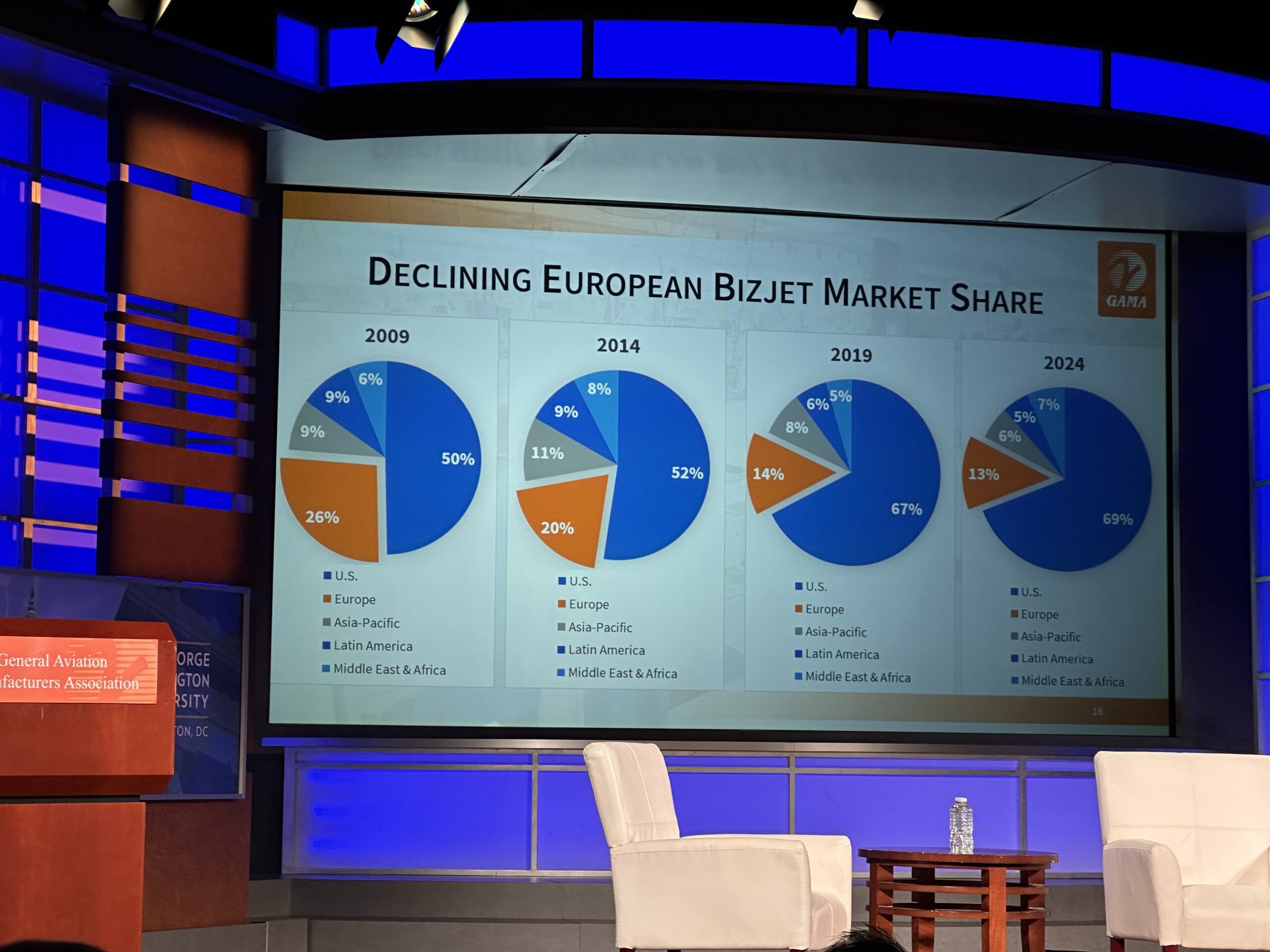
A move in Europe to enact Draconian passenger use taxes on business aircraft forms a third distinct threat to the forward momentum of the industry. France stands to implement a “green” tax that would charge up to 2100 Euro per passenger on every business flight operating in the country. It’s an absolutely fallacious means by which to purportedly limit business aviation emissions—and would only serve to kneecap the very segment of the aerospace industry that is the incubator for innovation. It’s a sector that a recent Oxford Economics study commissioned by GAMA and the European Business Aviation Association reported 440,000 jobs and an economic input of 110 billion Euro into the European economy.
“But what are we seeing over there?” asked Bunce. “We are seeing policies that attack our sector of aviation but also taxes that hit every sector of civil aviation—and these taxes aren’t what we thought about three or four years ago that dealt just with sustainability. These taxes are debilitative taxes that are simply going to be tax revenue for France or for other countries out there. The French government just signed into law a tax policy that has the potential of charging every passenger on a business aviation aircraft turboprop or jet up to 2100 euro per flight.
“Think about that,” he continued. “If you have an economy in Europe that boasts that they are shifting from a strategy of the green deal to the green industrial deal, and your major pillar in that strategy is competitiveness, you just shot yourself in the foot by doing this. Because we all know it’s business aviation that gives companies advantage whether you’re doing business in Europe or you’re doing it around the globe.”
The grand irony is that France need only look across its landscape for the very businesses that are spurring the “green industrial deal,” such as Daher, which in its recent annual press conference reported on core business across all its pillars pushing emphatically towards the sustainable future. From AI optimization of energy consumption to the utilization of advanced thermoplastics within its TBM and Kodiak aircraft—and culminating in whatever the follow-on to Eco-Pulse will be—Daher is not blasé—or isolated—in its commitment to our collective future.
The already-declining EU market for business jets faces strong headwinds if tax policy such as that recently voted in by the French government comes to pass, or expands to other countries. [Credit: Julie Boatman]
But we’re not done yet… other specters raised in Bunce’s comments included the privatization of the NAS, an ongoing fight. This time around, it’s in the name of modernizing and streamlining the outdated air traffic control system.
However, within the FAA Reauthorization bill and associated appropriations, the funding and support for required upgrades to equipment and advanced training for personnel are already earmarked and ready for implementation. If acting FAA Administrator Chris Rocheleau—a former NBAA exec and well regarded by the GA industry—is allowed to move this F&E forward, these issues untangle towards resolution. “But why would we want to go into that fight again when we can go and look at making this system better,” said Bunce. “I think if we’re distracted by another privatization fight, we’ve just lost this unique opportunity that all of civil aviation is united and said, ‘Congress, you can help us by appropriating more money in F&E, but also letting us use the trust fund more wisely, working with the appropriators to do it very smartly.’”
The GA Leadership panel, composed of GAMA chairman Henry Brooks, of Collins Aerospace, Pete Bunce, outgoing CEO of GAMA, and Jim Viola, CEO of VAI and incoming GAMA CEO. [Credit: Julie Boatman]
Finally, large-scale and immediate personnel reductions across the U.S. government have made the news every single day since January 20. And the FAA has not been immune, with an initial reduction of 400 employees imminent—and this to an agency that is already running at about an 800-personnel deficit, according to various reports. It feels particularly galling to have that salvo across the bow in the wake of the mid-air collision at Washington National last month, in which it appears understaffing may have played a part.
To this, Bunce returned to the presumption that we can trust the administration to stand by its commitments when the dust has settled. “We’re trying to understand with them what the impacts are,” he said, “and the numbers don’t sound like they’re as many as they were first reported. We know that the morale within the FAA was boosted by…the declaration late last week [that] those that have direct responsibility for safety—their jobs are safeguarded. In fact, they aren’t even allowed the ‘early out,’ for lack of a better term, and that helps with morale. It says, ‘You are important to this industry.’ But we are going to lose some support people out there. That just means we have to exploit efficiency.”
In closing, Bunce noted the need to continue to build the stories that convey the wide-ranging and deeply felt impact general aviation has on the world. GAMA, in concert with AOPA and other aviation associations, commissioned a study of their own through PWC to quantify that impact.
It’s human nature to base predictions of future action on past behavior. My biggest concern lies in whether that can be applied to each of these threats—and how we can fortify ourselves as an industry to weather those ensuing storms.
Reading the room gave me the same feeling. Can we trust those now leading the U.S. government to listen to our stories and follow through on their commitments?
Piston airplane deliveries showed the strongest growth by segment. [Credit: Julie Boatman]Turboprop airplanes notched a slight decline in deliveries, with a slight increase in billings. [Credit: Julie Boatman]Business jet shipments ticked up slightly, at just under 5 percent. [Credit: Julie Boatman]The 2024 GA billings report numbers reflect a steady increase since the knock-back in 2020 spurred by COVID. [Credit: Julie Boatman]
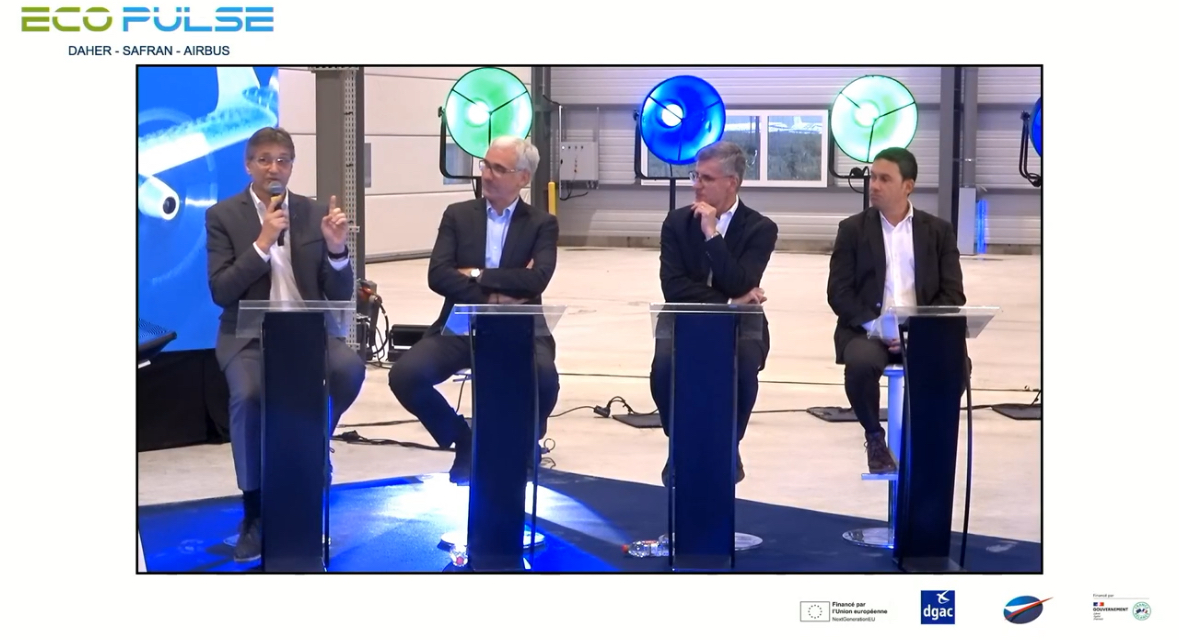
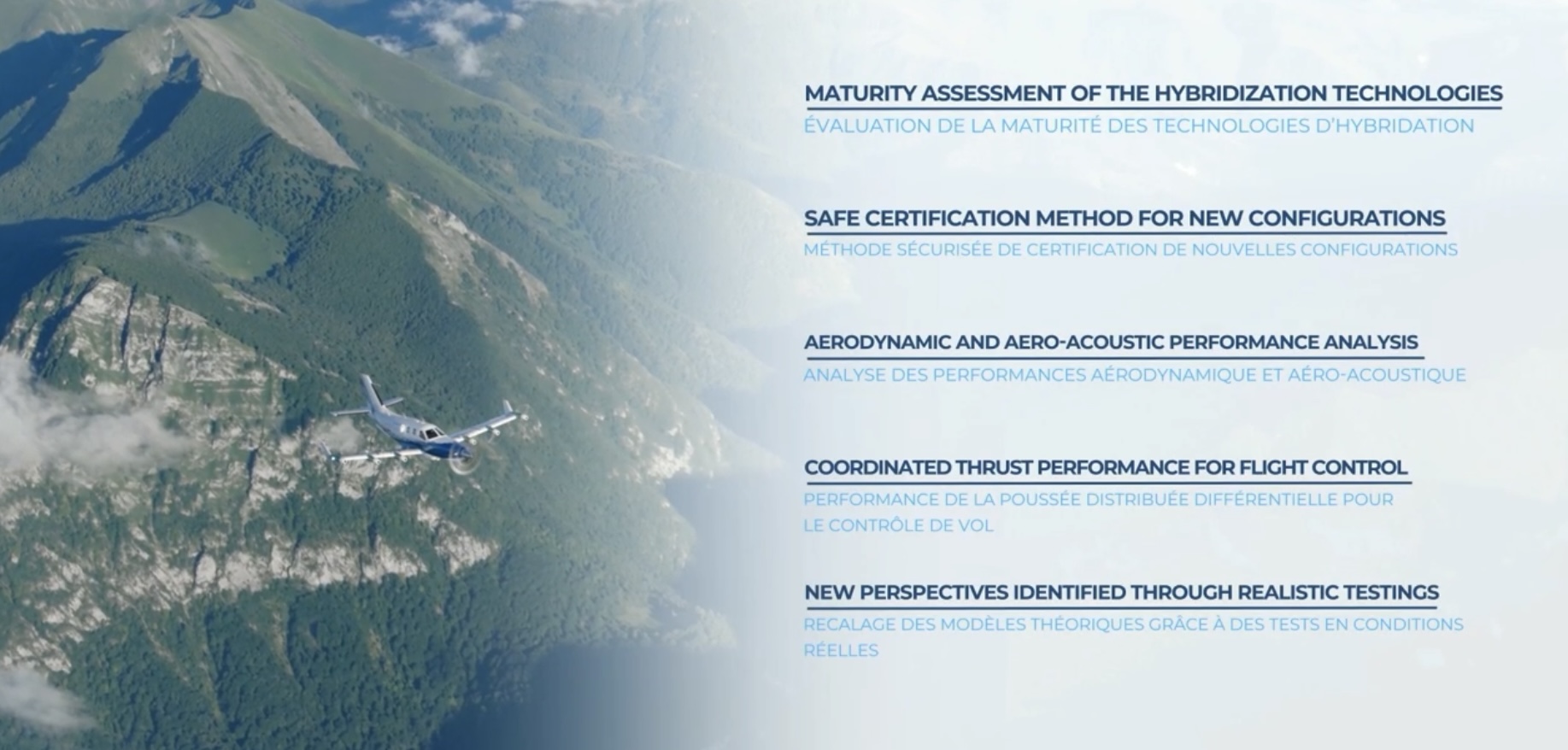
With the report from Daher, Safran, and Airbus on the Eco-Pulse hybrid-electric TBM-inflected tech demonstrator, the collective teams have the opportunity to stay future-forward—and incorporate lessons learned. In the interest of meeting the industry’s sustainable aviation objectives, we all have a vested interest in these outcomes.
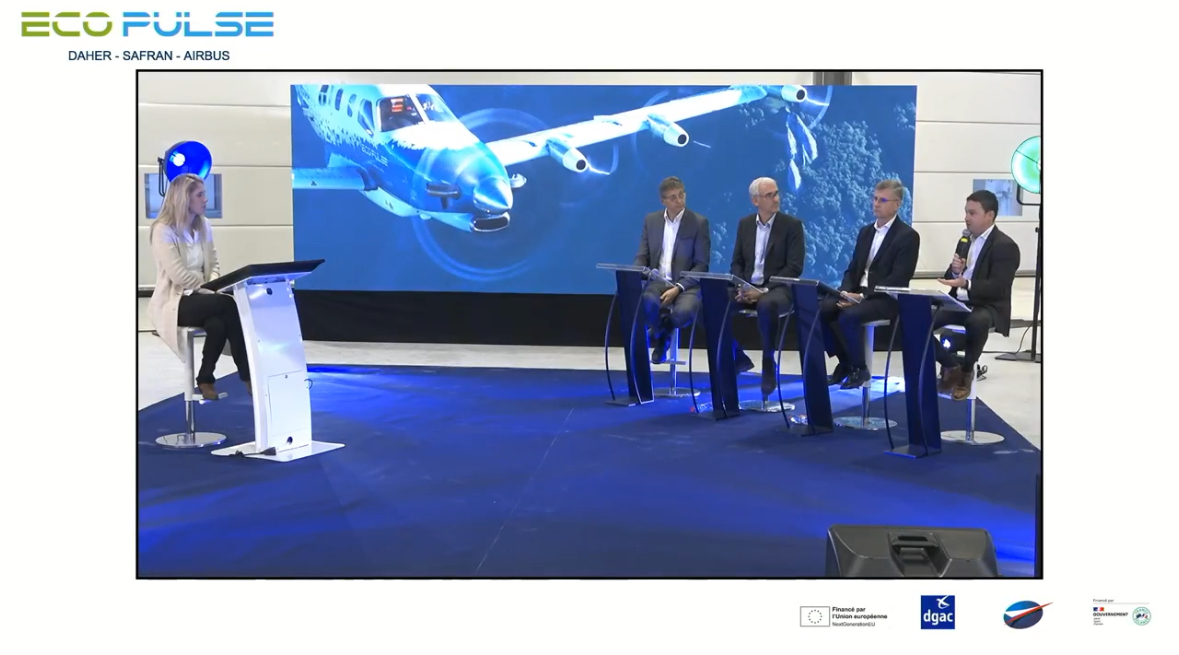
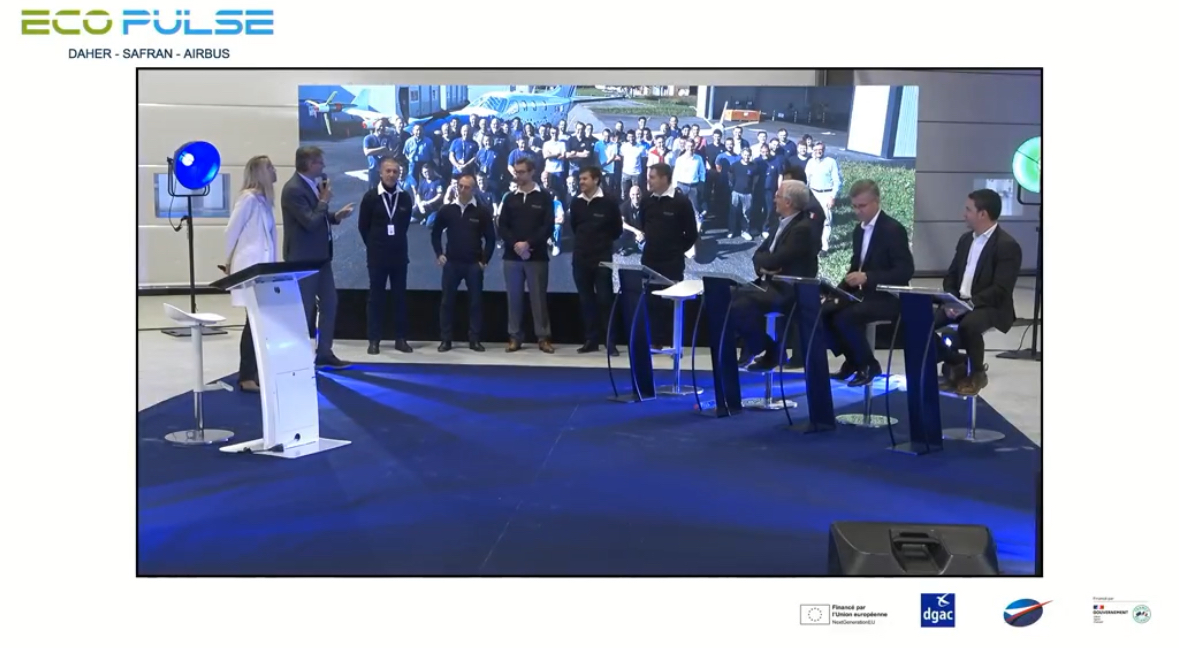
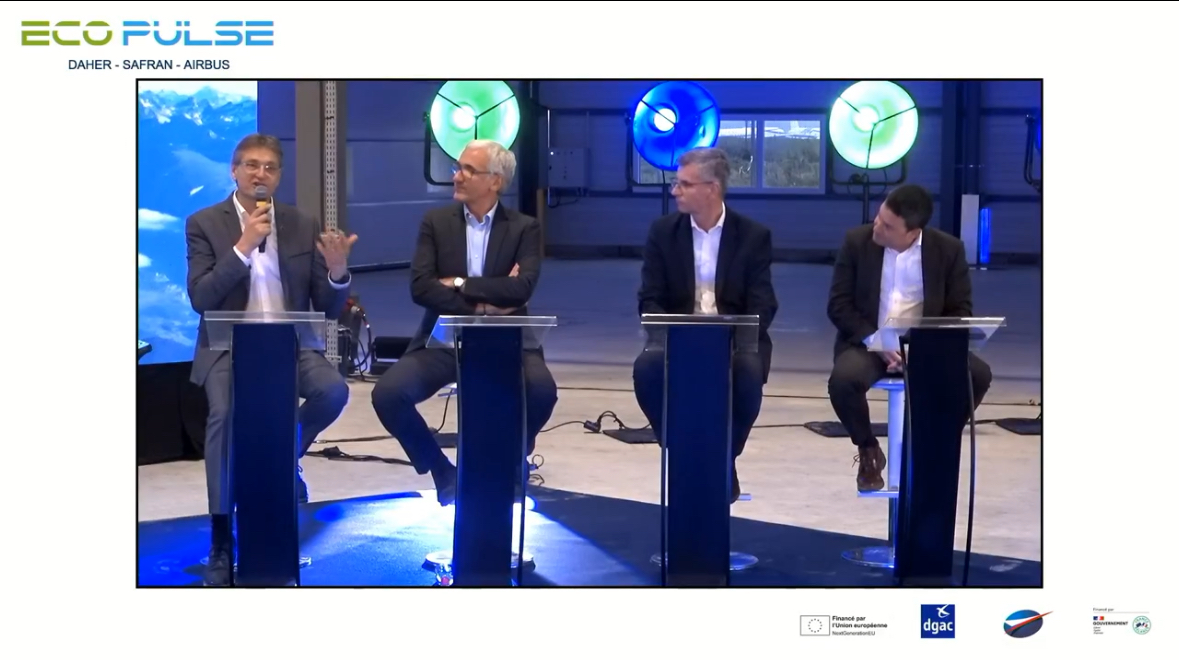
A media briefing preceded the LinkedIn liverstream on December 10, from Tarbes, France. Leaders from each company—including Pascal Laguerre, CTO of Daher; Éric Dalbiès, SEVP of strategy/CTO of Safran; and Jean-Baptiste Manchette, head of propulsion of tomorrow from Airbus—joined project lead and head of aircraft design Christophe Robin from Daher. Over the past five years since the project debuted at Paris Air Show in 2019, I’ve stayed in touch with Robin on its progress, which will inform the way forward for all three companies.
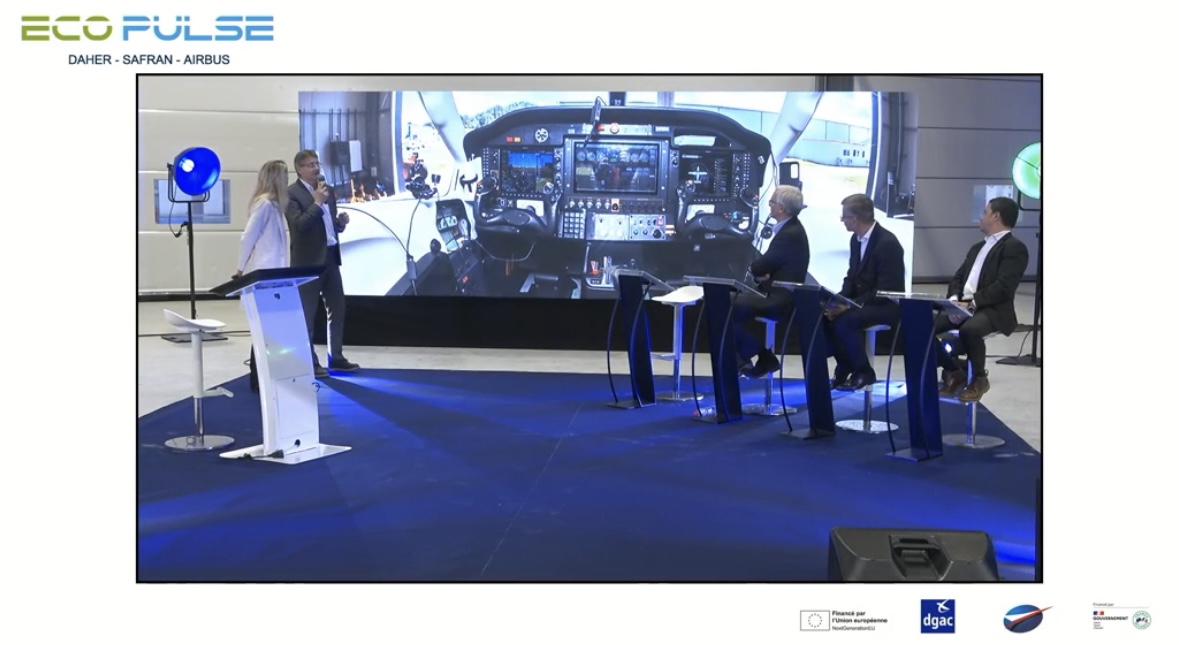
The panel of leaders from Daher, Safran, and AirbusChristophe Robin shows the flight deck of the Eco-Pulse along with its side stick unified flight control.
What Is Eco-Pulse?
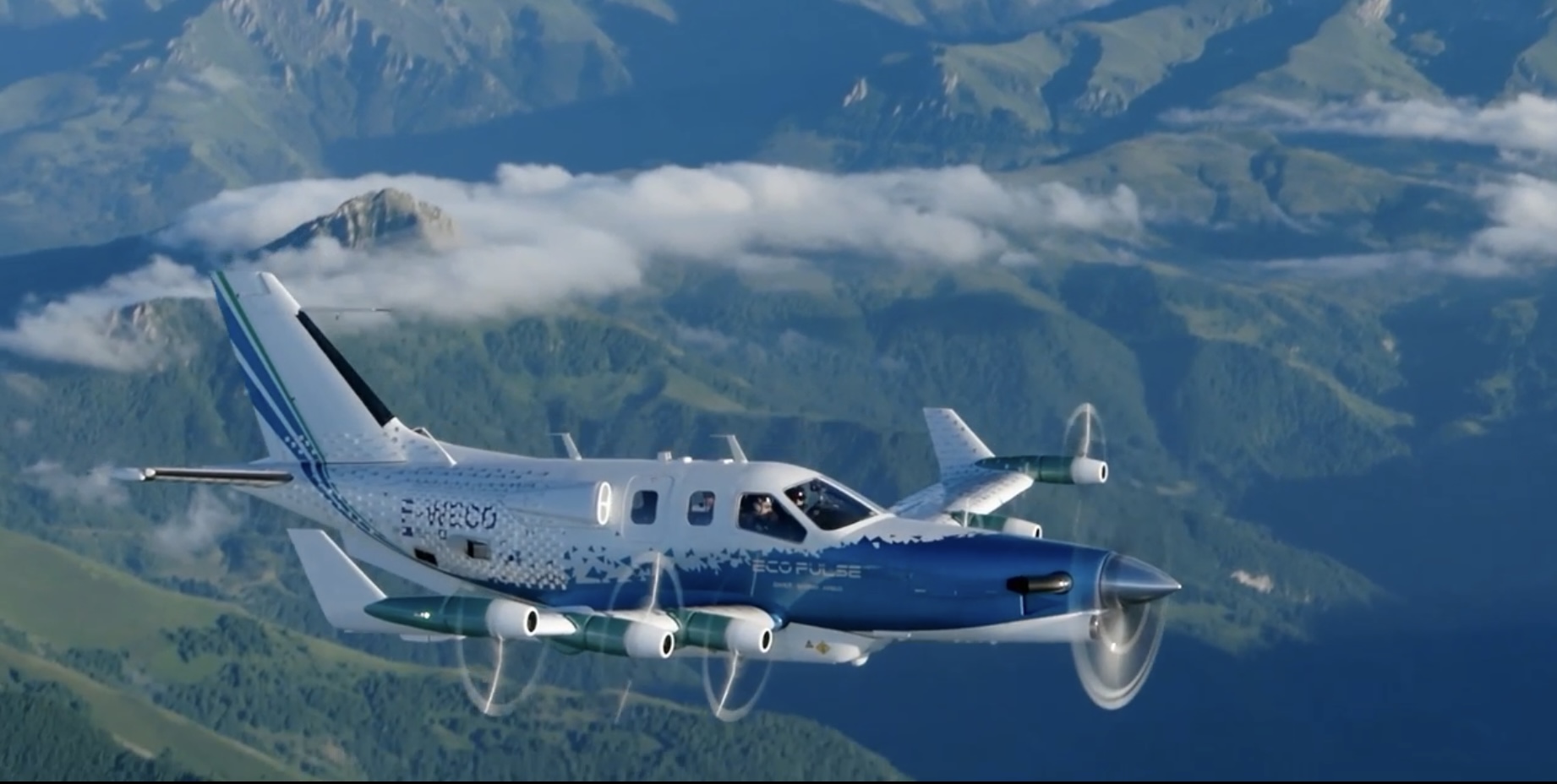
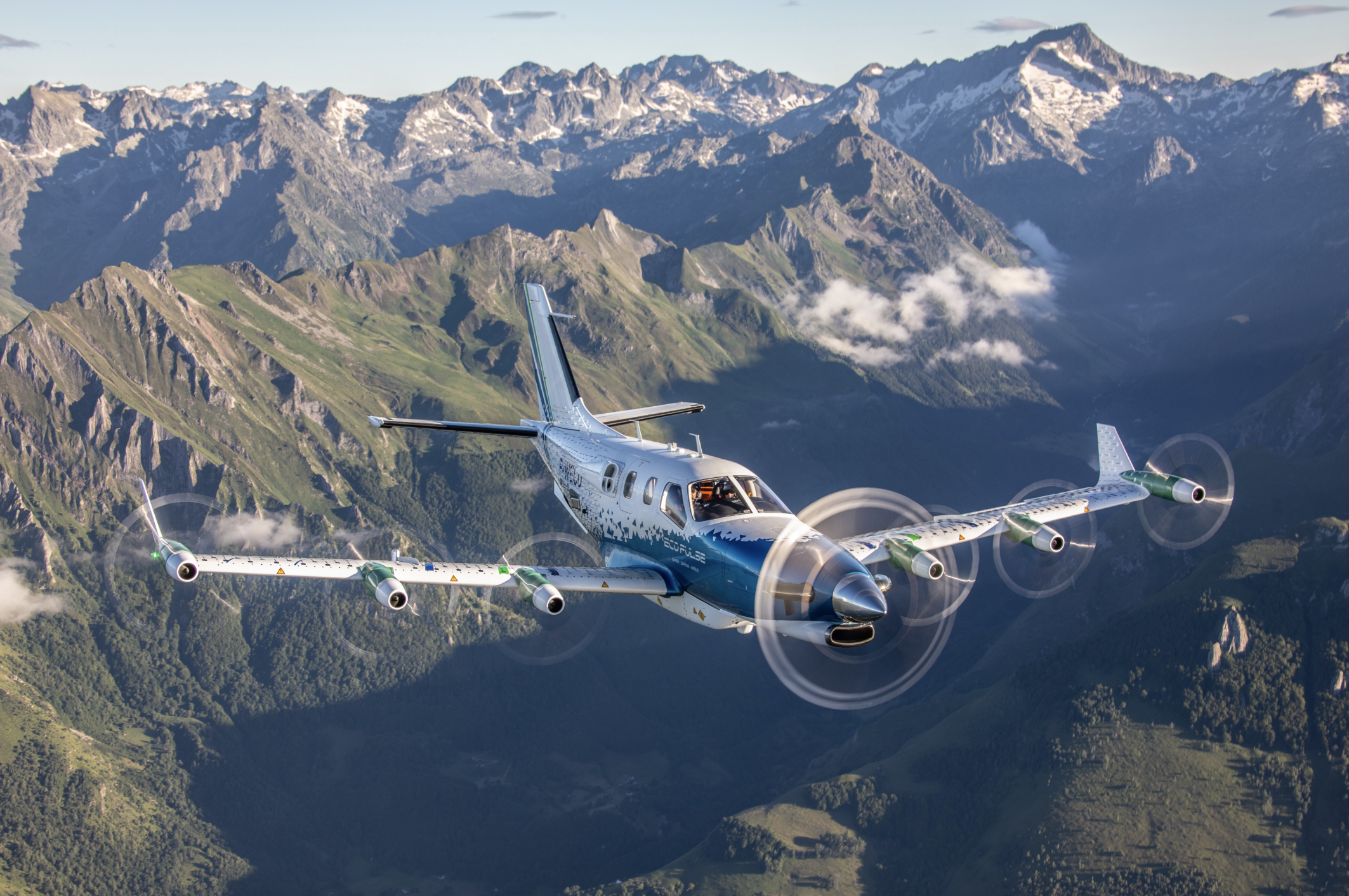
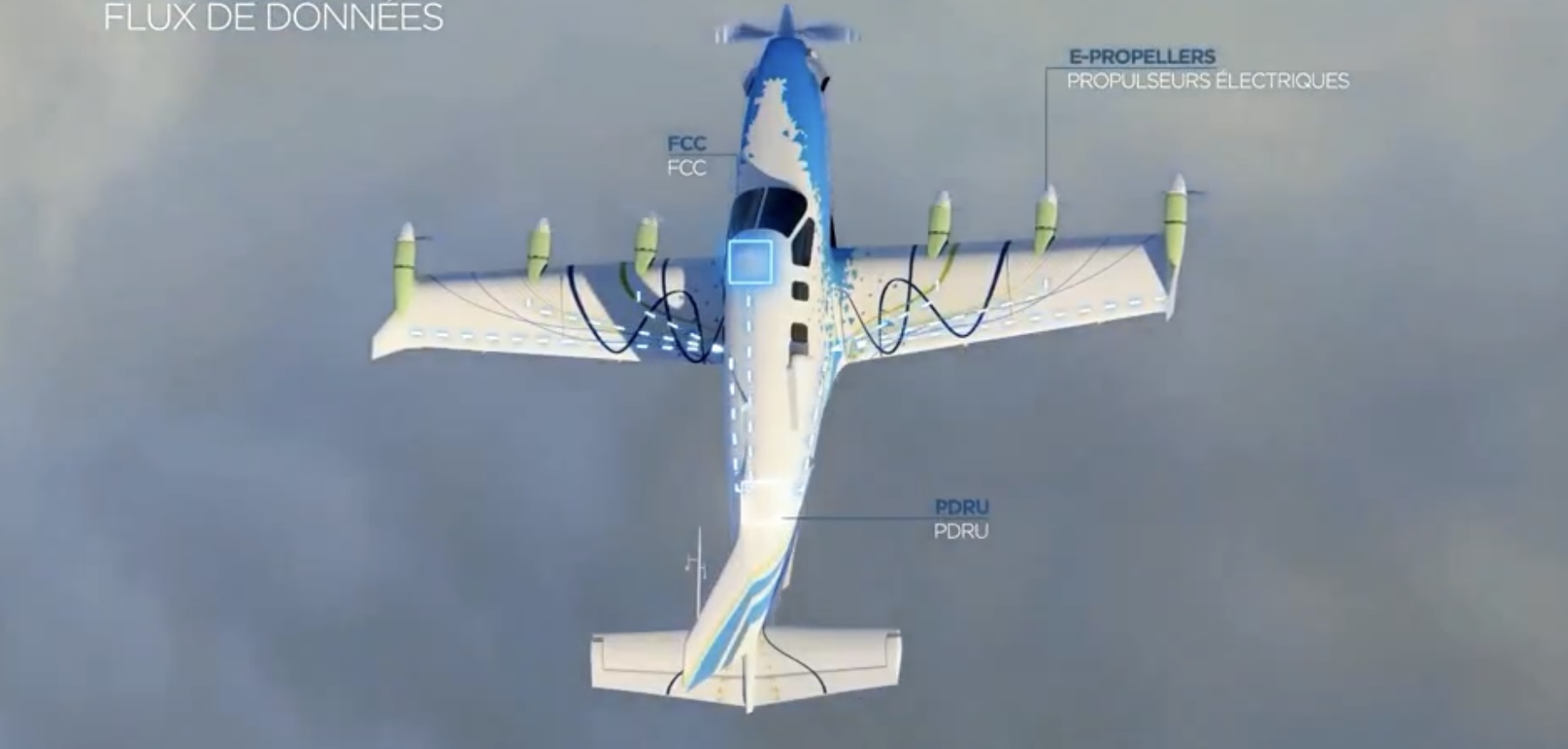
The Eco-Pulse project is critical for these leaders among aerospace OEMs because hybrid-electric propulsion forms a bridge between current jet-A (sustainable aviation fuel) burning turbine engines and full-scale electric propulsion. The aircraft at its heart is a technology demonstrator, in which a standard Pratt & Whitney PT6 turboprop engine remains in place on a tried-and-tested Daher TBM 900-series airframe. It’s joined by six Safran ePropellers on the wings integrated with a Safran-built turbogenerator and Airbus’ high-voltage battery pack (at 800 volts DC and up to 350 kW of power). A power distribution and rectification unit (PDRU) protects the high voltage network and distributes power via high-voltage supply harnesses.
The Eco-Pulse flew for the last time, perhaps, in July 2024. [Credit: Daher/Jean-Marie Urlacher]Distributed lift exploration formed a key takeaway from Eco-Pulse.
The pilot can use the six motors propelling distributed lift over the wing via a unified joystick-style flight control, via the integrated flight deck. It’s a unique marriage of tech dreams and true life—the Eco-Pulse project allowed for demonstration of these technologies within the envelope of safety required by the simple fact it was taking flight in the real world, not a simulation.
Flying it remains key to showing the operational safety necessary to move forward.
The flight testing took place mostly with the PT6 in “transparent” mode.Christophe Robin with the Daher flight test team on Eco-Pulse.
Flight Testing the Eco-Pulse
In the livestream, the flight test team described the progressive activation of the ePropellers and the eventually complete electrical actuation of the airframe and powertrain. During flight test, most of the hours of electric flight were conducted with the PT6 in “transparent” mode—not producing power, but not completely shut down.
Each step provided data to the respective companies, building on successive knowledge. For example, much was learned by flying the aircraft under its fly-by-wire (FBW) system, and under speed constraints. Stalls as well as the top speed of the demonstrator (190 kts) were explored. Slower airspeeds—as opposed to high-speed flight—provided some of the richest data, as the effect of the distributed lift caused by the ePropellers showed up most with lower in-flight airflow.
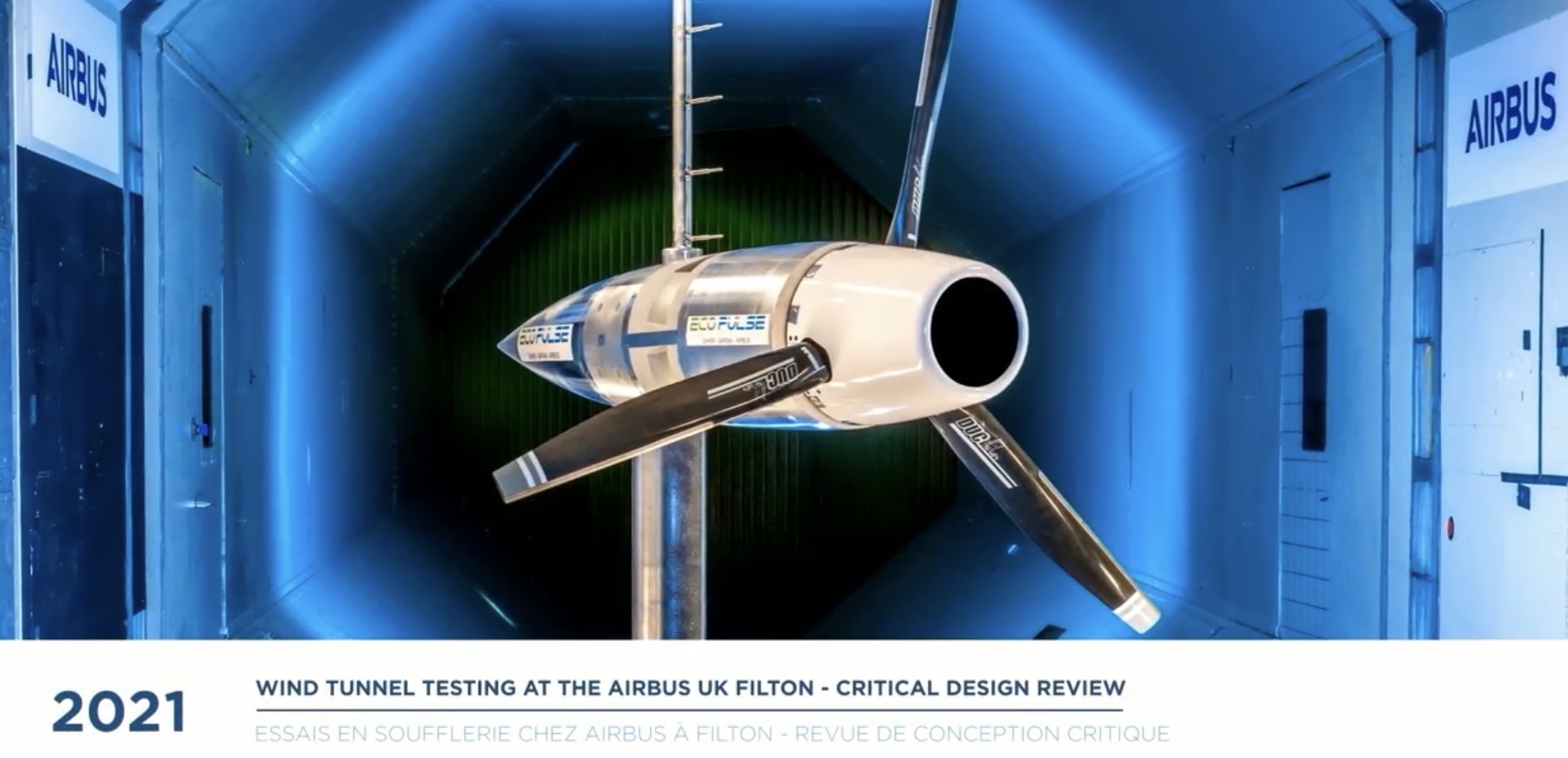
Wind Tunnel Test 2021Installation of ePropellers 2023
“You can imagine when when you have this propeller on the wing,” said Robin in the briefing. “The behavior is really different—you ‘blow’ the wing so the efficiency of the wing is completely different, thanks to the blowing effect of these six propellers. You increase the performance at takeoff, [and] during some maneuvers, and you can play with the flight controls, playing with the different[ial] power of these six engines. By doing that, you can play with the trajectory of the aircraft.”
Since the first hybrid-electric test flight on November 29, 2023, the Eco-Pulse has logged more than 100 hours in 50 flights, during which the team also noted other performance improvements, as well as the ability to reduce cabin noise with synchronization of the six propellers.
Two key learnings included a big challenge—managing the 800 VDC battery and the harness that distributes the power—as well as understanding how it will be maintained and serviced in real-world conditions. Things are just different in the air: A battery fire, for one, is more complicated than in ground-based vehicles, and because of the presence of the traditional turboprop engine, that fire may occur in close proximity to the fuel system.
The team learned from these issues: “Each unexpected issue on the aircraft has been ‘good news’,” said Robin. “There’s been…bad things, but also good news, because when on a subject…we didn’t think about, and Safran didn’t think about, that means that there was something real [to test and discover], That’s the point of making a demonstrator, to be in real life and not making only Powerpoints.
“We had some integration issues about the harness,” he continued. “It seems easy to install [an electrical distribution] harness with 800 volts in real life. [But] when you get more knowledge, [it’s] not that easy, especially when you have fuel, which is not too far away. You have to take care of all the dysfunctional cases. And we learned that some of them were probably not taken at the right level. We learned a lot on the integration of the harness.”
“We learned a lot also about the operation of high voltage aircraft,” he added, “because we are thinking design as an engineer [during] certification, but at the end of the day, well, you have an aircraft, and if you have 800-volt batteries, how you do you operate? How do the maintenance people take care of it?”
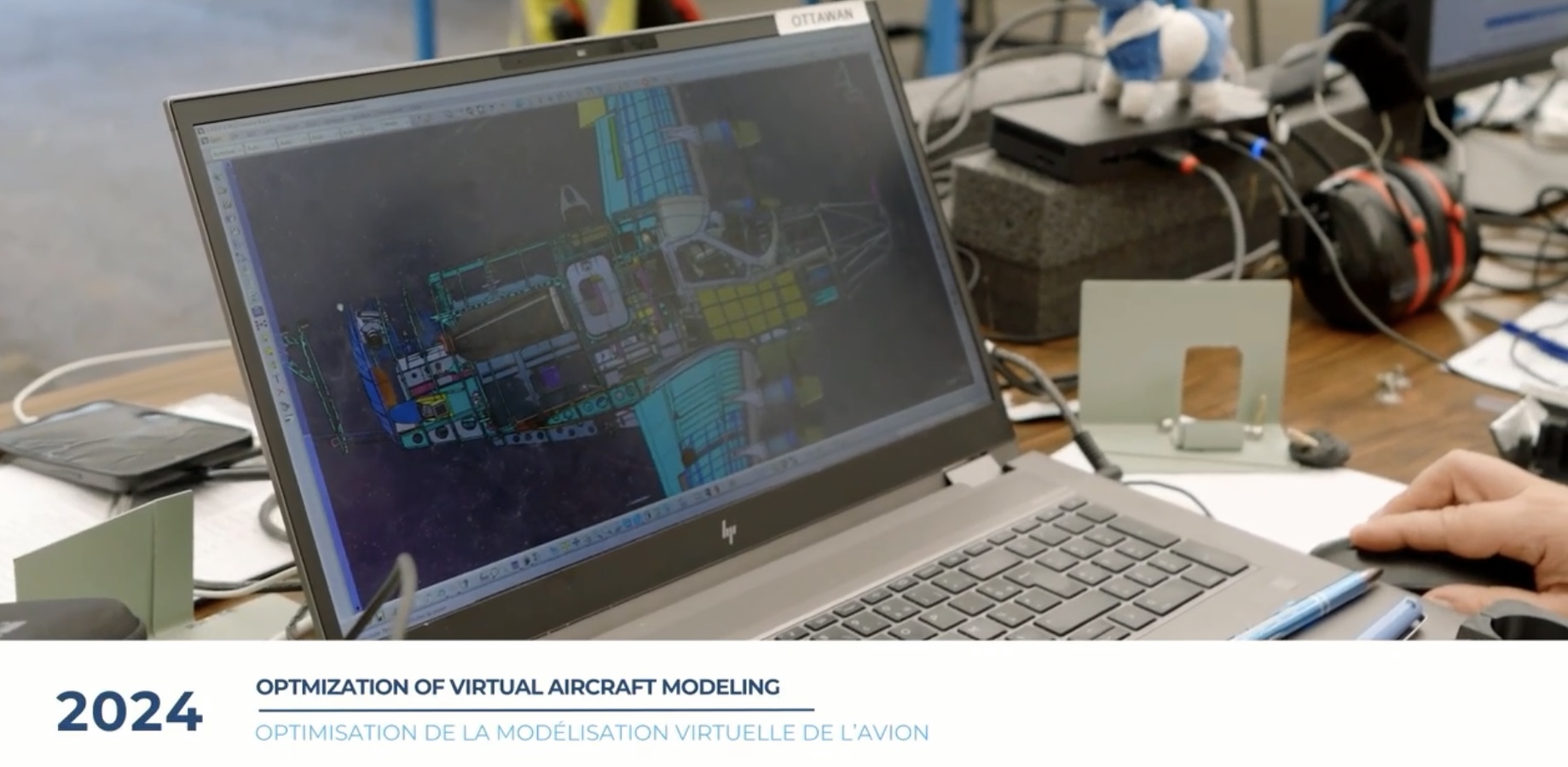
Ground Testing of High-Voltage Systems 2023Aircraft Modeling Optimization 2024
Daher + Safran + Airbus
Collaboration between the three giants was also a key takeaway: They essentially learned how to transform the relationship between airframe and powerplant OEMs as well as how to leverage the agility of start-ups that were brought into the development of the Eco-Pulse. The marketable aircraft program will depend on this coordination.
“So for the time being, we can enjoy something like 10-year periods, starting 2020 till the end of the decade, where we can focus our engineering teams on the preparation of the most disruptive technologies for the future,” said Pascal Laguerre in the media briefing. “That’s really an opportunity to make this happen. So we see this opportunity between our companies to align our goals at the same moment in time with the same mindset, the same intent, and saying, ‘Well, none of us individually can do it, can make it happen.’”
Sourcing of raw materials, including the rare earth metals needed for the batteries, from places on the globe that are not secure, is another takeaway from the program. Recycling those materials in a circular economy is vital to meeting several objectives, including those overall to support sustainable aviation. Finding other ways of approaching component construction and reuse is also critical.
Thrust Performance & Flight Controls 2024The three OEMs gained much more than expected from the collaboration.
What Comes Next for Daher?
The follow-on aircraft program from Daher and CORAC will be explored with a project beginning in 2025 with the goal of meeting the OEM’s objective of a go-to-market aircraft plan by 2027. With the real flight testing of Eco-Pulse, the goals are transformed beyond “the paper” according to Robin: “We have now a better idea of what the maturity is of the technological bricks [that] we can put inside an aircraft. We will launch next year a new CORAC project with Safran, in order to work on these hybridization and electrical technologies.
“The idea is to have this assessment of the [technologies’] maturity and to be able to meet the objectives given by my CEO [Didier Kayat],” he concluded. “That’s to propose a design and manufacture aircraft by the end of this strategic plan—so by the end of 2027, we [will be] working on this more electrical aircraft.” Also, Daher’s team will determine what the benefits were of the distributed propulsion system.
We’re certainly excited to see the next project leave the hangar…
The machinations of rulemaking crank through on often mysterious schedules…and we’ve collectively as an industry both suffered and been rewarded as of late with the timeliness of FAA process.
But the stars aligned for NBAA’s team in particular on Tuesday at BACE in Las Vegas, as the FAA released the SFAR (special federal aviation regulation) governing the new powered lift category just in time for administrator Mike Whitaker to sign it into action after his appearance with NBAA president and CEO Ed Bolen at the morning keynote. You could practically hear them popping corks in the D.C. offices all the way to Vegas.
This was the big news I’d alluded to in yesterday’s post. Yes, we have witnessed a milestone in the aviation story.
Mike Whitaker, FAA Administrator, delivers the great news on the SFAR on VTOL aircraft to Ed Bolen, president and CEO of NBAA at BACE 2024 Tuesday morning. [Credit: Julie Boatman]
The SFAR on Powered Lift
The ruling and its amendments outline the parameters for pilot certification, operating rules for powered-lift ops, and give guidance on how those aircraft will integrate into the national airspace system (NAS) with fixed- and rotor-wing aircraft. The rules are performance-based, for the most part, which means they generally tell OEMs and operators the metrics they need to achieve rather than prescribing strictly how they will achieve them.
That’s fantastic news for contenders in the market such as Joby, Archer, Lilium, and others who are well on their way into flight testing conforming (or near-conforming) initial production models, standing up the lines to make them, and building out training and support infrastructure.
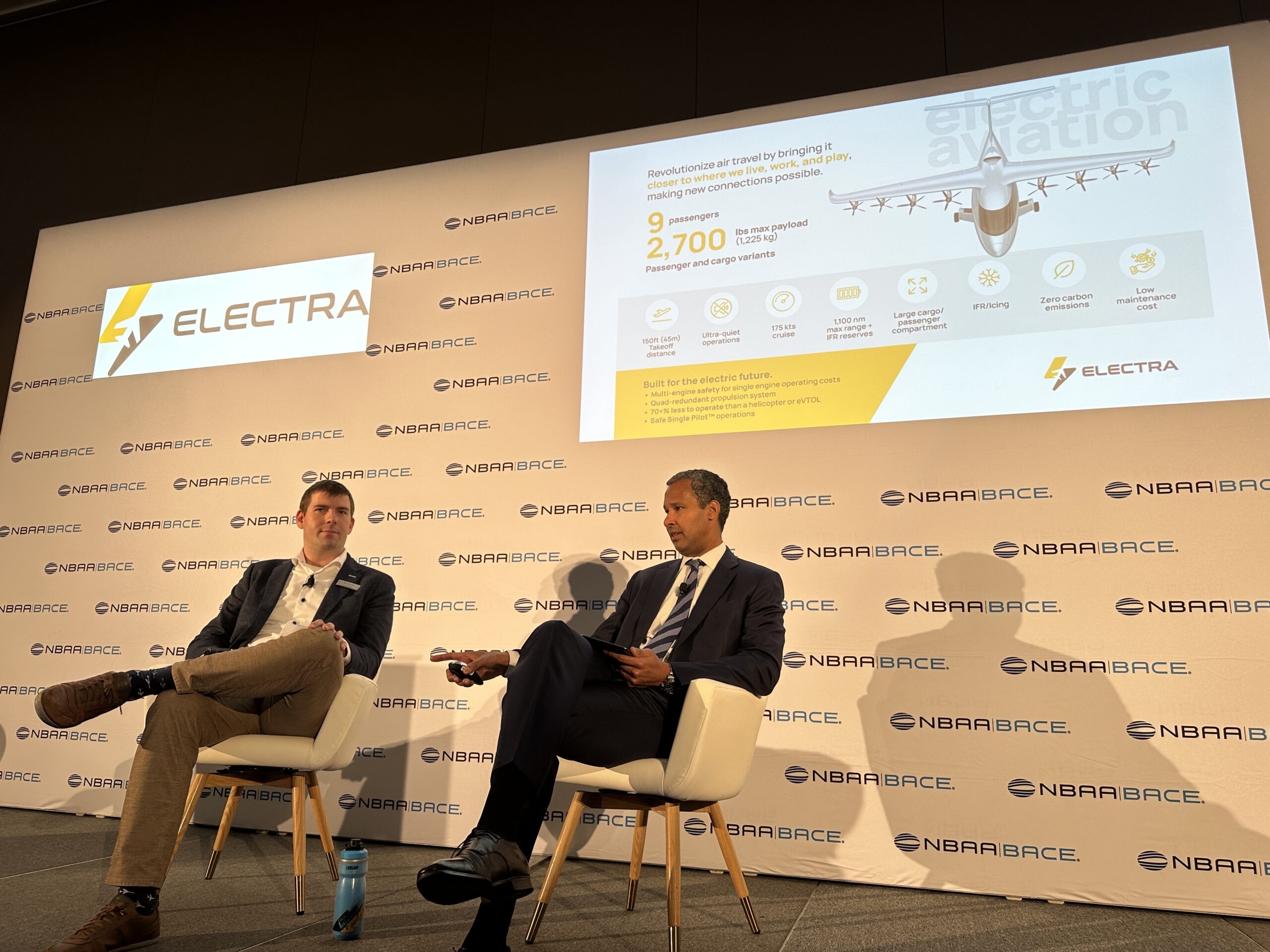
JP Stewart and B.Marc Allen deliver the latest updates on the E9 hybrid electric STOL aircraft program at NBAA BACE 2024. [Credit: Julie Boatman]
Electra Aero and eSTOL
But wait… there was more in store yesterday in terms of truly new aircraft program updates. Though their big reveal of the E9 “G0” test article won’t take place til November 13, Electra Aero’s J.P. Stewart and B. Marc Allen walked the media through the progress of the two-seat demonstrator and its test campaign underway in northern Virginia.
As a fan of short takeoff and landing (STOL) airplanes, I love this concept, which uses blown and distributed lift to enable super-slow takeoff and landing speeds, bringing those distances reliably under 150 feet. Stewart reported that they had the airplane down to 22 knots in flight—and they haven’t found the stall speed yet.
Think about that for a second. I can’t wait to witness the 9-seat version flying, likely next year.
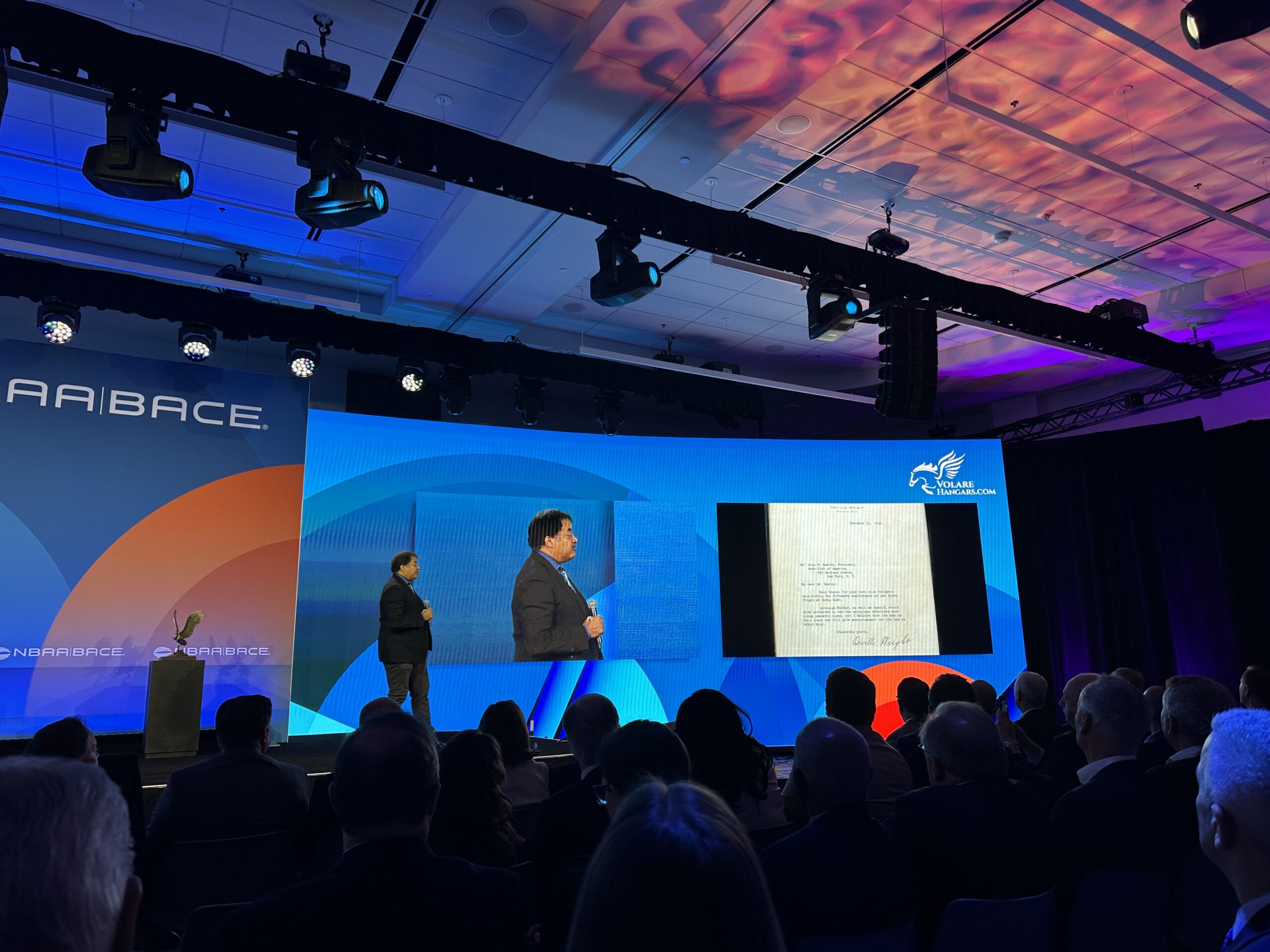
Bombardier founder Laurent Beaudoin and chairman Pierre Beaudoin of Bombardier with Lisa Stark receiving the Meritorious Service Award at NBAA BACE. [Credit: Julie Boatman]In a conversation with Joby Aviation’s Bonny Simi, Neil de Grasse Tyson shows a letter from Orville Wright in highlighting the exponential nature of progress in the aerospace industry. [Credit: Julie Boatman]
Inspiration… in Great Leaders
The other keynotes also touched the SRO audience at the morning session. First, Laurent and Pierre Beaudoin, the father-and-son leaders of Bombardier, received the Meritorious Service Award from NBAA for their dedication to building a benchmark airframe OEM out of a company that manufactured snowmobiles in Quebec in the 1960s.
And Joby’s Bonny Simi—riding a serious high with the SFAR now enabling her to press forward in defining ops and training for the eVTOL OEM—delighted in her conversation with astrophysicist/personality Neil deGrasse Tyson. We all did. Tyson managed to paint with words the picture of his 9-year-old self first seeing the stars inside a planetarium, and feeling so moved that he would make astrophysics his life’s work. I’m putting his book, Astrophysics for People in a Hurry, on my reading list. It’s one of Bonny’s faves, she says. Good enough for me.
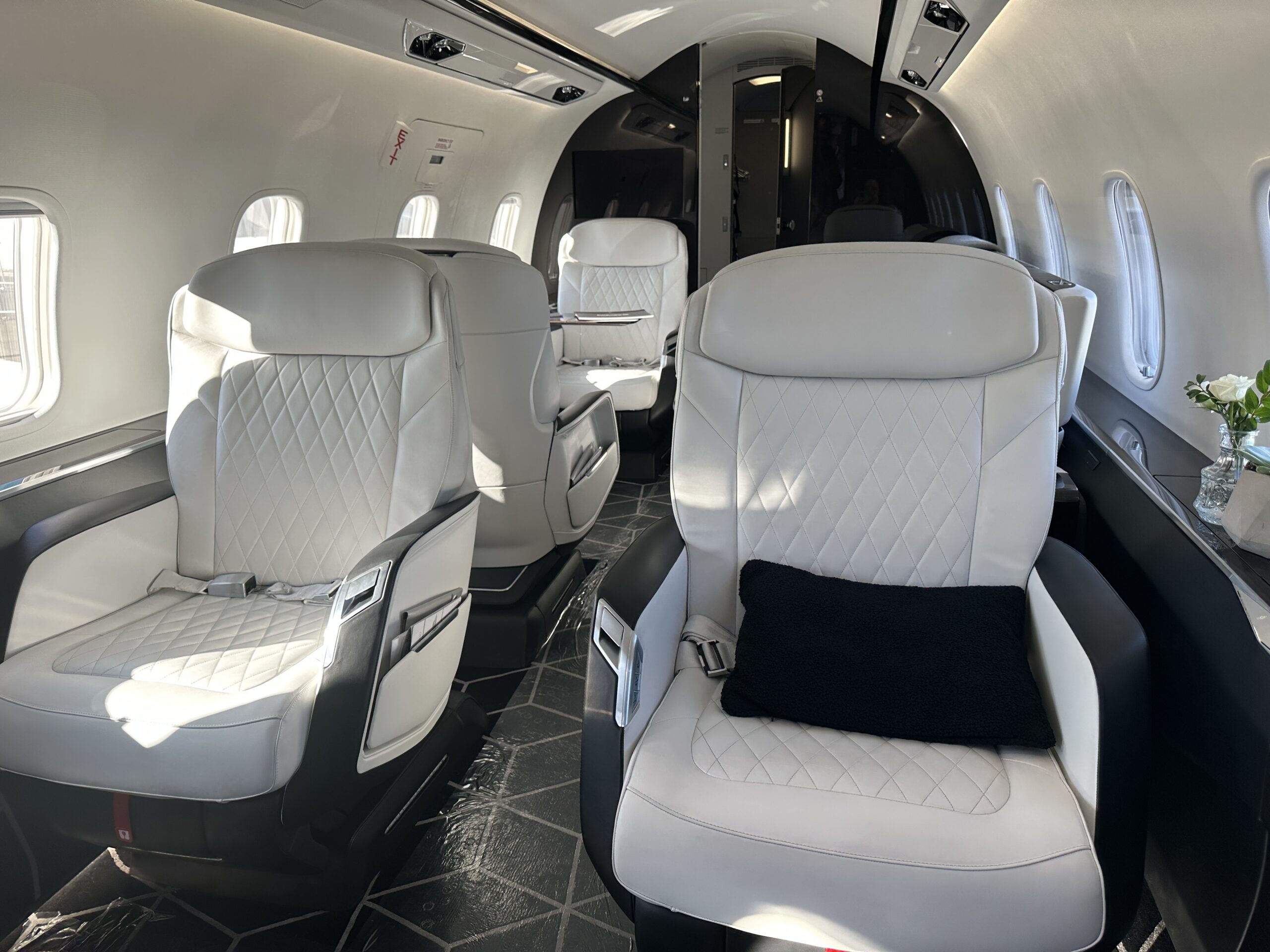
The Bombardier Challenger 3500 at NBAA BACE 2024. [Credit: Julie Boatman]Wiglets form one key part of the wing design on the Challenger 3500 that enable its legendary smooth ride. [Credit: Julie Boatman]The Nuage seating highlights the updated interior on the Bombardier Challenger 3500. [Credit: Julie Boatman]
Inspiration… in Great Airplanes
In the afternoon, I made it out to the static display at Henderson airport (KHND), to meet up with Bombardier’s comms team for an introduction to the Challenger 3500. With this update to the legendary CL-30 type, Bombardier has made a workhorse of the corporate fleet into a thoroughbred. I don’t usually turn right upon entering a business jet, but I needed to try out the Nuage seats that line the bright, well-windowed cabin.
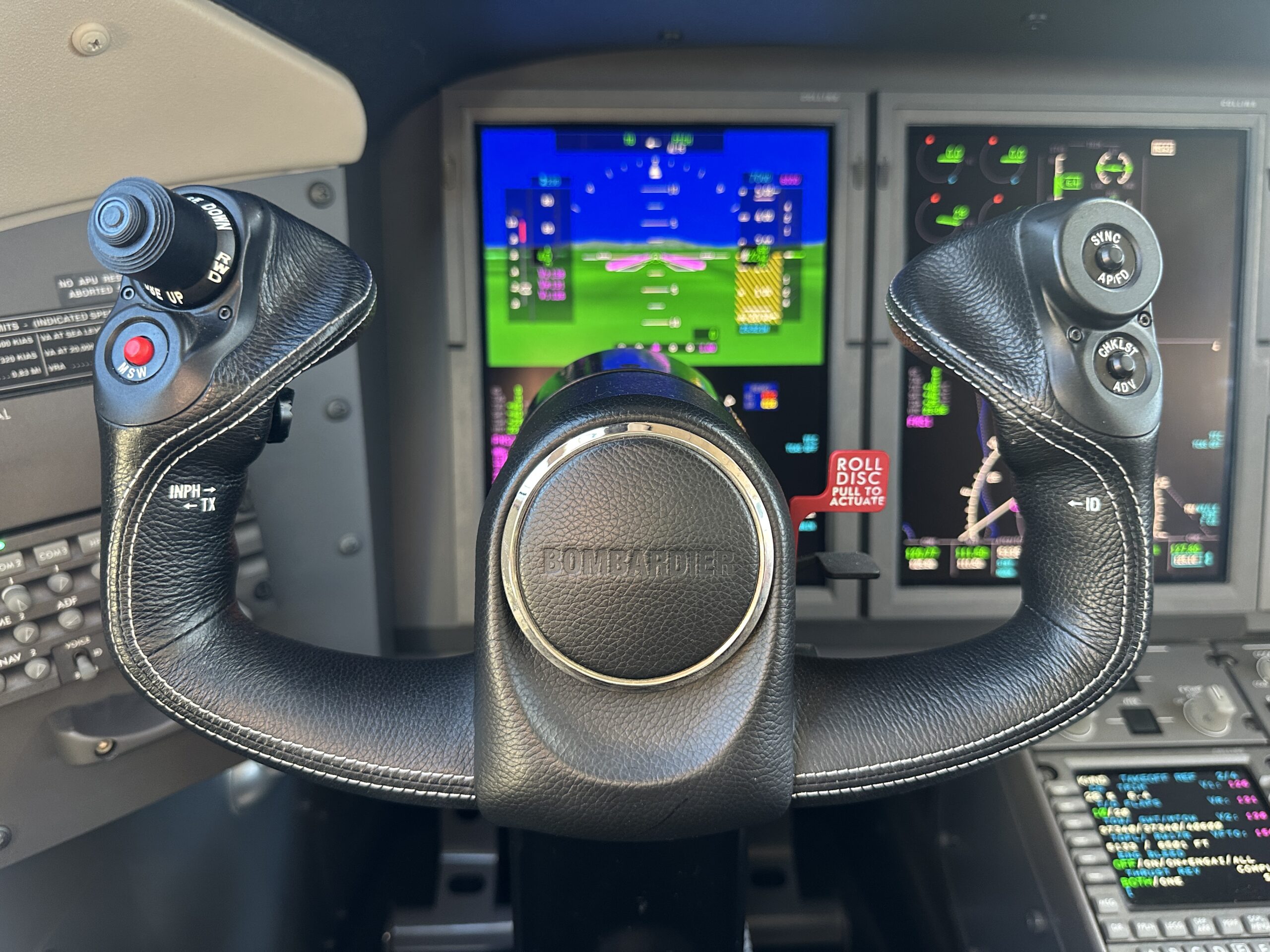
But I didn’t get too comfortable, because demo pilot Mark Ohlau had a tour ready for me of the Collins Pro Line 21 Advanced integrated flight deck. I nestled into the left seat behind the significant and traditional leather-covered yoke, and he walked me through the pilot-centered “dark cockpit,” so well organized that it doesn’t need an overhead panel. Ohlau especially likes the MultiScan weather radar, which has enabled his trips all around the globe in the airplane—including a recent bucket-list approach into Paro, Bhutan.
Stay tuned for a full pilot report to come…
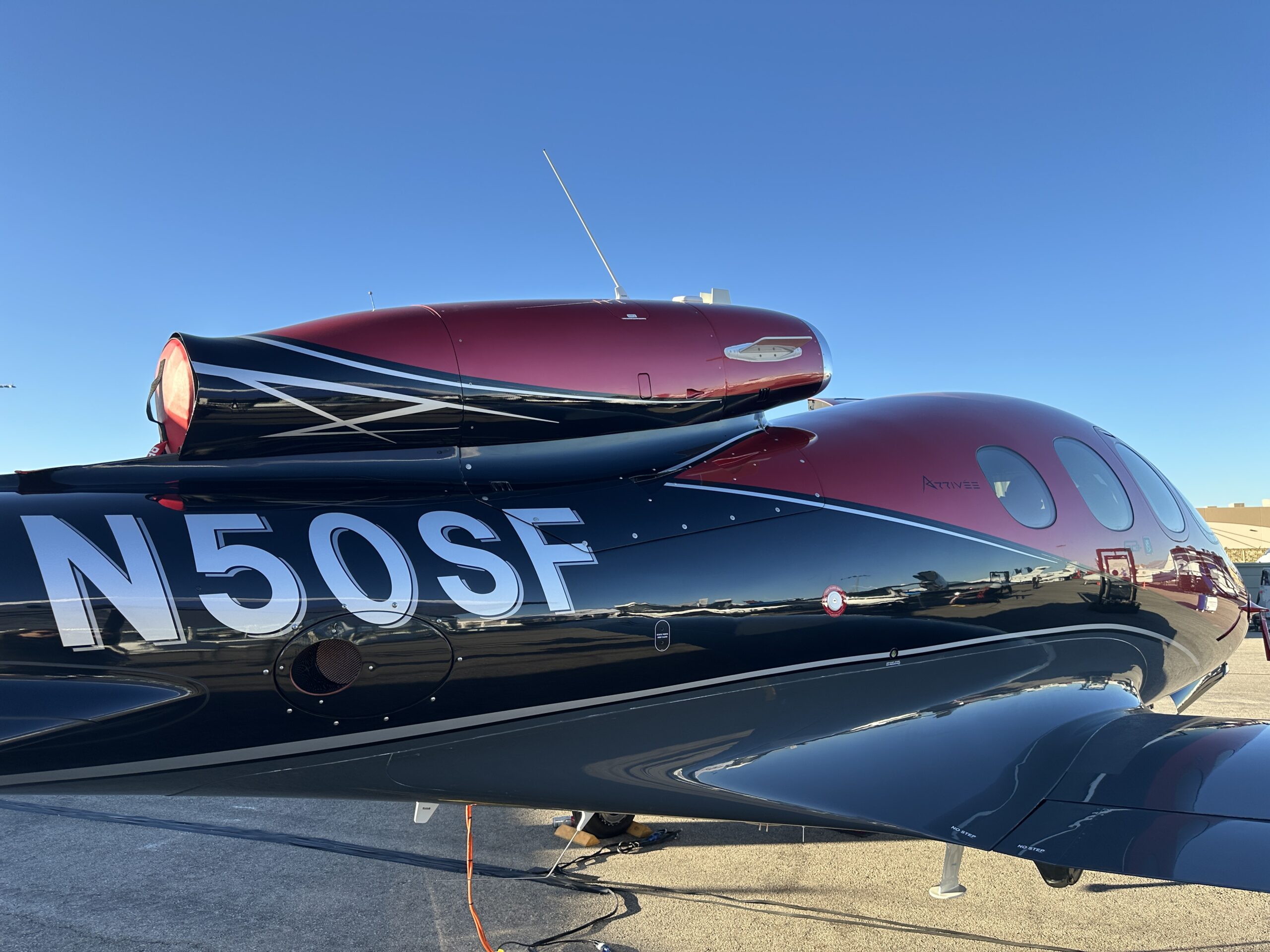
The Arrivée Cirrus SF50 Vision Jet on the static display at NBAA BACE 2024. [Credit: Julie Boatman]The Multi-Mission Daher Kodiak 900 Apex on the static display at NBAA BACE 2024. [Credit: Julie Boatman]
I visited other favorite airplanes on the display, in particular the latest Cirrus SR G7 launch edition, and the SF50 Vision Jet Microsoft Flight Sim edition, in honor of its inclusion in the latest release of that software. I also took some time to admire the latest Daher Kodiak 900, the multi-mission APEX version, with a digital camo paint scheme to suit its Swiss-Army-knife capabilities in the field.
Looking forward to my Day Three at the show…prepping for the Climbing.Fast panel with business aviation leaders who champion the sustainability cause. That facet of BACE kicked off Tuesday morning (early…yawn!) with a panel update co-hosted by GAMA.
I get up that early just to see what stylish (and sustainable?) ensemble Embraer’s Michael Amalfitano has pulled together… always check the socks.
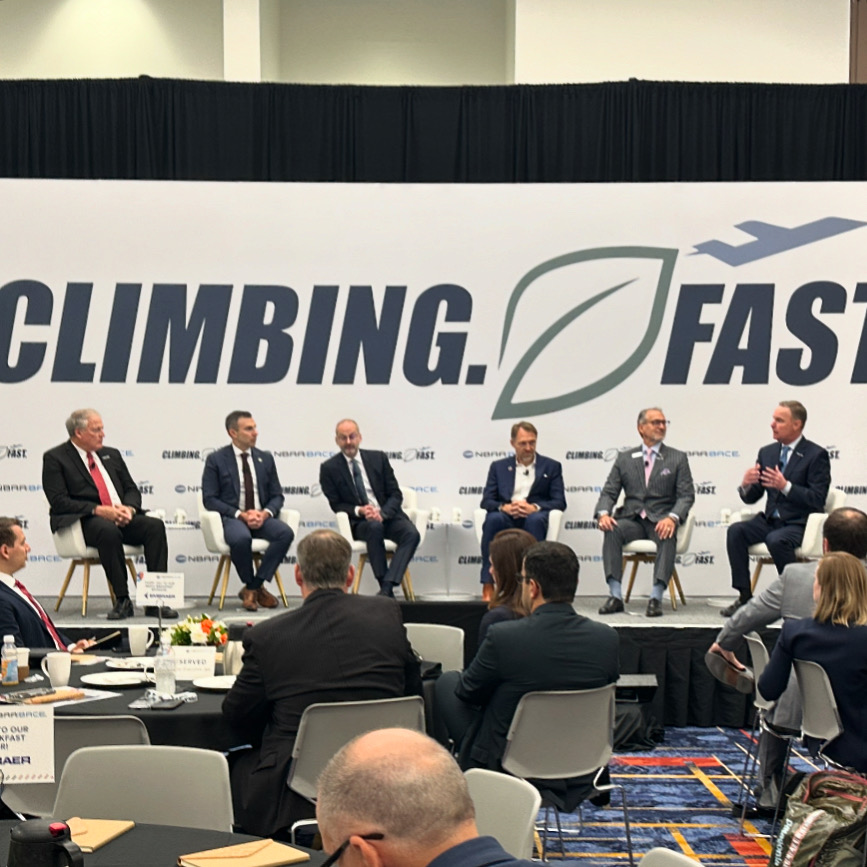
The media breakfast on Tuesday championed the Climbing.Fast. program and progress made on various pillars of the push to net-zero emissions by 2025. [Credit: Julie Boatman]
In times of uncertainty, what do people tend to do? Nothing.
Or perhaps more appropriately, they wait and see. They make incremental changes at most, staying a conservative course until some trigger releases them from this holding pattern.
Though the week will tell if this bears out, that sense of anticipation pervaded on the Monday before opening day of the National Business Aviation Association’s Business Aviation Convention and Exhibition 2024.
“‘I’d say uncertainty is the word right now,” said Rollie Vincent, founder of JetNet, in its annual state of the market briefing on October 21. “Whether it’s geopolitical, whether it’s political, election oriented, whether it’s ‘are we still going to like each other after a certain date on the calendar’…all these sorts of silly things, which aren’t so silly, because they create policy impacts that can drive our industry down, sideways, or in directions we don’t know.”
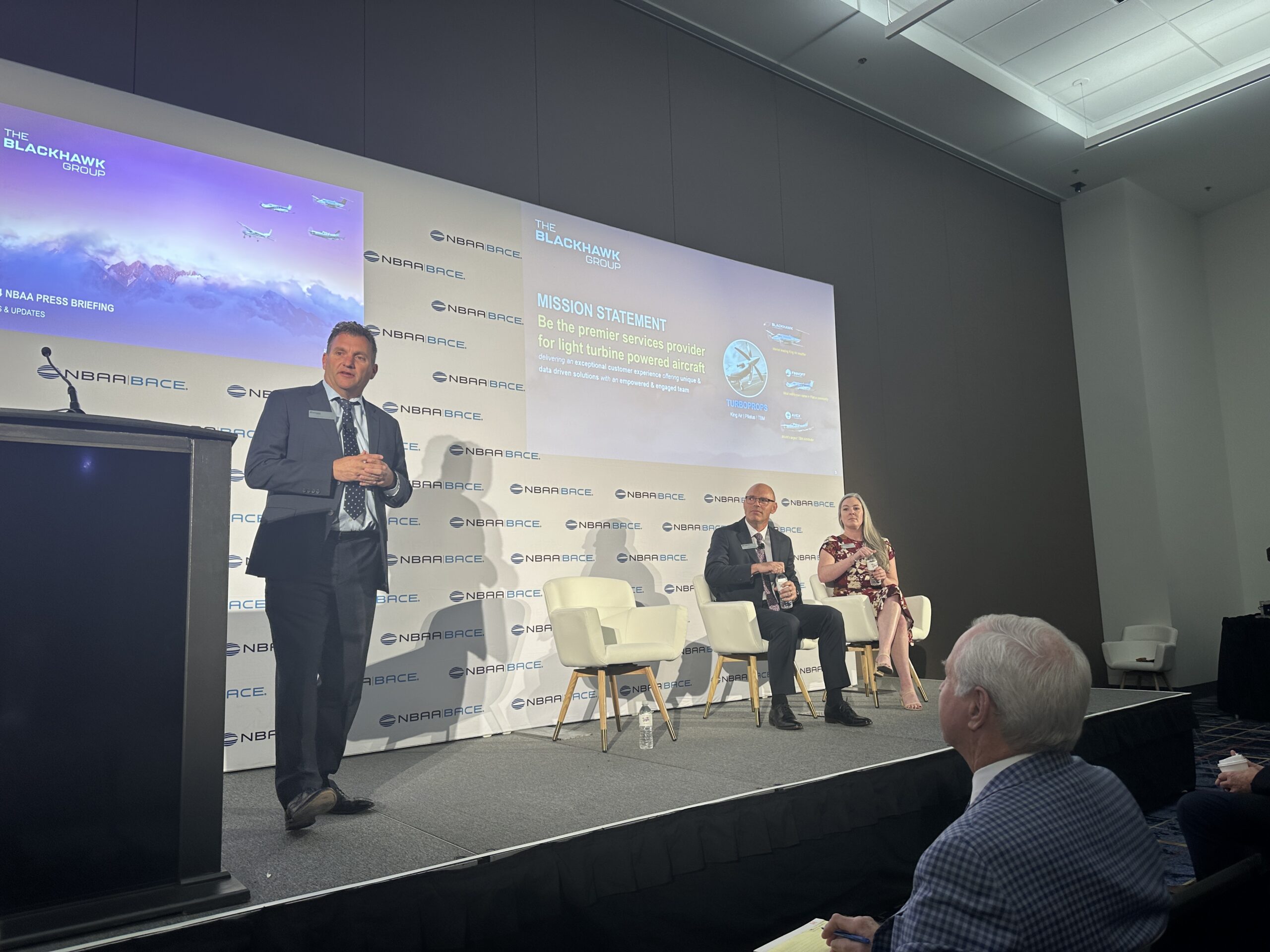
JetNet hosts the launch of WingX’s Global Insight Professional driving data into a concrete snapshot of business jet activity. [Credit: Julie Boatman]Blackhawk Group’s Chad Cundiff introduces a series of new programs that the Blackhawk/Avex/Finnoff association will bring to the market. [Credit: Julie Boatman]Nicolas Chabbert, CEO of Daher Aircraft, describes the customer service approach that has led to top scores in the segment in Professional Pilot surveys for 4 years running. [Credit: Julie Boatman]
Textron Aviation Puts Garmin G3000 Prime in CJ4 Gen3
Under the umbrella of that uncertainty, we still have innovation quietly laboring along, with tried-and-true platforms gaining from those evolutionary efforts. The news from Media Day—when the reporting pool and other associates move from press conference to luncheon to reception in hopes of gleaning stories from that access—bore out that observation.
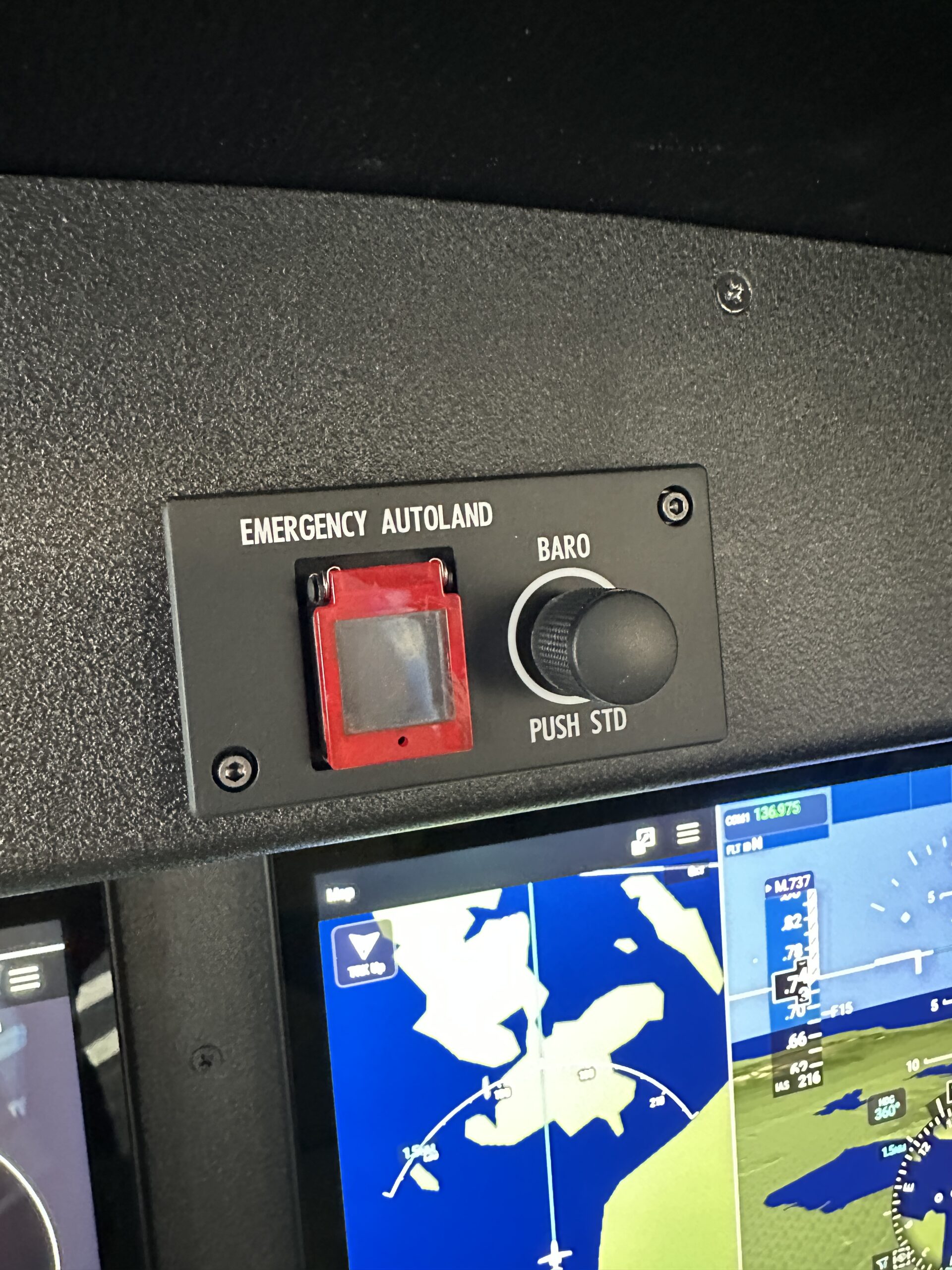
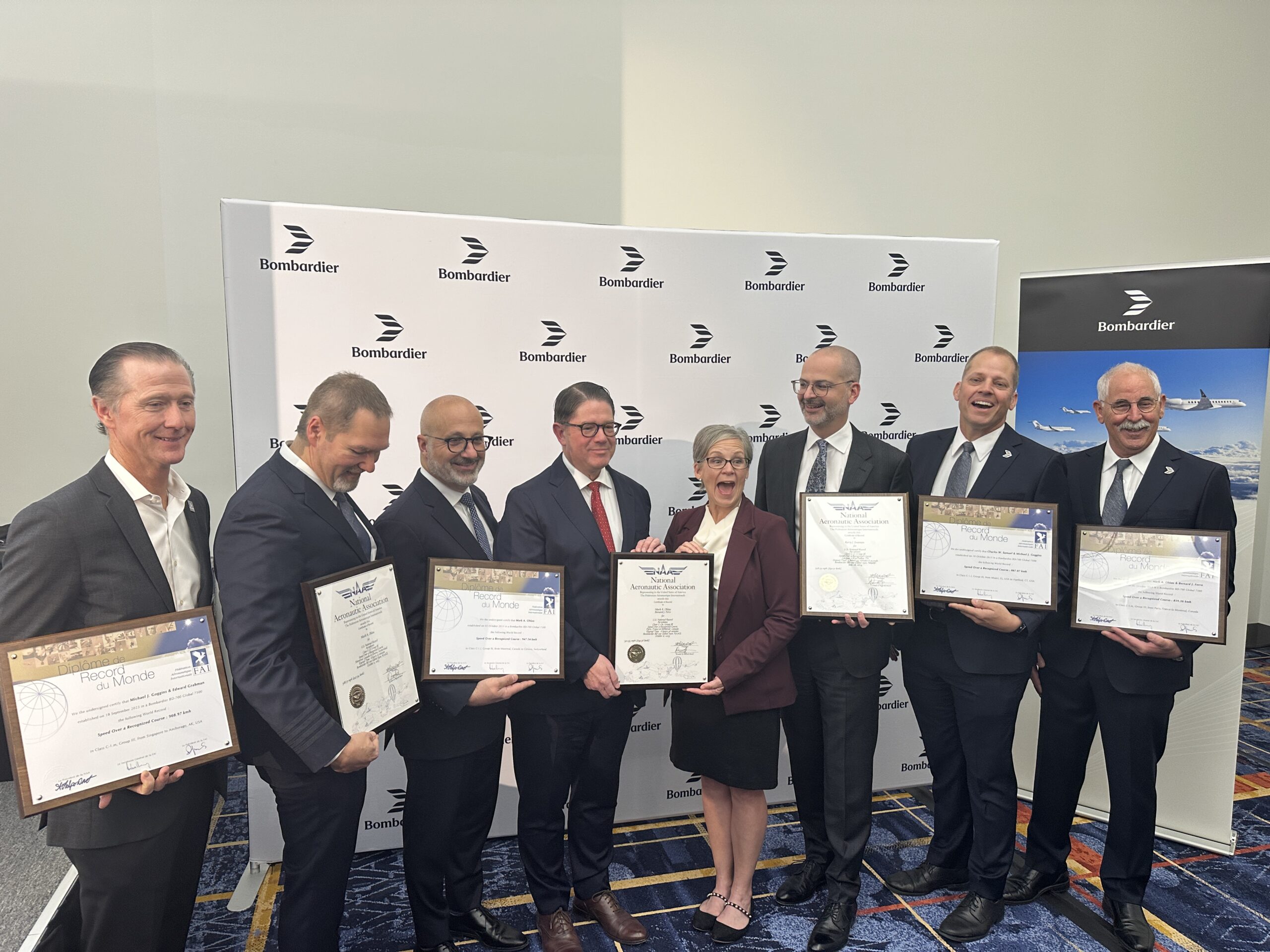
Lannie O’Bannion, SVP of Sales and Flight Ops for TextAV, presents the CJ4 Gen3 model to owner Ryan Samples. [Credit: Julie Boatman]Textron Aviation introduced the Citation CJ4 Gen3 as the launch platform for the new Garmin G3000 Prime flight deck, including Emergency Autoland, a first into the Citation line. [Credit: Julie Boatman]Bombardier’s Éric Martel (center left) and flight test team receive NAA speed records from NAA CEO Amy Spowart at NBAA-BACE. [Credit: Julie Boatman]
Textron Aviation announced the latest upgrades to its 2,600-unit fleet of Citation CJs (the 525 series), with the CJ4 Gen3 as launch platform for Garmin’s G3000 Prime all-touch flight deck, complete with emergency Autoland.
Blackhawk Aerospace Group walked through its turboprop-forward portfolio, including enticing ways to improve the very proven King Air 350, Pilatus PC-12, and TBM 700 series, each with a higher-horsepower flavor of the also-proven Pratt & Whitney PT6A.
Bombardier celebrated its NAA speed-record-setting Global 7500, and the progress on the evolution to the “faster, further, smoother” Global 8000, which has topped Mach 1 in flight test. When certified, the 8000 upgrades can be applied to 7500s in the field—keeping that order book solid for sure.
Daher noted the EASA approval of the 5-blade Hartzell prop on the Kodiak 100, as well as its implementation on float-equipped aircraft. The lower rpm (2,000) of the new prop reduces the noise footprint enough (~6.6dBa) to meet European flyover standards.
In the Newsmakers luncheon, NBAA president and CEO Ed Bolen brings together partners from across the aisle, Sam Graves and Rick Larsen to celebrate the passage of the FAA Reauthorization Bill. [Credit: Julie Boatman]
FAA Reauthorization Celebrated Too
At the Newsmakers Lunch, NBAA president and CEO Ed Bolen hosted congressmen Sam Graves (R-Mo.) and Rick Larsen (D-Wash.), partners on the Transportation and Infrastructure Subcommittee as chair and ranking member, in a recap of the FAA Authorization Bill and all of the wins tucked inside of it. There should be no uncertainty here… the bill passed with very little opposition. “I feel strong that we have the basis, regardless of which administration is the place, to say we’re very clear about what we want to get done,” said Larsen. “And so, it’s a matter of implementation. It’s not a matter of ‘do you want to do it or not do it?’ You do it—we made that clear.”
And while we’re waiting for the door to crack open on bigger news this week at the show, at least we have that message in place regardless of the election’s outcome next month. And maybe there is more to each of these nuggets of progress to discover—we’ll be diving into each one more deeply in the coming weeks.
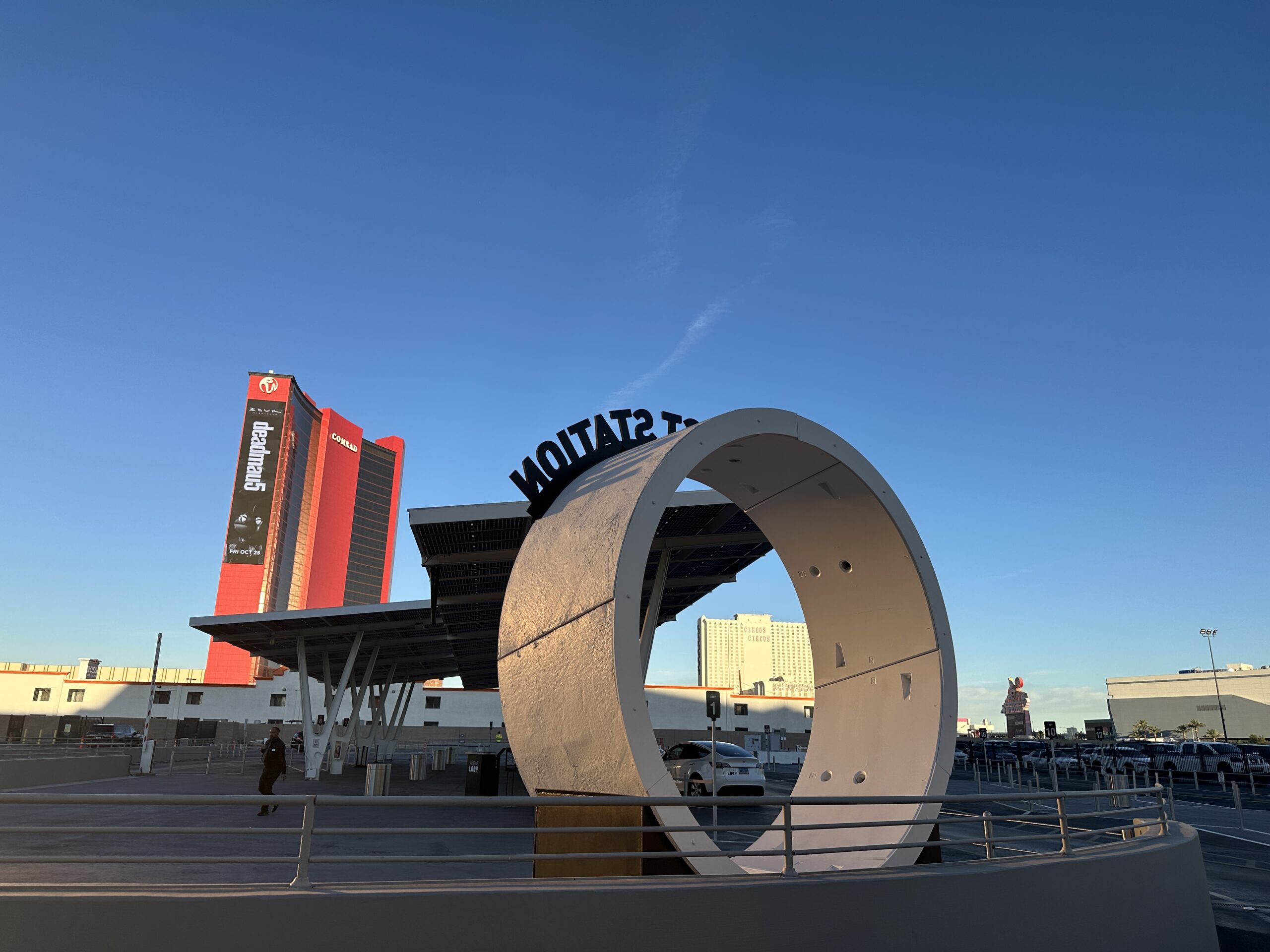
A quiet space can be found in Vegas. [Credit: Julie Boatman]