A Disaster at DCA, 77 Years Later


A look at history reveals the deeply embedded congestion issues confluenced with the pressure to utilize a close-in transportation hub.

I’ve been on that flight, essentially, more than a couple dozen times.

A direct Piedmont Airlines, or Envoy, or SkyWest flight into Washington National airport—KDCA—from some point on the map. Often Charlotte or Chicago, but also LaGuardia, Chattanooga, and Philly.

And Wichita, too.

So I’ve had ample time to contemplate both sides of the equation in the steep ramp-up in flights that American Airlines and others have made into DCA over the past three years. There’s the me that wants to get directly to where I’m going, and the me that has done a double-take at the stacking of aircraft on crossing taxiways and runway ends that it apparently takes to accommodate that increase in flights.

I took a picture once because I thought for sure a runway incursion had at least a 50/50 chance.

A snap from the window seat of a CRJ waiting to take position for Runway 19 at DCA in Washington, in February 2023. [Credit: Julie Boatman]

I took other pictures because at its heart, I love DCA, though because of 9/11 I never have flown into it as PIC. I love the River Visual, the finesse it takes to stick the landing, and the central location. The close-in economy parking. The quick check-in by the North Security area.

But it turns out, DCA has been an accident waiting to happen for a long time. In fact, an accident similar to the one in which a PSA CRJ700 collided with a U.S. Army Black Hawk helicopter that took 67 lives last January 29 happened there, in the late 1940s.

After a nighttime landing at DCA, in February 2023. [Credit: Julie Boatman]

Eastern Air Lines in 1949

Eastern Air Lines Flight 537, N88727, was a Douglas DC-4 aircraft en route from Boston, Massachusetts, to Washington, D.C., by way of a few stops on the old airmail route on November 1, 1949. But a horrifying accident took place near the approach end of Runway 3 (now 4) at Washington National that day. The DC-4—often taking on the role of regional airliner in that day—struck a military aircraft. This time it was a P-38 Lockheed Lightning undergoing an acceptance flight test trial for the Bolivian Air Force.

At 300 feet and a half-mile from the threshold, it killed the 55 passengers and crew aboard the DC-4 and—amazingly—only seriously injured the pilot of the P-38, a Bolivian national by the name of Erik Rios Bridoux.

According to the Wikipedia entry, “at the time, it was the deadliest airliner incident in United States history.”

But even with that dramatic loss of life in the heart of the nation’s capital, it wouldn’t be the trigger that set in motion real change in the governance of aviation in the U.S.

What Does It Take to Make Real Change?

That distinction would go to the much more well-known Connie vs. DC-7 mid-air that took place over the Grand Canyon in 1956, which took the lives of 128 people between the two aircraft.

There’s a symmetry here: a keystone accident preceding the bigger one that turned out to be the last straw.

The 1956 mid-air has long been identified as the catalyst for creating a federal aviation agency with coordinated national air traffic control—now the FAA. Perhaps the accident on January 29, 2025, is the similar catalyst that help mitigate issues of congestion and staffing shortages at one of the nation’s most critical airports. Because it does not compute that the denizens of D.C. (myself included) will want to give up their direct flights, regardless of their political clout.

But it can’t be a catalyst without continuous funding support for ATC, disentangled from the machinations in D.C. As Rep. Rick Larsen, D-WA, ranking member of the House’s Transportation & Infrastructure Committee, said in December 2025, “We have to avoid history repeating itself.” 

The Aviation Funding Solvency Act (HR 6086) is part of the current proposition to achieve this goal. It “provides continuing appropriations to the Federal Aviation Administration (FAA) if (1) an appropriations bill for the FAA has not been enacted before a fiscal year begins, or (2) a law making continuing appropriations for the FAA is not in effect,” according to the entry on congress.gov.

During the National Transportation Safety Board meeting on the PSA/BlackHawk mid-air on January 28, the NTSB reviewed several recommendations it would make within its final report, most pointing the finger at the FAA for issues of system and culture that persist at DCA. 

So far, only one has already been addressed—the rendering permanent of the TFR closing the helicopter route that placed the Black Hawk in the path of the PSA CRJ700. The remainder hangs in the balance as we teeter towards another government shutdown—particularly if HR 6086 doesn’t come to fruition in advance of that stoppage.

We have the technology tools to help mitigate one cultural issue—the regular reliance on visual separation by the DCA control tower. With the final report yet to be released, we can push for the increased staffing that will almost certainly boost sagging morale, and potentially decrease persistent mental fatigue levels amongst our friends at ATC.

While the DC-4 disaster at DCA didn’t prompt change back in 1949, perhaps nearly 77 years later we’ll see a hauntingly similar regional-and-military mid-air lead to real solutions. Surely we’ve come that far along in all of those years.

The TBM 980 Captures a New Era

A Daher TBM 980 single-engine turboprop airplane in flight over the mountains in southern France, with a charcoal grey top and white base with flash orange accents.

With the snow capping the Pyrenées to the south, my last visit to Tarbes took place on a chilly day in November 2021. I was meeting up with Margrit Waltz, who readied a new TBM 940 for its ferry flight across the ocean.

At the time, I didn’t realize that the next TBM had already moved onto the production line, the serial number (SN) that would become the first TBM 960. That model debuted in April 2022, and I had a chance to fly it from Sun ‘n Fun Aerospace Expo down to Daher’s then HQ in south Florida, at KPMP, Pompano Beach.

Now, nearly four years later, Daher debuts its latest, the TBM 980, and what looks like a similar aircraft has changed significantly under its gorgeous skin.

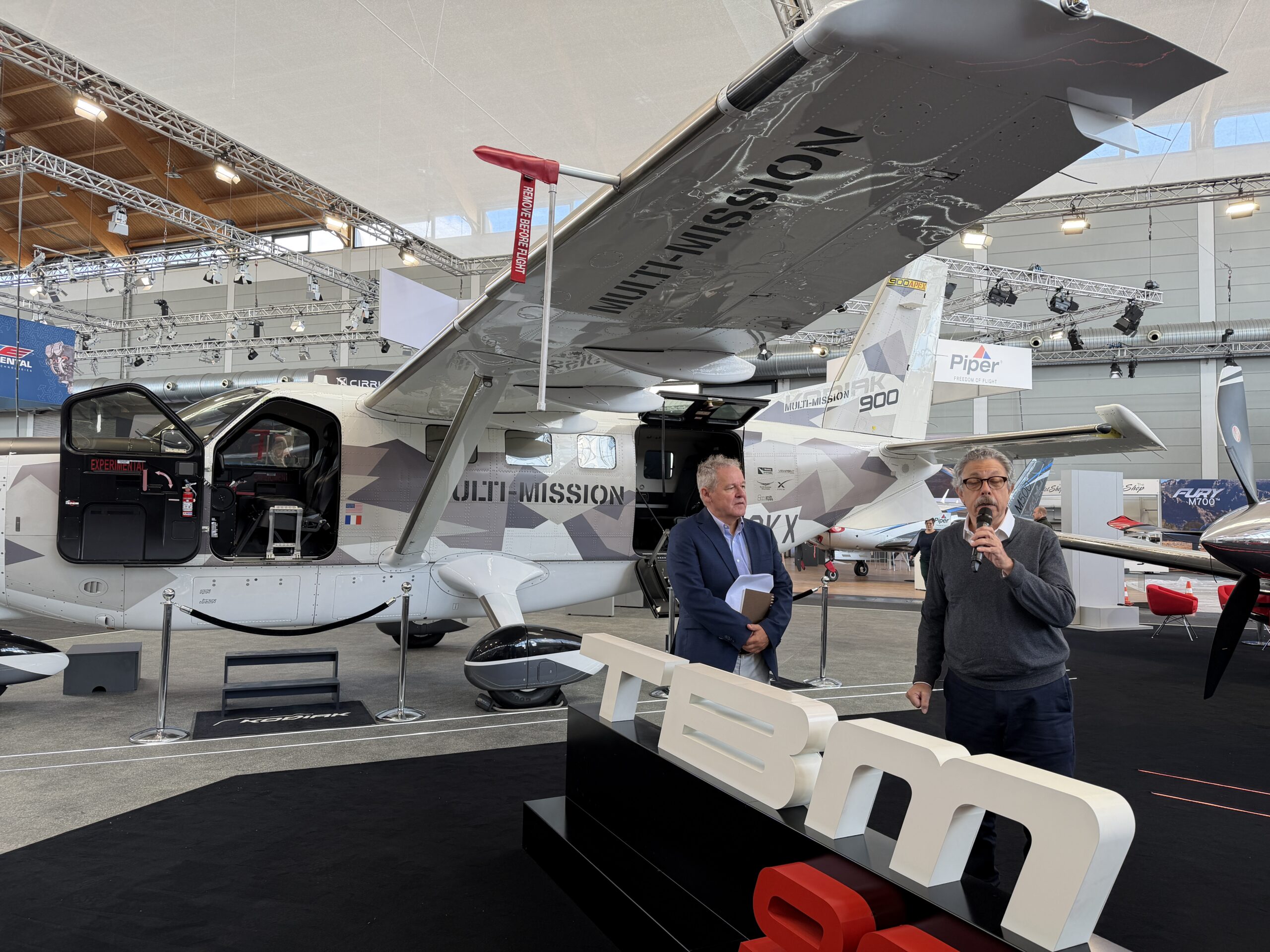
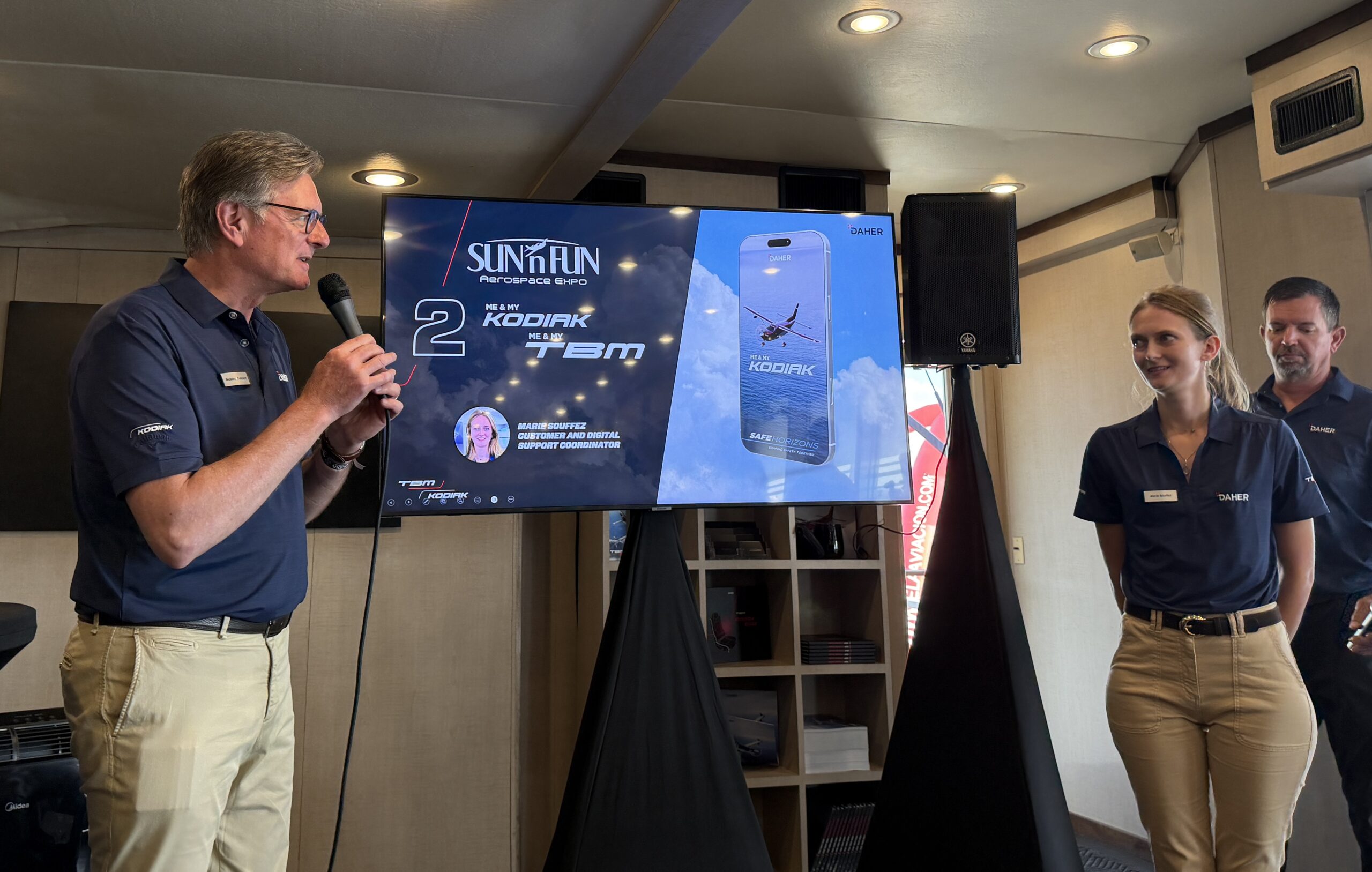
Similiarly, Daher may look like the same company if you just glance at the buildings collected on the ramp at LFBT, but so much has changed. The company has three locations now in Florida—at KSUA where the TBM will soon be built on a new line, and at KFLL where the new U.S. headquarters is located. And the Kodiak’s home base in Sandpoint, Idaho, now churns out Kodial 900s as well as the 100 Series III.

And…just in time to kickoff 2026, the TBM 980 takes the stage.

The sixth 900-series turboprop launched by Daher since it took possession of the aircraft model line in 2014, the TBM 980 integrates the Garmin G3000 PRIME that the avionics OEM debuted in late 2024 on the competing Pilatus PC-12 Pro. But this is more than a makeup game. The G3000 PRIME replaces the previous G3000 with three 14-inch touchscreens and app-based functionality to evolve the flight deck experience to match what most pilots carry in their pockets.

The first integrated flight deck into the TBM series took off when Garmin and then-SOCATA signed the contract to put the G1000 into the TBM 850 at NBAA 2005. It was the beginning of the end of “federated” avionics—the separate boxes that worked in concert that we used to know so well.

Twenty years and 1,000 TBMs later, the flight deck now integrates into the pilot’s life. “When you pick up an iPad, you don’t read a manual, you pick it up and use it intuitively,” said Nicolas Chabbert, Daher Aircraft CEO, at a livestream event on Thursday, January 15, in the evening from Daher’s main hangar in Tarbes. The PRIME drives closer to that mark than any flight deck thus far.

The presets are contextual, allowing for the phase of flight to drive them. And that’s just the beginning. There’s a joystick to aid in selection, rather than a button for scrolling, and the ability to check in on the airplane remotely via Garmin PlaneSync.

Guillaume Remigi, test pilot, said at the event that the biggest surprise he discovered during flight test was how much he appreciated the touchscreens. Rather than being a novelty, they became natural and intuitive, he found.

Another operational improvement sure to be well-received by pilots is the ability to operate without adding Prist to the fuel. The Prist-free option had to be validated in hot and humid weather conditions, so the test pilots related during the livestream how they flew to Agadir, Morocco, leaving the aircraft outside overnight, experiencing temperatures ranging from +40C to -50C in the desert, and up to 90 percent humidity on the coast.

An enhanced interior features a new passenger display through which the folks in the back can see flight data… Chabbert likened it to Concorde, though perhaps not into the Mach numbers!

The new TBM will be Starlink Mini-capable, and to preview this, Daher’s Michel Adam de Villiers and longtime TBM pilot and superfan Dr. Ian Fries called in during the event from in-flight over Florida. Fries is the first publicly announced customer to purchase the TBM 980, which will be SN 1634, ready in March—Number 6 for Dr. Fries. That said, SN 1627 and SN 1628 are already poised to depart for their first customers.

Frankly, I can’t wait to get my hands on the new yoke—and on the touchscreens—either.

Garmin’s Autoland Activation in the Wild

Canva filter in purple and neon orange with Autoland sequence display shown on a display in an instrument panel.

I’ve been thinking about the first activation of the revolutionary Garmin Autoland system “in real life” for more than a week.

I recall clearly sitting as a silent witness to the compelling initiation and execution of the Autoland sequence several years ago. A couple of times, in fact.

Both of these activations happened in demo mode and were not the full “in the wild” experience. The first took place before the system was certificated, at Garmin’s flight department headquarters at New Century AirCenter (KIXD) near Olathe, Kansas, in August 2019, in a Piper M600 modified for testing.

My second experience took place in the Beechcraft King Air 200 used as the test bed for the currently deployed aftermarket system on that airframe, away from Garmin’s home base, and with a Garmin flight demo pilot in the left seat, and me in the right seat. The tower had been advised of the demonstrations taking place, but we otherwise slotted into the regular stream of traffic at a busy airport. No total clearing of the airspace took place, because it was understood by ATC not to be an emergency.

You can see essentially the same demo I sat through here, on AvBrief.com.

A lot has been said about the circumstances surrounding the event, which happened over the Rocky Mountains on December 20, 2025. That activation occurred not with a push of the guarded Autoland button, but when the pilots of N479BR [operated by Buffalo River Aircraft Services] experienced a pressurization emergency at 23,000 feet after taking off from Aspen (KASE). The Garmin integrated system sensed the loss of cabin pressure and activated the Emergency Descent Mode (EDM). The EDM protocol commands a descent to 14,000 feet. If no response is sensed from the pilots after 60 seconds of inactivity, the Autoland system engages thereafter.

The pilots of the ferry flight had no passengers on board, and elected to allow Autoland to progress to its conclusion, which ended in a safe, apparently textbook approach and landing at Rocky Mountain Metro Airport (KBJC) in Broomfield, Colorado.

My friend and colleague Max Trescott happened to be flying in a Cirrus SF50 Vision Jet in Colorado at the same time as N479BR activated Autoland, and he managed to record much of the comms on Guard, sharing this with listeners on the podcast NTSB NewsTalk he produces with another former colleague of mine, Rob Mark.

As it turns out, the King Air leveled at 18,000 feet instead—my assumption is that the aircraft stopped at 18,000 feet because of MEAs along the mountainous route, until you reach the relative flatlands of the Front Range near KBJC. The audio that Max replays on the podcast illuminates one interesting situation for pilots who remain conscious and compos mentis during the Autoland engagement: The crew reported they could only transmit on Guard; it’s true that a pilot (or passenger) can’t change the radio frequency once activated—you’d need to disengage Autoland in order to do so, and recommence flying.

Autoland can easily be deactivated by pressing the autopilot key on the a/p control panel, or the a/p disconnect switch on the pilot’s control yoke or stick. So, the question on many a commenter’s mind is why the pilots rode the system out to its conclusion rather than disengaging Autoland once they were descended below 14,000 feet msl. Some bemoan the giving over of command to the system too easily—and the potential for piloting skills to erode further as we let automated systems handle the hand-flying to a greater and greater extent.

While my experience in high altitude ops is limited, I can’t help but think back to a cross-country flight I took back in 1995 in a friend’s Cessna T303 Crusader—you don’t hear enough about these classy airplanes imho—where we elected to fly at FL250 on oxygen masks headed from Colorado to Chicago. As a climber and well acclimated by years of living at 10,000 feet, my friend in the left seat took off his mask and ate lunch while I stayed on the gas and the controls from the right. About 5 minutes later, he donned the mask again, and I took my turn.

I got about three bites into my granola bar when I found I couldn’t chew anymore. The hypoxic effects took only that long to sink in. So yes, a pressurization event at FL230 is no joke to me. After years of flying in Colorado, I know hypoxia is insidious, and that a pilot can feel giddy and overconfident as a result. That would lead me to choose to monitor a fully and correctly functioning Autoland system while I monitored my own condition and that of the airplane while on supplemental oxygen. That’s me.

Frankly, I’m more surprised the first irl activation took this long to occur. As a corollary, the Cirrus SR20 obtained certification on October 23, 1998, and the first Cirrus Airframe Parachute System (CAPS) “save” took place not quite 4 years later, in an SR20 on October 3, 2002. Autoland gained its first cert on the Piper M600/SLS Halo in May 2020—so we took 5.5 years for that fateful button push. And that’s for a system you can reset. Once a CAPS is deployed, the cat is out of the bag, literally.

I think about it this way: The Autoland sequence began at an altitude where pilot incapacitation remained a serious concern. With the system flying the airplane, the crew could focus 100 percent on their own health, and running checklists and other troubleshooting, maintaining greater situational awareness. In your everyday flying, if the autopilot is making a coupled approach well, do you click it off just to prove you could hand fly the airplane?

We have a conscious choice to keep our skills from eroding in the face of a capable “auto-whatever,” whether it’s CAPS or Autoland or just a really great autopilot. The advent of tools that leverage technology requires more from pilots than just accepting them carte blanche and allowing them to take over every time. And we need to practice our hand-flying skills regularly.

But during an abnormal or emergency situation, when you need to access all of the resources at your disposal, it surely makes sense to me to keep Autoland engaged as long as it’s performing as promised.

There’s always the little red button on the yoke.

Happy 90th Birthday, DC-3

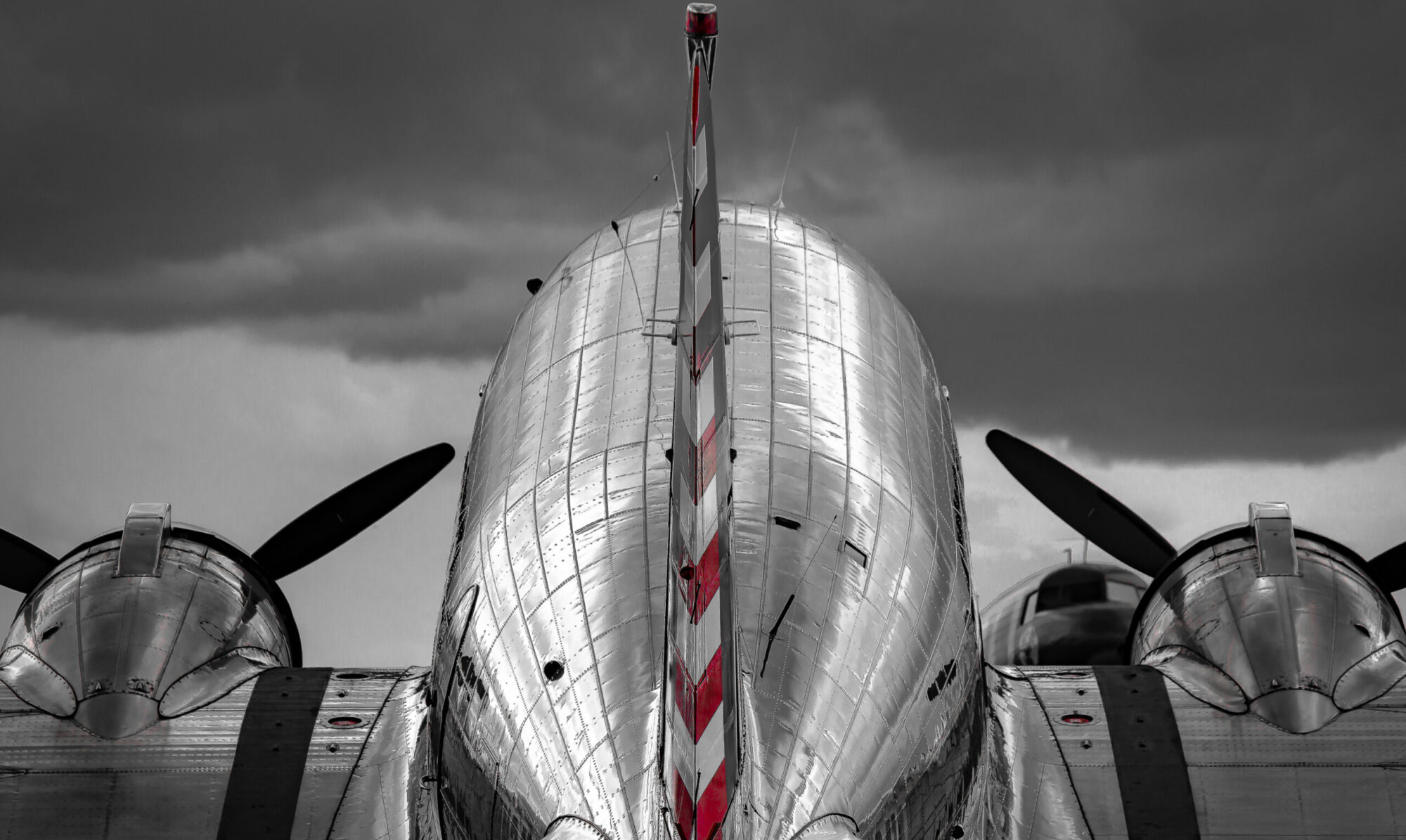
A polished silver and blue Douglas DC-3 twin radial engined airplane sits on the green-brown grass at an airfield with a blue sky and clouds behind.

For the past 20 years, we’ve celebrated December 17 in our household a little differently than most aviation enthusiasts and pilots, who rightfully note the Wright Brothers’ achievement of powered, controlled flight in 1903.

Even if you are from the segment of folks who question the Wrights’ place in history to the extent it has been sanctified, you cannot question that the first flight of the Douglas DC-3 line, the inaugural Douglas Sleeper Transport, took place on the afternoon of December 17, 1935. Carl Cover, the chief pilot and commander of the test flight noted it in his logbook. He was not prone to hyperbole, so NX14988 sits on a single line there without fanfare.

The cool, clear day heralded the uneventful flight, and the airplane itself went on to delivery to American Airlines a few months later.

You can read all about it in my story posted by our friends at Vintage Aviation News, “The Mighty Douglas DC-3 Celebrates 90 Years Flying.”

Tomorrow, we’ll also be hosting the “Throttle Thursday” installment of the DC-3 Society’s 90th Anniversary commemoration week, with a great line-up of DC-3 pilots and crew, including Nicholas Cerretani, Paul Bazeley, Brooks Pettit, Sergio Alen, Mark Stewart, and Daniel Wotring.

Check it out here, or drop me a note and I’ll send you the Zoom link and password.

However you celebrate DC-3 Day, lift a favorite glass (filled with scotch if you’re a Douglas) to toast the man who made it possible, and the crew that flew the DST that glorious day.

A view of the Santa Monica airport in the 1940s in black and white from above, with the runway 21 numbers at the near end of the image, looking out towards the Pacific Ocean. Manufacturing plants line both sides, and aircraft wait on the ramp.
The Santa Monica Municipal Airport, known as Clover Field, was a bustling place in the 1940s, for Douglas Aircraft Company, which launched the first flight of the Douglas DC-3 model here. [Credit: Julie Boatman Archives]

The Real Story on Better Avionics Simulation

A Flight1 Tech AATD emulating a Cirrus SR series airplane with a wide screen, instrument panel and overhead CAPS assembly to replicate pulling the airframe parachute.

“When it comes to learning advanced integrated avionics, the airplane is perhaps the worst place to learn. But the right simulator is the better option for obvious reasons, and not all are created equal.”

What’s the scoop behind the claim? Calvin Fraites of Flight1 Aviation Technologies joined The Smart Aviator’s Larry Anglisano on AvBrief. com to explain just what this means and how both flight schools and private owners can incorporate robust simulation into their regular practice as well as pursuit of certificates—especially the instrument rating—in Cirrus SR Series and Piper PA28 aircraft equipped with the Garmin Perspective and G1000 NXi.

A screenshot of an AvBrief.com thumbnail with the YouTube icon over images of a flight sim instrument panel and a Cirrus G7 airplane.
Flight1 Tech’s Calvin Fraites joined Larry Anglisano of AvBrief.com on The Smart Aviator podcast on November 5, 2025. To visit the podcast, go to the AvBrief website.

We’ve been working with Flight1 Tech to promote its AATDs because I’ve seen how well they work within the flight training organizations with which I’ve collaborated over the years. I’ve known founder and president Jim Rhoads since my days at AOPA, when his company built the Cessna Cardinal model for Microsoft Flight Sim that accompanied the AOPA Sweepstakes Catch-a-Cardinal.

Since then, Flight1 Tech’s FAA-approved AATDs have evolved to emulate faithfully the Cirrus SR series, complete with Garmin’s Perspective+ and CAPS (Cirrus Airframe Parachute System) deployment, and the nuances of the PA-28 based on Jim’s longtime ownership and piloting of his own Piper Cherokee. Now, the modern version replicates an Archer with Garmin’s G1000 NXi avionics suite.

For training that sticks, you need an honest rendering of the instrument panel and associated hardware, and Flight1 Tech does it in a way that keeps it low cost and approachable for a wide range of flight schools as well as private owners.

Take a look, and if you want to see more, visit their web site.

NBAA 2025: Hall & Static

A closeup of the Citation Ascend placard and the nose of the jet.

Trying to re-vision a massive event like NBAA’s BACE—the association’s largest annual gathering—takes time as well as overcoming a lot of inertia, both institutional and across the industry.

With a long-term agreement signed with the Las Vegas Convention Center, NBAA is constricted in its ability to revamp the conference, but it made valiant efforts to do so this year, and try to bring value to the members of the association and the companies and customers they serve.

I found the most value in the meetings, the networking, and the chance conversations that only bringing together a lot of disparate folks in person can do. And that’s really why bizav exists, really, that gathering people together, face to face.

At one point on the exhibit hall floor, I was in a gathering of random friends I knew from no less than 3 prior corporate engagements. No one can plan that kind of synergy.

By necessity, the exhibit hall floor was smaller, less full, as well as the static display, with fewer aircraft overall (and a wind/duststorm on Tuesday that drove people away from KHND). But there were some big players there (Gulfstream, Bombardier) as well as new entrants (Epic in a sleek, super-black E1000 GX). In fact, black was a bit of a theme, with Daher’s Kodiak 100 showing up in stealth colors as well.

The new Citation Ascend from Textron Aviation made the scene too, and its upgrade from the XLS (though it shares the same type rating, as I was assured) looks pretty spiffy. I can’t wait to fly it. Someday. Maybe I’ll get a chance to do some other Citation flying when the next Special Olympics Airlift comes around—in June 2026, into Minneapolis-St. Paul. It will be my fifth SOA if I can make it happen.

In talking with colleagues from around the bizav space following the show, there was good energy—the dynamic duo of Dierks Bentley and Steuart Walton at the keynote was a high point. I wonder how many downloads/streams of “Drunk on a Plane” or “Riser” happened from that GPS location on the Strip immediately following the keynote… I admit I claim both of them.

All in all, this was still a show not to miss. I found a lot of value in networking and will come away with new business and strengthened relationships across the board.

But the slimmed-down versions of most exhibitors seemed to serve them well too. Your thoughts?

NBAA 2025 Media Day: A Pretty Crazy Year

Looking out of the 12th floor of a hotel in Las Vegas at the sun rising over the mountains to the east, sun just breaking the horizon.

The unofficial kickoff for the annual BACE in Vegas included reflections from all corners of the business aviation industry in a quest to make sense of a challenging, changeable time.

For those of us coming in from the East Coast, or Europe, the sun doesn’t rise quickly enough in Las Vegas. As usual, I woke up, sans alarm, at 4:57 am, ready to roll. Fueled by Tacos El Gordo from the night before, the action began at 7:30 am and did not conclude until I walked “home” from the Honeywell media event at the Las Vegas Country Club (very old school Vegas in a mid-century modern clubhouse) at 8:30 pm. Whew.

A man in a dark suit and white shirt stands a podium with Bombardier on it, and next to a slide that reads "Introducing the Bombardier Global 8000; The world's fastest business jet."
Éric Martel, president of Bombardier, announced the goal of a Mach 0.95 certification MMO for the Global 8000. [Credit: Julie Boatman]

Bigand FastJets

We covered Gulfstream’s G300 launch in late September in Savannah. The greater story lies in the rationalization of their product line that has occurred under the leadership of Mark Burns and team. I’m hoping to talk later at BACE with chief of engineering flight test, pilot Scott Evans, out at the static display where the G400 test article, G800 production model, and G300 cabin mockup grace the ramp.

Bombardier in a celebration fested by Cirque du Soleil gymnastiques announced its Global 8000 will aim for certification at a new top MMO of Mach 0.95. The nuances behind the number have been significant, and clearly already addressed in flight test to date, but the traverse to M1.2 during those tests opens up a slew of questions.

The Market

At the Newsmaker’s Luncheonduring which The Air Current’s Elan Head deservedly secured NBAA’s Gold Wing Award for business aviation reportingthe mood in the room smacked of cautious optimism (that has been a theme for a while), with the collective sentiment captured in two keynote speeches referencing the current political situation in the U.S. as well as the leadership panel convened following lunch.

Those two keynotes formed an interesting parallel. Nick Daniels, president of the National Air Traffic Controllers Association, gave an impassioned plea for Congress to work towards the same kind of bipartisan solution to resolve the shutdown as the one that had led to the FAA reauthorization bill of last year, and which was discussed by Rep. Sam Graves in his remarks just prior to Daniels’. We can all hope, but hope is not a strategy.

The uncertainty generated by global economic and geo-political forces underpins each of the market reports presented to the media on Monday, both by Rollie Vincent (JetNet IQ) and Christoph Kohler (WingX/JetNet) and by the Honeywell team, led by strategic planning manager Kevin Schwab. While the demand for business jets continues to risewith 8,500 (Honeywell) or 9,700 (JetNet) new jets predicted to deliver over the next decade, forces from tariffs, to regulatory/shutdown headwinds, to black swan events on the geo-political scene are keeping everyone on pins and needles about the tenacity of that demand.

Leveling things out a bit, Michael Amalfitano, president and CEO of Embraer Executive Jets (and wearer of the purple socks, always spot on in style) noted the significant impact that large fleet sales have on their business. “What you have in terms of stability of strategic partners like FlexJet…is a great testimony to being able to find efficiencies in your production line, look for solutions that are going to bring more volume to that sector, and recognize that they’re a sales group in the sky.” However, Ron Draper, CEO of Textron Aviation, offered a balancing note–and one grounded in the company’s experience during the recession of 2008: “Fleet customers can change as the economy goes up and down. And so we like a mix of retail and fleet orders, and that’s what our backlog represents today.”

Brazil, Multimission in Focus

In several press conferences, the growth recently seen in Latin America has led to a greater focus on that market by OEMs seeking to capitalize on economic opportunity there, particularly in Brazil, where light jets and turboprops find great application in connecting remote areas of the country to its population centers. As an example, Daher opened its Brazilian office this summer and has now appointed its leadership team on site: Paulo Cesar Olenscki assumes the role of Executive Director for the operation in São Paulo, along with Rodrigo Cendon as the Customer Relations Director.

Also noted by Daher Aircraft CEO Nicolas Chabbert, the Tagine R&D project continues to roll along under funding by the French government. “This program is underway and is delivering papers and a cabinet full of ideas on the innovation side,” said Chabbert. “We took the Kodiak as a good bench to provide the mix between what could be advertised and what solutions can you do when it comes to the trade offs with the battery, and electricity. So this is the purpose of Tagine; it doesn’t necessarily end up with a product.”

In fact, the mountain of papers and data resulting from the joint exercise will be published publicly, according to Chabbert, so the company will determine following that report out if it will put into application the learnings gleaned from it. The problem presented by slow progress on improving energy density in the batteries currently available remains—capacity is roughly 50 percent of what it should be, he noted. And with collaboration on the FAA side that has come to a standstill during the current government shutdown, Chabbert would only remark that Daher’s progress on certification programs in process have paused.

Partnerships

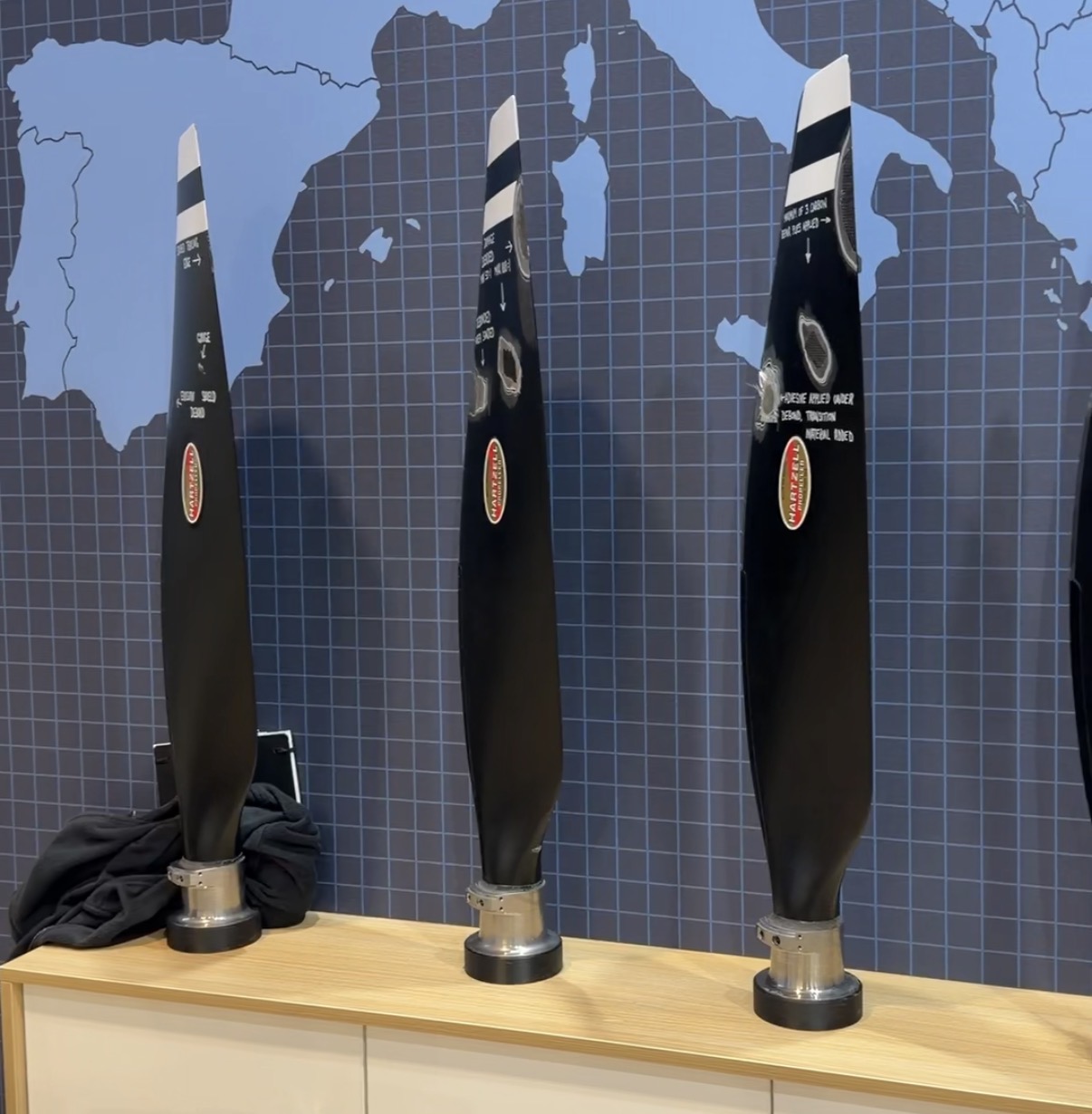
Hartzell Propeller and The Blackhawk Group also announced their partnership ahead of BACE this fall. The plan is to leverage the service and support capabilities of both entities and expand their footprint in North America and Europe. Hartzell will supply its Top Props to Blackhawk for use on its upgrades and aircraft overhaul programs, and provide maintenance and overhaul facilities via its eight service centers.

We look forward to more time in the exhibit hall and at the static display on the official Day One of NBAA on Tuesday…more aircraft pics to come, along with fun times celebrating aviation with friends and colleagues.

The Flying Easter Egg in #TS12

Screenshot of an Apple music screen showing the album cover for The Life of a Showgirl, with Taylor Swift in a rhinestone bodysuit on a sea green background.

There’s always an aviation angle.

For most folks, Taylor Swift is either a pop star of marginal interest, or a cultural icon, or simply a musician and songwriter to appreciate. The fact she flies often on a Dassault Falcon either means little, or perhaps paints her with an elitist brush. 

To aviators, the Easter egg in her latest album, “The Life of a Showgirl,” is that the recording couldn’t exist without her ability to leverage private aviation. 

In a clip posted early on the morning of October 3 with the album’s release, Swift recalled saying to her producers, in the midst of the European portion of The Eras Tour: “Do you guys want to do this? I’ll come to you; I’ll make this easy.”

The Swedish producers Max Martin and Shellrock were just a quick leg at FL3X0 away… the pair had collaborated with Swift on three of her previous albums, the glittering and jeweled halls of Red (2012), 1989 (2014), and Reputation (2017).

“It fueled me for the European leg of the tour… getting done with a show, hopping on a plane, and going and writing new songs,” said Swift in the clip.

As an entrepreneur, Swift is an excellent case study, because though her business application (global superstar musician) may not be available to most of us, the lessons she has learned and demonstrated can teach us a lot, especially those of us who work in creative fields.

One that strikes me—a goal that she has successfully obtained earlier this year—is to own your work. I will give you one good reason to listen to her appearance on the New Heights podcast (hosted by her soon to be brother-in-law Jason Kelce and future hubs Travis Kelce) in which she revealed #TS12, her twelfth album—she discusses in detail (starting at 25:15 so you can go right to it) her acquisition of her masters from her first six albums, which she purchased in May. Somewhere before the “folklore” and “evermore” albums of the Covid era, I posit that she fully grasped the raw deal she’d been handed via the recording contract she signed at a tender age.

I didn’t realize (naively) how little most musical artists “own” of their creative product. But I suppose it’s like my having been employed by various aviation publications throughout my life. Little of what you’ve read of my work has actually been produced under my sole ownership.

(Except this is. And it feels awesome. Every time.)

Swift vowed to make it right, and invest in herself and her brand, so buy those masters back she did, from Shamrock Capital, to the tune of $360 million. All of those Eras Tour tickets funded the investment. Now she owns not only the master recordings, but the associated album art with them, among other assets. Bravo!

As for her carbon footprint in the sky, like many responsible corporate and private aviation operators, Swift reports that she purchases “double” what her impact would be, through offsets.

Keeping flying, Tay!

"You are not the opinion of someone who doesn't know you." -Taylor Swift quote on an opalite background

Gulfstream Evokes Harmony With Debut of G300

The flight deck of a Gulfstream G300 mockup dark but illuminated with three main screens and 4 smaller touchscreen controllers, 2 to either side and two centered above the throttle quadrant.

True to form, Gulfstream’s team had an ace up their sleeve ready to lay on the table at their Discover the Difference customer event strategically positioned on September 30, two weeks before NBAA-BACE 2025.

During the opening remarks kicking off the event, Gulfstream Aerospace President Mark Burns unveiled the latest model in the Savannah-based OEM’s new line of business jets: the G300. A super midsize jet set to compete in a segment with a very deep bench, the G300 will replace the popular G280, which just celebrated its 300th delivery back in June.

I was happy I’d made the trip down to Georgia once again, if only for a quick peek at the silvery new mockup and a whirlwind tour of the new Service Center East—with 367,000 square feet accommodating up to 26 aircraft—and an eagle-eye view of the G500/G600 production lines.

The visit gave me the chance to reflect on my previous two, in which I’d been introduced to the G700, G800, and G400, and witnessed the first of the G500s and G600s on that same line.

Gulfstream has achieved under Burns’ watch over the past decade a rationalization of its high-end product, the luxury form of transportation that has entered the cultural lexicon. What started with the turboprop Gulfstream I back in 1958 hit its stride with the Gulfstream GIV and V in 1987 and 1998, respectively. The G650 has logged more than 1 million flight hours with roughly 560 in service.

But Gulfstream has its replacements ready in its long-range, large cabin models. The show must go on. And that’s a good thing, from a pilot’s perspective. Not just because we love to fly something new, always.

On the Gulfstream Flight Deck

The G700 possesses the first flight deck of  a large-cabin jet that made me feel—as soon as I comforted myself into the left seat—as if I could turn it on and taxi it away with little prompting.

I’ve yet to actually prove this theory, but hear me out.

Synchronicity—maybe they should have named it that rather than Symmetry, or the slimmed version on the newly announced G300, Harmony—of the flight deck underpins this feeling, and Gulfstream has taken it across the model line to demonstrate the point. From the long-legged G800 through to the soon-to-deliver G400, the Symmetry flight deck makes its trade in presenting clearly to the pilot what needs to happen next, in its context-driven Phase-of-Flight architecture. 

Gulfstream continues the pilot-centric view with the digital flight control system, twin “active control” sidesticks that work together to translate the pilot flying’s desires into action—without producing unwanted confusion between the two sticks, and therefore, improving their communication to the pilot not flying should they take the controls.

Fold in the Predictive Landing Performance System, EVS and SVS, and heads-up displays, there’s a lot going on underneath the surface.

We’ll get a chance to delve more deeply into what Gulfstream has for pilots in an upcoming feature. Til then… I’m biding my time.

NAFI Summit: The FIRC In Between

The MAPS Museum at the Akron-Canton Airport includes a rare B-26 Martin Marauder restored by volunteers. This is shown in the background with a US flag and Blue Angels jet in the foreground.

When I began the technical writing phase of my career, in 1997, I joined Jeppesen’s Aviation Courseware Development department. Led at the time by editor Pat Willits, ACD had the responsibility of producing Jepp’s distance-learning flight instructor refresher clinic (FIRC), delivered on VHS cassettes for $199 (plus tax and shipping).

The FIRC allowed instructors for the first time to complete their every-two-years certificate renewal without having to attend an in-person or “live” FIRC, which were held over the course of two days (16 training and testing hours total), in hotel conference rooms across the U.S.

After securing my initial CFI certificate in 1993, I renewed first by getting my CFI-Instrument in 1994, placing my renewal on its current even-years rhythm. For my first renewals, I attended AOPA’s live FIRCs, where I enjoyed meeting fellow instructors and sharing stories and best practices as well as a laugh or two about the commiserate moments of working with student pilots.

After a year or so at Jepp, I was promoted to Assistant Editor, and tasked with acting as its Airman Certification Representative (ACR), responsible for the physical review and signing of every FAA 8710 form that came in with the FIRC completion before the CFI’s new certificate could legally be issued. Every week I’d go upstairs to the customer service area and sign roughly 50 to 100 of the forms.

My first brush with aviation fame came when I signed Patty Wagstaff’s 8710.

Jepp went on to develop and produce in concert with AOPA the second online FIRC to gain approval from the FAA, and I was part of the team that put it together. With online FIRCs now composing the grand majority of CFI renewals, the live FIRC has all but vanished. Most instructors just “get it done” every two years, take in the minor and major updates to the regs and processes, and honestly probably retain little else from the exercise. The FAA requires the 16-hour training curriculum, and while providers strive to keep us entertained whilst sitting in front of the laptop or clutching an iPad for that period, it’s probably not something most of us would choose to participate in, given the choice.

We still find more meaning in connecting face to face.

For Monday and Tuesday of this week, I attended the Summit hosted by the National Association of Flight Instructors. NAFI’s two-day conference this year, at the MAPS Museum at the Akron-Canton Airport (KCAK) in Ohio, featured about… 16 hours of presentations on a buffet of topics eerily similar to those covered within a standard FIRC TCO (training course outline).

The Summit kicked off with presentations from FAA AFS-810 manager Everette Rochon on the Part 141 Modernization rulemaking group progress, and two panels, one gathering experience designated pilot examiners (DPEs) Karen Kalishek, Katie Sample, and Jason Blair, and the mental health one moderated by Dr. Victor Vogel, with Federal Air Surgeon Dr. Susan Northrop, Greg Feith, and Dr. Tony Reed.

Martha and John King (whose Kings Schools online FIRC I’ve taken many times) led a talk on risk management, with easy mnemonics to use on the flight deck to enable solid aeronautical decision making. Samantha Bowyer, professor at Embry-Riddle Aeronautical University, outlined the changes brought forth by the passing of the MOSAIC ruling for pilot and aircraft certification, with a lively Q&A trying to find clarity on the topic. And Dr. Reed walked instructors through the ways they can make lifestyle changes to support their own physical health.

Day Two featured more breakout sessions, with great choices to select from, including how to ensure the first hours of training connect with the prospective student, as well as the use of AI in training, implementation of sims within a course syllabus, and a deep dive on spins, slips, and skids. Mental health was addressed in more detail by Dr. Rob Zeglin, and Judge Couch zoomed in remotely to illuminate the process behind the NTSB’s Office of Administrative Law and how to mitigate and protect against certificate actions as an instructor.

All in all, with the exception of the TSA training session, I felt nothing was missing from the program that would preclude it counting as a CFI renewal. NAFI currently gives FAA WINGS credit for the session, which helps a pilot complete ongoing training in lieu of a flight review, but it would gain a lot of value for attendees if the Summit could become, yes, an in-person FIRC for its investment of $300 to attend.

It certainly gave that value to me.

But the best part of the event came in the new connections I forged with fellow instructors, and the longtime friendships we have kept in the industry over the years. In those in-between moments, sitting around a table of 8 with a standard Midwestern buffet lunch, I met CFIs from around the country and across the globe, and understood again how much we have in common, and how much we can learn from each other, simply by taking the time and listening.