“When it comes to learning advanced integrated avionics, the airplane is perhaps the worst place to learn. But the right simulator is the better option for obvious reasons, and not all are created equal.”
What’s the scoop behind the claim? Calvin Fraites of Flight1 Aviation Technologies joined The Smart Aviator’s Larry Anglisano on AvBrief. com to explain just what this means and how both flight schools and private owners can incorporate robust simulation into their regular practice as well as pursuit of certificates—especially the instrument rating—in Cirrus SR Series and Piper PA28 aircraft equipped with the Garmin Perspective and G1000 NXi.
Flight1 Tech’s Calvin Fraites joined Larry Anglisano of AvBrief.com on The Smart Aviator podcast on November 5, 2025. To visit the podcast, go to the AvBrief website.
We’ve been working with Flight1 Tech to promote its AATDs because I’ve seen how well they work within the flight training organizations with which I’ve collaborated over the years. I’ve known founder and president Jim Rhoads since my days at AOPA, when his company built the Cessna Cardinal model for Microsoft Flight Sim that accompanied the AOPA Sweepstakes Catch-a-Cardinal.
Since then, Flight1 Tech’s FAA-approved AATDs have evolved to emulate faithfully the Cirrus SR series, complete with Garmin’s Perspective+ and CAPS (Cirrus Airframe Parachute System) deployment, and the nuances of the PA-28 based on Jim’s longtime ownership and piloting of his own Piper Cherokee. Now, the modern version replicates an Archer with Garmin’s G1000 NXi avionics suite.
For training that sticks, you need an honest rendering of the instrument panel and associated hardware, and Flight1 Tech does it in a way that keeps it low cost and approachable for a wide range of flight schools as well as private owners.
When I began the technical writing phase of my career, in 1997, I joined Jeppesen’s Aviation Courseware Development department. Led at the time by editor Pat Willits, ACD had the responsibility of producing Jepp’s distance-learning flight instructor refresher clinic (FIRC), delivered on VHS cassettes for $199 (plus tax and shipping).
The FIRC allowed instructors for the first time to complete their every-two-years certificate renewal without having to attend an in-person or “live” FIRC, which were held over the course of two days (16 training and testing hours total), in hotel conference rooms across the U.S.
After securing my initial CFI certificate in 1993, I renewed first by getting my CFI-Instrument in 1994, placing my renewal on its current even-years rhythm. For my first renewals, I attended AOPA’s live FIRCs, where I enjoyed meeting fellow instructors and sharing stories and best practices as well as a laugh or two about the commiserate moments of working with student pilots.
After a year or so at Jepp, I was promoted to Assistant Editor, and tasked with acting as its Airman Certification Representative (ACR), responsible for the physical review and signing of every FAA 8710 form that came in with the FIRC completion before the CFI’s new certificate could legally be issued. Every week I’d go upstairs to the customer service area and sign roughly 50 to 100 of the forms.
My first brush with aviation fame came when I signed Patty Wagstaff’s 8710.
Jepp went on to develop and produce in concert with AOPA the second online FIRC to gain approval from the FAA, and I was part of the team that put it together. With online FIRCs now composing the grand majority of CFI renewals, the live FIRC has all but vanished. Most instructors just “get it done” every two years, take in the minor and major updates to the regs and processes, and honestly probably retain little else from the exercise. The FAA requires the 16-hour training curriculum, and while providers strive to keep us entertained whilst sitting in front of the laptop or clutching an iPad for that period, it’s probably not something most of us would choose to participate in, given the choice.
We still find more meaning in connecting face to face.
The Douglas C-47 Ruptured Duck has no engines in its nacelles as it stands outside the MAPS Museum at the Akron-Canton Airport in Ohio. [Credit: Julie Boatman]A panel on mental health for pilots at NAFI Summit was moderated by Dr. Victor Vogel, and included Federal Air Surgeon Dr. Susan Northrop, former NTSB member Greg Feith, and Dr. Tony Reed, with Samantha Bowyer behind the podium. [Credit: Julie Boatman]
For Monday and Tuesday of this week, I attended the Summit hosted by the National Association of Flight Instructors. NAFI’s two-day conference this year, at the MAPS Museum at the Akron-Canton Airport (KCAK) in Ohio, featured about… 16 hours of presentations on a buffet of topics eerily similar to those covered within a standard FIRC TCO (training course outline).
The Summit kicked off with presentations from FAA AFS-810 manager Everette Rochon on the Part 141 Modernization rulemaking group progress, and two panels, one gathering experience designated pilot examiners (DPEs) Karen Kalishek, Katie Sample, and Jason Blair, and the mental health one moderated by Dr. Victor Vogel, with Federal Air Surgeon Dr. Susan Northrop, Greg Feith, and Dr. Tony Reed.
Head of FAA AFS-810 Everette Rochon presented at the NAFI Summit on the progress on Part 141 Modernization. [Credit: Julie Boatman]ERAU professor Samantha Bowyer outlined the changes brought into reality by the passing of MOSAIC for pilots and aircraft certification. [Credit: Julie Boatman]
Martha and John King (whose Kings Schools online FIRC I’ve taken many times) led a talk on risk management, with easy mnemonics to use on the flight deck to enable solid aeronautical decision making. Samantha Bowyer, professor at Embry-Riddle Aeronautical University, outlined the changes brought forth by the passing of the MOSAIC ruling for pilot and aircraft certification, with a lively Q&A trying to find clarity on the topic. And Dr. Reed walked instructors through the ways they can make lifestyle changes to support their own physical health.
Day Two featured more breakout sessions, with great choices to select from, including how to ensure the first hours of training connect with the prospective student, as well as the use of AI in training, implementation of sims within a course syllabus, and a deep dive on spins, slips, and skids. Mental health was addressed in more detail by Dr. Rob Zeglin, and Judge Couch zoomed in remotely to illuminate the process behind the NTSB’s Office of Administrative Law and how to mitigate and protect against certificate actions as an instructor.
Martha and John King presented at the NAFI Summit on their experience and how it relates to teaching sound aeronautical decision making and risk management. [Credit: Julie Boatman]NAFI’s Paul Preidecker and Karen Kalishek give closing remarks at the NAFI Summit 2025 in Ohio. [Credit: Julie Boatman]
All in all, with the exception of the TSA training session, I felt nothing was missing from the program that would preclude it counting as a CFI renewal. NAFI currently gives FAA WINGS credit for the session, which helps a pilot complete ongoing training in lieu of a flight review, but it would gain a lot of value for attendees if the Summit could become, yes, an in-person FIRC for its investment of $300 to attend.
It certainly gave that value to me.
But the best part of the event came in the new connections I forged with fellow instructors, and the longtime friendships we have kept in the industry over the years. In those in-between moments, sitting around a table of 8 with a standard Midwestern buffet lunch, I met CFIs from around the country and across the globe, and understood again how much we have in common, and how much we can learn from each other, simply by taking the time and listening.
Lots of pilots come to EAA AirVenture each year to learn, whether it’s in a builder’s forum, an expert panel, or a session in a flight sim at the Pilot Proficiency Center.
Thursday held a training theme for me around master instructors, with three gatherings tuned to bring CFIs together.
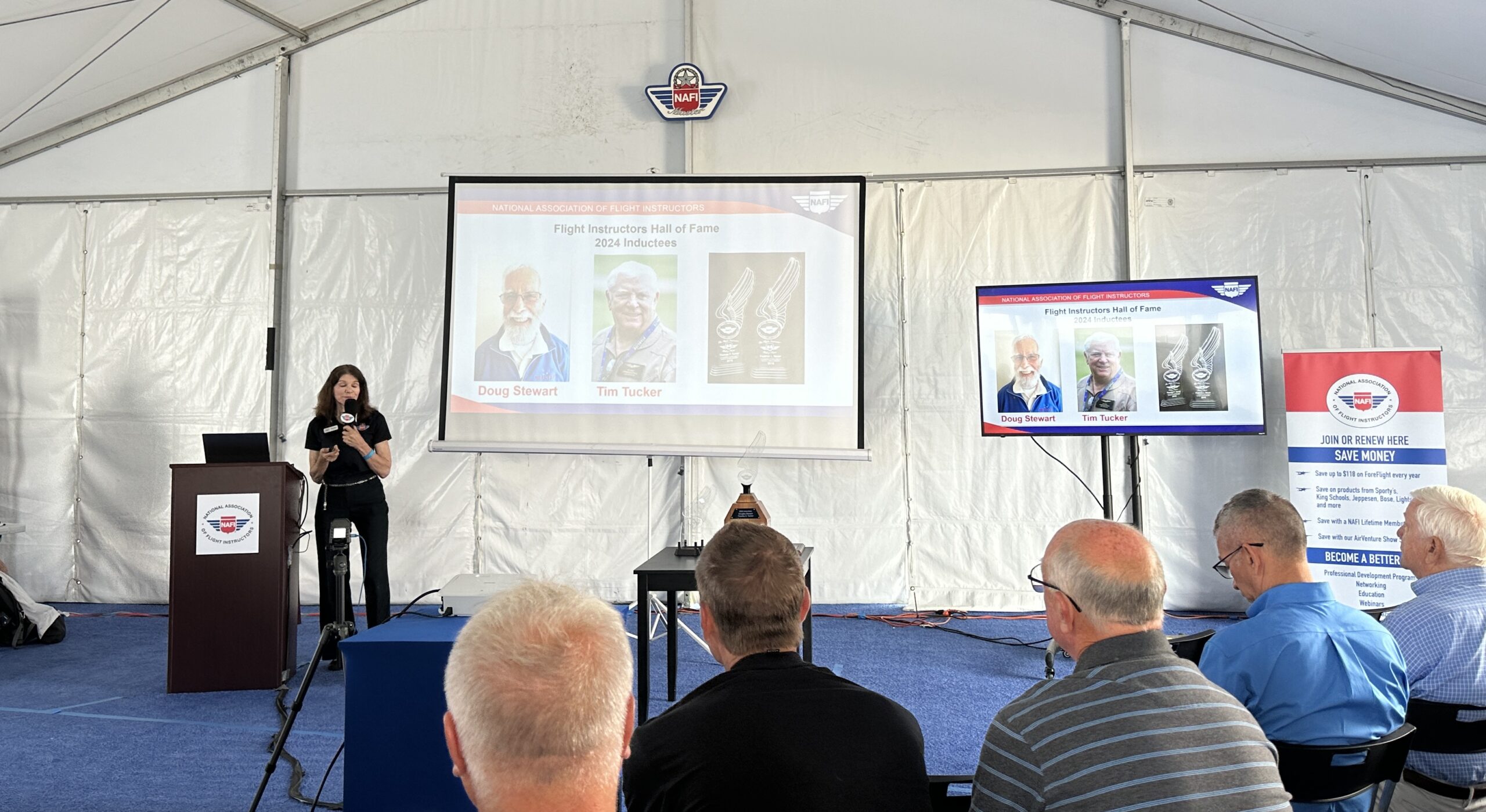
The first was the annual member breakfast for the National Association of Flight Instructors (NAFI). During the event, NAFI inducted Doug Stewart and Tim Tucker into the Instructor Hall of Fame, and gave the Eggespuehler and Laslo awards to Samantha Bowyer and author Steve Rutland.
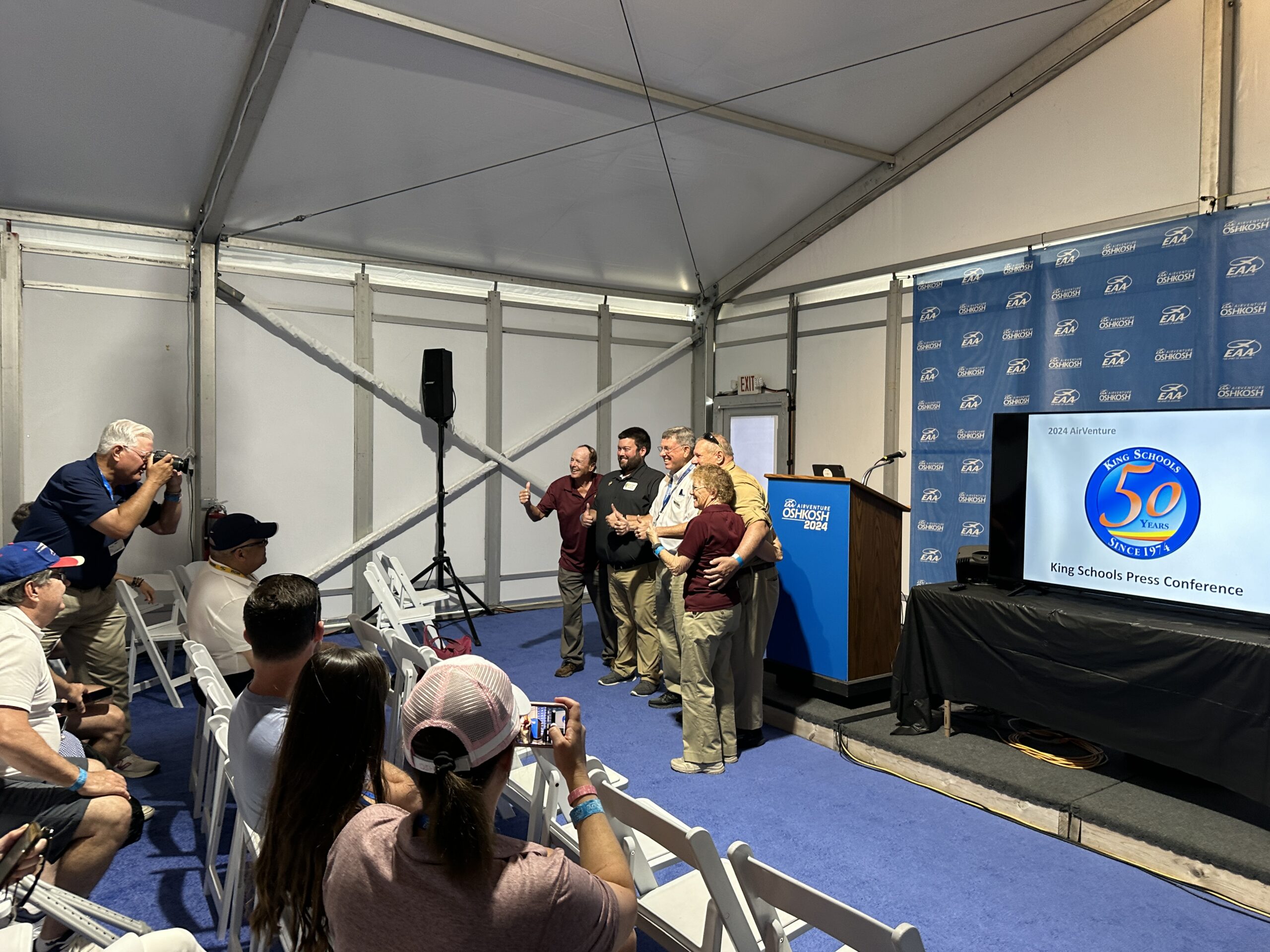
The second was the annual King Schools press conference and lunch, which gathered flight school leaders and scholarship winners along with John and Martha King—legendary instructors who take the time to talk with everyone who comes their way.
Third was the dinner hosted by the Society of Aviation and Flight Educators (SAFE), during which Instructor Hall of Fame member Rich Stowell gave his presentation on 9 Principles of Light Aircraft Flying.
At each event, I took away something I intend to apply to my own dual given.
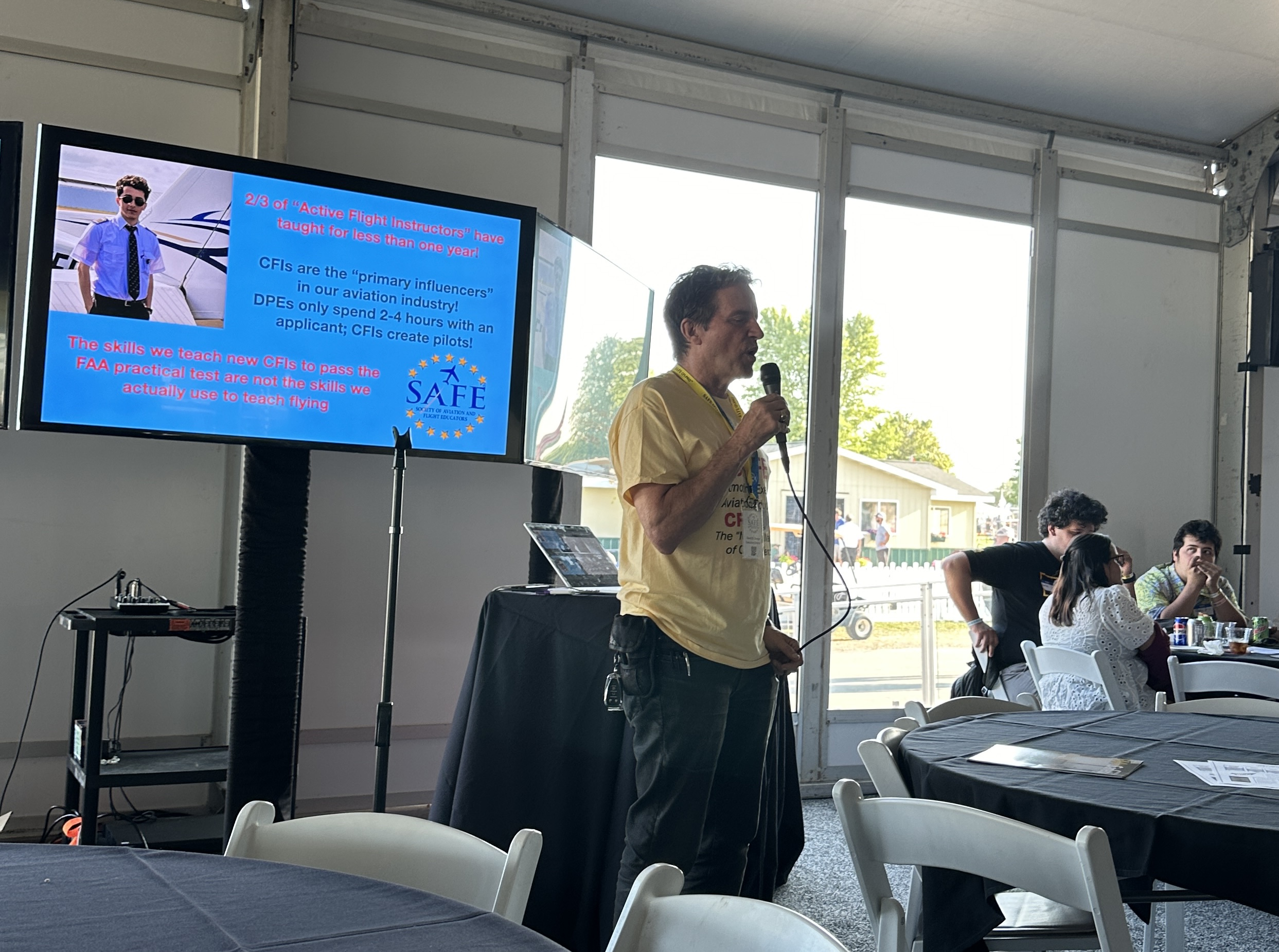
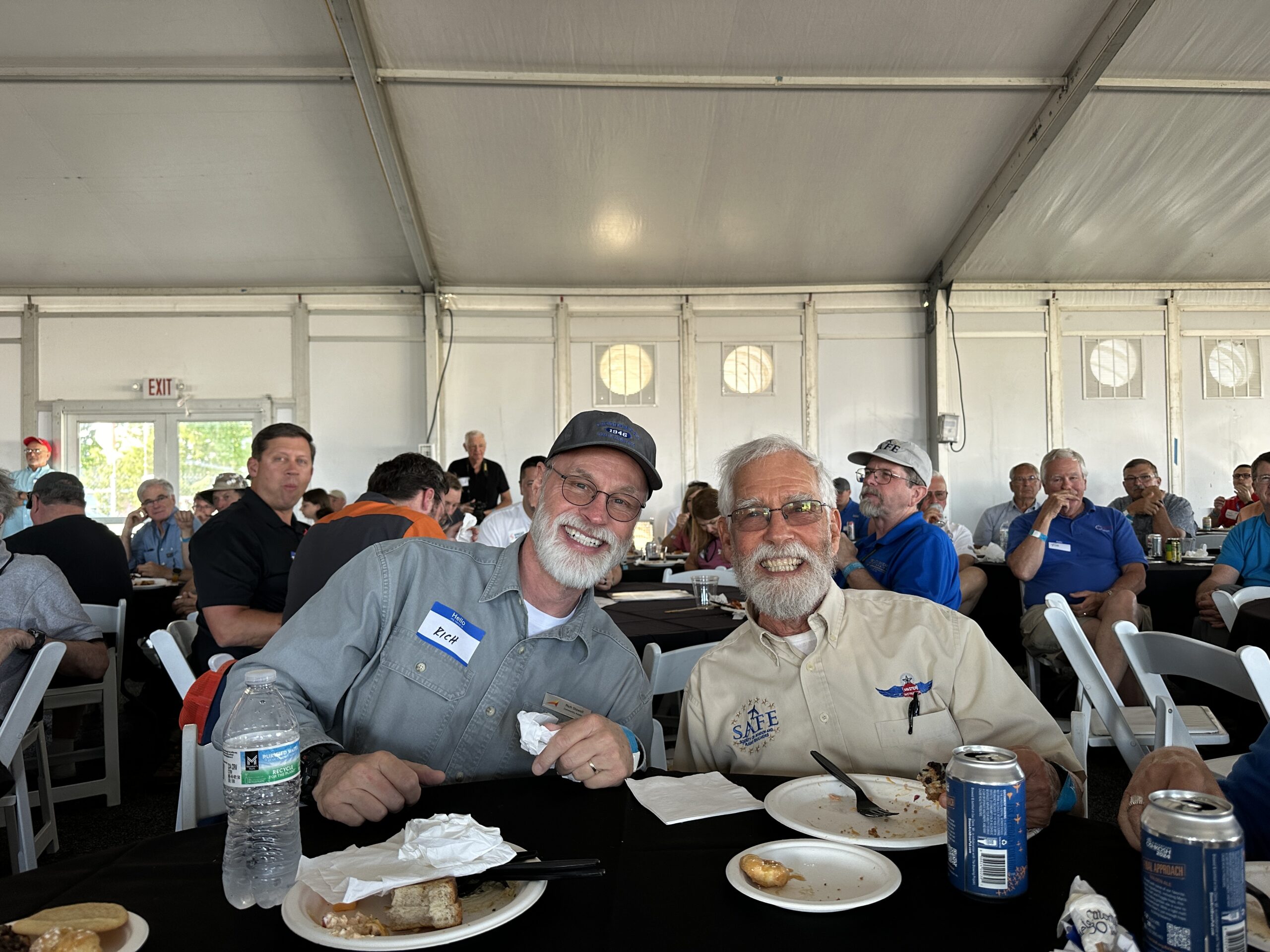
The 2024 inductees to the National Instructor Hall of Fame were honored at NAFI’s breakfast. [Credit: Julie Boatman]John and Martha King pose for their raving fans at their lunch press conference. [Credit: Julie Boatman]David St. George kicks off the annual SAFE dinner on Thursday evening. [Credit: Julie Boatman]Rich Stowell and Doug Stewart catch up at the 2024 SAFE dinner at Oshkosh 2024. [Credit: Julie Boatman]
Friedrichshafen, Germany — April 15, 2024 — JulietBravoFox Media, a U.S.-based limited company, launched today its creative content production suite of services upon the opening of AERO 2024.
The company, founded in 2014 by aviation strategist and media leader Julie Boatman, specializes in aerial storytelling, including editorial development, aviation marketing and press relations, and flight training. “Our interests reach out in several directions, bringing together our 30-plus-year experience in the aerospace industry with our passion for traveling the world, exploring new food and wine, and enjoying the great outdoors,” said Boatman. “People don’t really fit into neat categories, and neither do we. That is our strength, allowing us to flex, to make new connections, and to think differently about our clients’ projects.”
JulietBravoFox Media taps into a network of creative minds, with deep expertise in aerial photography, with story development, mission planning and execution, and video and print production. With collaborative partners in the U.S. and Europe, and access to a wide range of aerial platforms, the company can tap into capabilities globally to execute on client needs.
“Connect with us to explore how we can help you solve a problem, deliver a message, or strategize a new direction,” said Boatman.
Company principals Boatman and Stephen Yeates, creative director, are available at AERO 2024 for direct consultation.
I’ve spent much of my aviation life with one foot in the future, and one foot in the past.
Most recently, I spent a year and a half working with new pilots just starting their studies towards an airline transport pilot’s license, young people from all over the world, in a new country (to all of us), fighting to perfect their English along with puzzling through General Navigation—one foot in the future, one foot in the past.
At the same time (along with a team of real aviation history geeks), I brought into life the biography of a man, Donald Douglas, who changed our world a hundred years ago, as he graduated from the dewy-new MIT to establish the Douglas Aircraft Company and build the iconic DC-3.
As I continue to field DMs from students, as they struggle and succeed, and as I read news every day of the latest innovations trying to solve our questions of future propulsion, economy, and environmental care—I can’t help but be struck by the parallels back to similar questions Donald Douglas grappled with in the 1920s and 30s, as his wily band of engineers competed, collaborated, and convinced a wary public that flying around the world was not only possible, but safe—and should be something we must keep doing.
Clearly that general public took the bait, because we’re still building airplanes, we’re still needing pilots, and so much of the world’s commerce can happen because it’s possible for me to get on an airplane in Lisbon this afternoon and be in Singapore 26 hours later (with a few hours cooling my jets in Dubai).
A couple of weeks ago, the FAA hosted a symposium in Washington, D.C., seeking to loosen the hairy knot that’s choking the development of the aviation workforce. Because we live in a connected world, I participated in it livestream from my couch via Facebook.
Opening Panel of the FAA’s Aviation Workforce Symposium
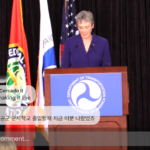
Dr. Heather Wilson, Secretary of the Air Force, gives key insights into leading diversity
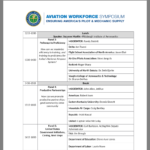
Snapshot from the FAA’s Aviation Workforce Symposium agenda
After conceding that the opening panel reflected the current state of affairs (and politics)—and deftly illustrated that we haven’t yet tackled diversity in our upper ranks—I was encouraged as the day moved on with a variety of thoughtful leaders from around the community floating up idea balloons that deserved more time than the space provided. It reminded me of the similar Pilot Training Reform Symposium hosted by SAFE (Society of Aviation and Flight Educators) in Atlanta in May 2011.
At that conference, we outlined a host of problems to address. Coming off of the worst recession many of us had witnessed firsthand, we discussed the lack of student starts, drop in aircraft sales, and diminishing flight hours all around that hung a dark cloud over the industry—but we were determined to fight these issues.
The ideas that came from that 2011 event (increase flight instructor professionalism, revamp the testing process, find new ways to market to the next generation) felt solid, but only through the collaborative effort between industry, government, and user groups did we come up with real change. Regardless of how you feel about the new Airmen Certification Standards, they reflect the substantial transformation that can happen when folks set aside their fiefdoms and work to create something new.
And that was the overall message I heard from the Aviation Workforce Symposium this September. We have a new landscape, with airlines around the world clamoring for personnel—not just pilots—and willing to pay for training and better wages to bring them on board. Turns out that when the real pain strikes you, what was once a nagging ache turns into an emergency you must address.
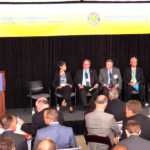
Priming the Pipeline Panel at the FAA’s Aviation Workforce Symposium
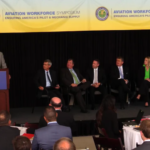
Pathways to Proficiency Panel from the FAA’s Aviation Workforce Symposium
At the symposium, the people who found success in recruiting diverse new entrants into the aviation community (be it pilots, technicians, or the host of support personnel making airplanes fly)—these folks brought up repeatedly the partnerships that had energized the process. The collaborations make it happen.
Case in point—and one I can relate to, given my recent experience: Students that have come into our training programs in Portugal typically do not have the same experience with the mechanical world that I had as a teenager. When I turned 16, more than 30 years ago, I had a car, and I learned how to change a tire, and an air filter, and the bulbs for my headlights. Today, even in the U.S., where a similar teen could also have access to a car, it might take dropping the entire front end of the car to get to the headlights—we’re so advanced, we’re no longer meant to service our own machines.
As for the young people I’ve mentored in the last two years: They not only may not have ever driven a car before coming to Portugal—some have never ridden a bicycle. It’s far from a lack of intelligence (that same kid could build an app for my iPhone), but a difference in exposure. At the same time, the airlines need more relevant skill in their initial candidates, though there may be less skill coming in the front door, a point brought up by several voices at the symposium.
We fiercely need to innovate and collaborate to attack this lack of exposure. If the flight school, and, subsequently the airline, notes this lack, and in partnership brings training into the high schools, we can solve this pervasive problem—and at the same time the industry gets to take advantage of the inherent marketing that occurs when a child encounters aviation in a natural, practical, relevant way.
We innovate in aviation in a stunning variety of ways, and I feel in my bones we’ll address our issues about fuel, noise, cost, comfort, and safety through evolutions we can’t yet visualize. The first flight around the world, in the Douglas World Cruisers in 1924, resulted from the innovation of the new aviation industry, backed by the support and investment of the Army Air Corps. Doug had witnessed the ineffective (at best) way government worked when unchecked, through his year with the Signal Corps in World War I—but he also knew that serving the greater good through this government contract could have a large financial payoff for his private-sector business.
I’d like to see the action list resulting from the Aviation Workforce Symposium—and determine the project to which I’ll sign my name. If each of us does the same, we can direct the innovation to address our problems.
One action item we can each put into play? Take a cue from entities as diverse as Boeing,Redbird Flight Simulations, and AOPA, and—using the work they’ve done in creating STEM curricula and other programs—help them find traction in our local schools and youth clubs. Supplement this greater action with other gestures to enhance it, such as donating materials and subscriptions to a local youth program or technical college.
My personal action has been giving support to our local air museum, and mentoring past students (our diverse “flock”) as they navigate their own specific course to an aviation career. Parallel to this? To counter any lack of opportunity, purposefully seek out young people who wouldn’t otherwise get a ride to the airport, and go to them where they are—maybe that kid isn’t watching airplanes from outside the fence because he or she can’t physically get there.
Collaboration wins, but it takes each of us to move the needle forward.